
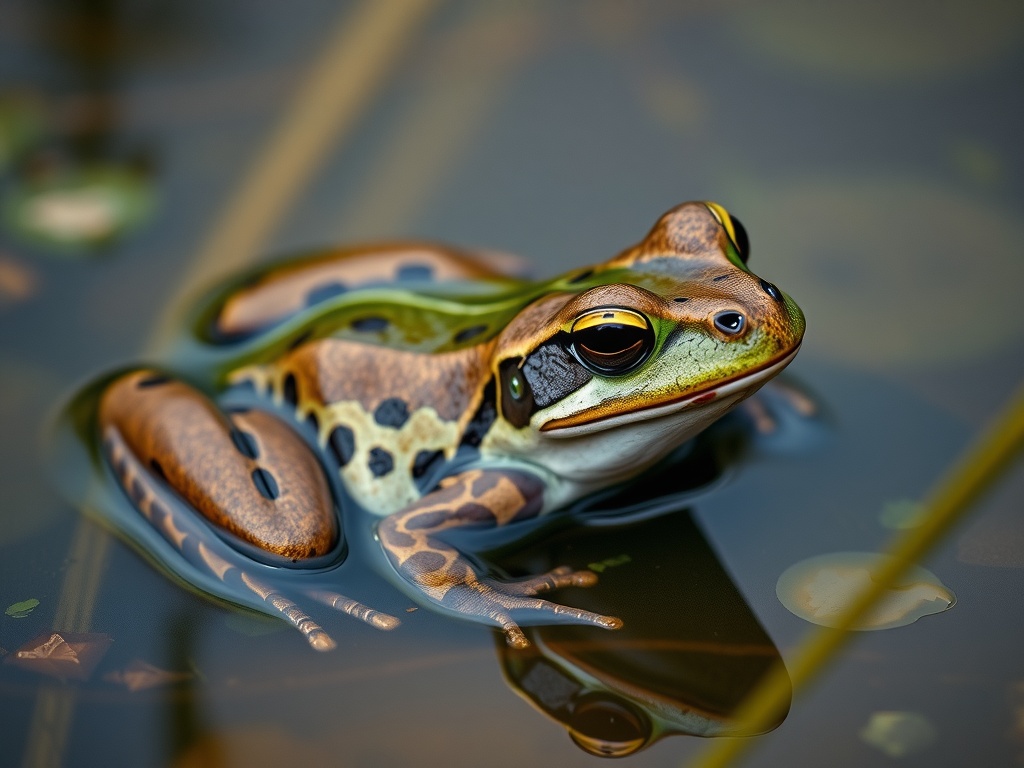
About the Paradoxical Frog
The Paradoxical Frog is a fascinating amphibian native to South America, primarily occupying slow-moving freshwater bodies. It is most famous for its unusual life cycle: its tadpoles grow to be much larger than the adult frogs, sometimes reaching up to 25 cm before metamorphosis. As adults, these frogs are greenish to brownish in color, with smooth skin and long hind legs adapted for swimming. They are nocturnal and spend most of their time in or near water, where they feed on a variety of small invertebrates.
Fascinating facts
Shrinking Tadpoles
Paradoxical Frog tadpoles can reach up to 25 cm, but shrink to just 4-7.5 cm as adults after metamorphosis.
Aquatic Lifestyle
These frogs spend most of their lives in water and are rarely found far from their aquatic habitats.
Diet of Invertebrates
As adults, Paradoxical Frogs primarily eat insects, small crustaceans, and other invertebrates found in and around their watery homes.
Detailed description
The Paradoxical Frog (Pseudis paradoxa) is a medium-sized aquatic amphibian notable for its unique ontogeny and morphological adaptations. Adult frogs typically measure 4.5–7.5 cm in snout-vent length, with females generally larger than males. Their dorsal coloration ranges from bright green to olive or brown, often with mottled or spotted patterns that provide camouflage among aquatic vegetation. The skin is smooth and moist, and the hind limbs are exceptionally long and muscular, enabling powerful swimming and jumping. The eyes are large and positioned dorsally, aiding in surface vigilance while submerged. P. paradoxa is almost entirely aquatic, rarely venturing far from water bodies. Its most remarkable feature is the dramatic size reduction during metamorphosis: tadpoles can reach up to 22–27 cm in length, making them among the largest known tadpoles, but shrink to a quarter or third of this size as adults. The species is primarily nocturnal, with adults emerging at dusk to feed and breed. They possess a well-developed lateral line system, rare among adult frogs, which enhances their ability to detect vibrations in water. Socially, they are loosely gregarious, often found in groups during the breeding season but otherwise solitary.
Did you know?
Paradoxical Frog tadpoles can reach lengths up to four times that of the adult frog before shrinking dramatically during metamorphosis.
Research & sources
Wikipedia summary
Pseudis paradoxa, known as the paradoxical frog or shrinking frog, is a species of hylid frog from South America. Its name refers to the very large—up to 27 cm (11 in) long—tadpole, which in turn "shrinks" during metamorphosis into an ordinary-sized frog, only about a quarter or third of its former length. Although the recordholder was a tadpole in Amapá that belonged to this species, others in the genus Pseudis also have large tadpoles and ordinary-sized adults.
Behaviour & social structure
Paradoxical Frogs are predominantly nocturnal, spending daylight hours concealed among aquatic plants or submerged to avoid predators. At night, they become active, foraging for small invertebrates such as insects, crustaceans, and occasionally small fish. Their hunting strategy is primarily sit-and-wait, relying on sudden lunges facilitated by their powerful hind legs. Tadpoles are herbivorous or detritivorous, feeding on algae, plant matter, and organic debris. Adults communicate through a series of short, low-pitched calls, especially during the breeding season, with males establishing loose territories in shallow water. Social interactions outside the breeding period are minimal, though aggregations may occur in resource-rich habitats. They exhibit escape behaviors such as rapid diving and burying themselves in mud or vegetation when threatened.
Reproduction & life cycle
Breeding occurs during the rainy season, typically from November to April, when water levels rise in their habitats. Males call from the water's surface to attract females, engaging in vocal competition. Amplexus is axillary, with the male grasping the female behind her forelimbs. Females lay large clutches of eggs (up to several thousand) in gelatinous masses attached to submerged vegetation. Embryonic development is rapid, with hatching occurring within a week. Tadpoles undergo a prolonged larval stage, sometimes lasting several months, during which they attain their maximum size. Metamorphosis results in a dramatic reduction in body length and a shift to carnivorous feeding. There is no parental care post-oviposition; survival depends on the abundance of aquatic vegetation and the absence of predators.
Adaptations & survival
Pseudis paradoxa exhibits several unique adaptations for an aquatic lifestyle. The retention of a functional lateral line system into adulthood is unusual among frogs and allows for detection of water movements and prey. Their large, muscular hind limbs facilitate efficient swimming and rapid escape from predators. The enormous size of their tadpoles is hypothesized to be an adaptation to ephemeral aquatic habitats, allowing rapid growth and increased survival odds. Tadpoles possess highly vascularized tails, possibly aiding in cutaneous respiration. Adults have cryptic coloration and the ability to remain motionless for extended periods, enhancing camouflage. Their skin secretes mucous to reduce water loss and may contain mild toxins as a deterrent to predators.
Cultural significance
While not a major figure in indigenous mythology, the Paradoxical Frog has attracted scientific and popular interest due to its unusual life cycle. Its 'shrinking' metamorphosis has been cited in educational materials as an example of amphibian diversity and developmental plasticity. In some South American regions, local names and folklore reference its large tadpoles, sometimes attributing them with medicinal or magical properties, though there is little evidence of widespread traditional use.
Recent research
Recent research has focused on the developmental biology of P. paradoxa, particularly the hormonal regulation of its dramatic metamorphic shrinkage. Studies have examined the ecological significance of large tadpole size, suggesting advantages in predator avoidance and resource exploitation. Molecular phylogenetics has clarified its relationships within the Hylidae family, revealing deep divergence from other aquatic frogs. Ongoing studies are investigating the species' resilience to environmental stressors and its potential as a bioindicator for wetland health. The retention of the lateral line system in adults is also a subject of neurobiological research.
Videos
Habitat
Freshwater marshes, ponds, and slow-moving streams


Conservation
The Paradoxical Frog is currently classified as Least Concern on the IUCN Red List.
Threats & challenges
Currently classified as Least Concern by the IUCN, Pseudis paradoxa faces localized threats from habitat destruction, pollution, and the introduction of predatory fish. Agricultural runoff and pesticide use can degrade water quality, impacting both adults and larvae. Wetland drainage and conversion for agriculture or urbanization reduce available breeding sites. Although populations are stable in many areas, ongoing monitoring is necessary due to potential threats from climate change and emerging amphibian diseases such as chytridiomycosis. Overharvesting for the pet trade is not a significant threat at present.
Taxonomy
Scientific name
Pseudis paradoxa
- Kingdom
- Animalia
- Phylum
- Chordata
- Class
- Amphibia
- Order
- Anura
- Family
- Hylidae
- Genus
- Pseudis
- Species
- paradoxa
Community notes
Share your observations about the Paradoxical Frog.
No community notes yet. Be the first!
Discover more wildlife
More fascinating animals from the encyclopedia.