
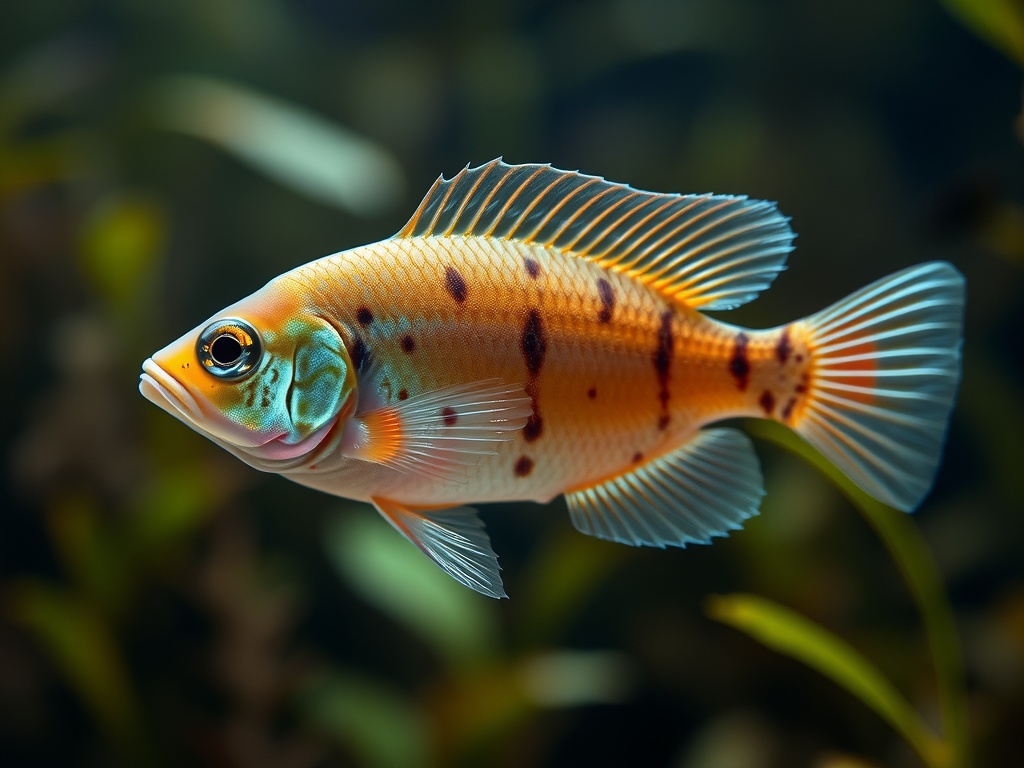
About the Pearl gourami
The pearl gourami is a striking freshwater fish known for its shimmering, pearl-like spots and delicate, thread-like ventral fins. Native to Southeast Asia, it inhabits slow-moving, acidic waters rich with vegetation. This species is admired for its peaceful temperament and is a popular choice among aquarium enthusiasts. Males develop a vivid orange-red throat and breast, especially during breeding season, making them even more visually appealing.
Fascinating facts
Labyrinth Organ
Pearl gouramis possess a labyrinth organ that allows them to breathe atmospheric air, enabling survival in oxygen-poor waters.
Bubble Nests
Males create floating bubble nests from mucus and air to house and protect fertilized eggs until they hatch.
Adaptable Diet
In the wild, they eat insects, crustaceans, algae, and plant matter, making them highly adaptable omnivores.
Detailed description
The pearl gourami (Trichopodus leerii) is a medium-sized labyrinth fish, typically reaching 10–12 cm (4–5 in) in standard length, with females slightly smaller than males. Its most distinctive feature is the intricate pattern of iridescent, pearl-like spots covering its silvery body, complemented by a dark horizontal stripe running from the mouth to the caudal fin. The elongated, thread-like pelvic fins are highly sensitive and used for tactile exploration of the environment. Males exhibit a striking orange to red coloration on the throat and breast, which intensifies during courtship and breeding. The dorsal and anal fins are elongated and pointed, especially in males, and often edged in red or orange. The species possesses a labyrinth organ, allowing it to breathe atmospheric air, an adaptation for oxygen-poor waters. Pearl gouramis are generally peaceful, displaying gentle swimming and a preference for densely vegetated, slow-moving waters. Their large, upturned mouths are adapted for surface feeding, and their laterally compressed bodies allow them to navigate through thick aquatic vegetation with ease.
Did you know?
Despite their delicate appearance, pearl gouramis are quite hardy and can tolerate a range of freshwater conditions.
Research & sources
Wikipedia summary
The pearl gourami is a species of gourami native to Southeast Asia.
Behaviour & social structure
Pearl gouramis are diurnal, spending most of their active periods foraging near the water surface or among submerged plants. They are omnivorous, feeding on small invertebrates, insect larvae, zooplankton, algae, and detritus. In the wild, they often graze on biofilm and periphyton growing on plant surfaces. Socially, they are gregarious and thrive in small groups, displaying a loose social hierarchy. Males may become territorial during breeding, defending small areas among dense vegetation. Courtship involves elaborate displays, with males flaring fins and intensifying coloration. Outside of breeding, aggression is minimal, and they are known for their compatibility with other peaceful fish species. Pearl gouramis use their thread-like pelvic fins to explore their surroundings and communicate tactilely with conspecifics.
Reproduction & life cycle
Pearl gouramis are bubble nest builders, with breeding typically triggered by the onset of the rainy season or changes in water parameters such as temperature (optimal: 26–28°C) and pH (5.5–7.0). The male constructs a floating bubble nest among surface vegetation using air bubbles coated with saliva. Courtship involves the male displaying vivid coloration and circling the female, who is enticed beneath the nest. Spawning occurs in an embrace, with the female releasing up to 300–500 eggs per event. The male collects the eggs in his mouth and deposits them in the bubble nest, where he guards and tends them, fanning the eggs and repairing the nest as needed. Incubation lasts 24–36 hours, after which the fry hatch and remain in the nest for several days. The male continues to guard the fry until they become free-swimming, after which parental care ceases.
Adaptations & survival
The labyrinth organ is a key evolutionary adaptation, enabling the pearl gourami to extract oxygen directly from the air, allowing survival in hypoxic, stagnant, or acidic waters where dissolved oxygen is low. Their laterally compressed bodies and elongated fins facilitate movement through dense aquatic vegetation, providing both camouflage and maneuverability. The thread-like pelvic fins are highly sensitive, functioning as tactile organs for navigation and social interaction. Their coloration and pearl-like spots serve as disruptive camouflage, breaking up their outline among dappled light and aquatic plants. Behavioral adaptations include bubble nest building, which ensures oxygenation and protection of eggs in low-oxygen environments.
Cultural significance
Pearl gouramis are highly valued in the global aquarium hobby for their beauty, peaceful nature, and adaptability, often symbolizing tranquility and harmony in aquascapes. In Southeast Asia, they are sometimes kept in ornamental ponds and are regarded as auspicious due to their shimmering appearance. There are no significant roles in mythology or traditional medicine, but their popularity has contributed to increased awareness of wetland conservation in their native regions.
Recent research
Recent studies have focused on the genetic diversity of wild and captive populations, with concerns about genetic bottlenecks due to selective breeding in the aquarium trade. Research on the labyrinth organ has provided insights into evolutionary adaptations to hypoxic environments among anabantoid fishes. Behavioral studies have examined the role of tactile communication via pelvic fins and the impact of environmental enrichment on stress reduction in captive settings. Conservation research is ongoing to assess population trends and the effectiveness of habitat restoration efforts in Southeast Asia.
Videos
Habitat
Freshwater swamps, lowland lakes, and streams


Conservation
The Pearl gourami is currently classified as Least Concern on the IUCN Red List.
Threats & challenges
The pearl gourami is currently classified as Near Threatened by the IUCN due to ongoing habitat loss, primarily from wetland drainage, deforestation, and conversion of swamps for agriculture and urban development across its native range in Thailand, Malaysia, Sumatra, and Borneo. Overharvesting for the aquarium trade has also contributed to localized population declines, although captive breeding has alleviated some pressure. Pollution from agricultural runoff and sedimentation further degrades their habitats. Climate change, resulting in altered rainfall patterns and water chemistry, poses an emerging threat. Despite these challenges, the species remains common in the aquarium trade due to successful captive propagation.
Taxonomy
Scientific name
Trichopodus leerii
- Kingdom
- Animalia
- Phylum
- Chordata
- Class
- Actinopterygii
- Order
- Anabantiformes
- Family
- Osphronemidae
- Genus
- Trichopodus
- Species
- leerii
Community notes
Share your observations about the Pearl gourami.
No community notes yet. Be the first!
Discover more wildlife
More fascinating animals from the encyclopedia.