
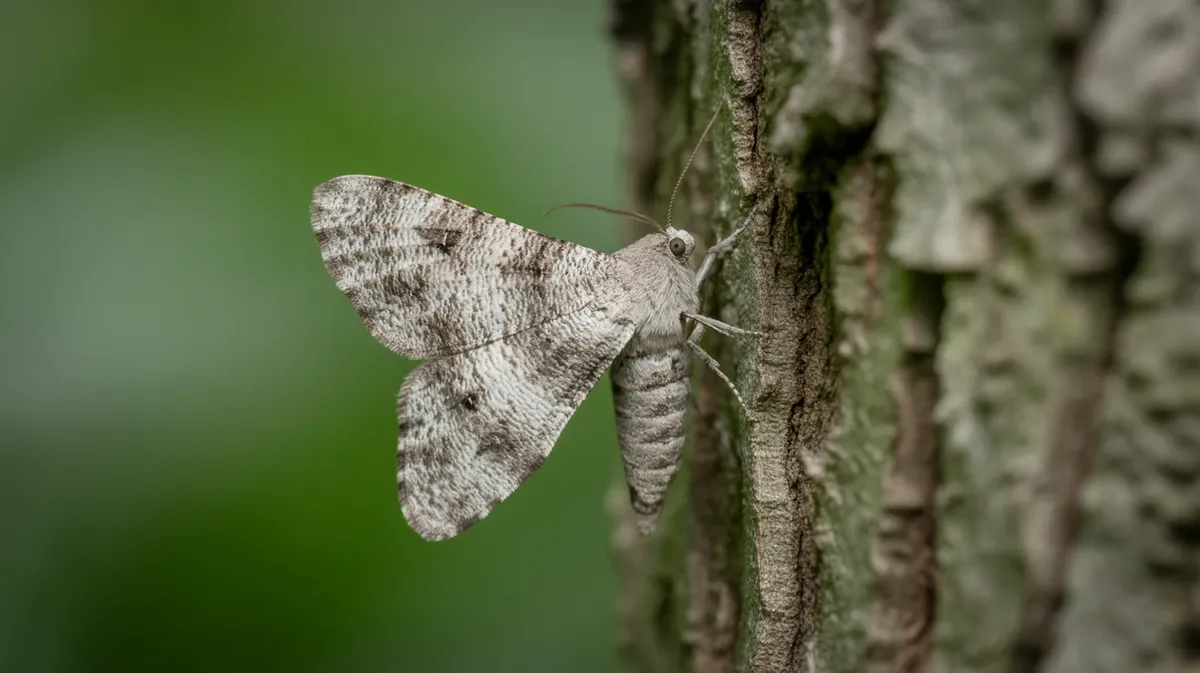
About the Peppered Moth
Biston betularia is the most famous case study in evolution taught in schools, and it is also the most often falsely claimed to be a fraud. The facts: before industrialisation, nearly all British peppered moths were the speckled white typica form, cryptic on lichen-covered bark. As soot killed the lichens and blackened tree trunks around Manchester and Birmingham, the melanic carbonaria form, first recorded in 1848, rose to about 98 percent of the population in industrial areas by 1900. After the Clean Air Acts, the frequency reversed, and carbonaria is now rare again — a change tracked in real time across decades. Creationist critics attacked Bernard Kettlewell's 1950s experiments on the grounds that he pinned dead moths to trunks and that moths do not naturally rest there. Michael Majerus then ran a meticulous seven-year field experiment, published posthumously in 2012, using moths in natural resting positions on tree branches and directly observing bird predation; it confirmed the effect cleanly. In 2016 the actual mutation was identified: a transposable element, a jumping DNA sequence, inserted into the cortex gene, and its timing dates to around 1819, consistent with the historical record.
Fascinating facts
Industrial Melanism
The peppered moth is a textbook example of industrial melanism, where the prevalence of the dark morph increased in polluted areas to avoid predation.
Camouflage Expert
Its cryptic wing pattern allows the moth to blend seamlessly into lichen-covered bark, significantly reducing the risk of being eaten by birds.
Nocturnal Behavior
Peppered moths are mainly active at night, when they fly and mate, while spending the daytime resting on tree trunks.
Detailed description
The peppered moth (Biston betularia) is a medium to large geometrid moth, with a wingspan ranging from 45 to 62 mm. Adults display a characteristic speckled pattern of black, white, and gray scales on their forewings, providing effective camouflage against lichen-covered bark. The species is sexually dimorphic, with females typically larger than males, though both sexes share similar coloration. The body is slender, with long, narrow wings held flat when at rest. Antennae are filiform in females and bipectinate in males, aiding in pheromone detection. Larvae are twig mimics, exhibiting cryptic coloration and posture to avoid predation. The species is primarily nocturnal, with adults flying from dusk through the night, especially during the warmer months. Peppered moths are univoltine or bivoltine depending on latitude, with one or two generations per year. Their life cycle includes egg, larval, pupal, and adult stages, with overwintering occurring in the pupal stage. The species is distributed widely across temperate regions of Europe, Asia, and North America, occupying deciduous and mixed woodland habitats as well as urban and suburban environments.
Did you know?
During the Industrial Revolution, the frequency of the dark-colored (melanic) form of the peppered moth dramatically increased in polluted areas due to better camouflage on soot-darkened trees.
Research & sources
Wikipedia summary
The peppered moth is a temperate species of night-flying moth. It is mostly found in the northern hemisphere in places like Asia, Europe and North America. Peppered moth evolution is an example of population genetics and natural selection.
Behaviour & social structure
Peppered moths are solitary and primarily nocturnal, with peak activity occurring shortly after dusk. Adults are strongly attracted to artificial light sources, a behavior known as positive phototaxis. During the day, moths rest on tree trunks and branches, selecting backgrounds that match their wing coloration to maximize camouflage. Larvae feed at night on the leaves of a variety of deciduous trees and shrubs, including birch (Betula), willow (Salix), oak (Quercus), and alder (Alnus). When threatened, larvae adopt a rigid, stick-like posture, enhancing their resemblance to twigs. Adults do not feed and rely on energy reserves accumulated during the larval stage. There is no evidence of social structure or cooperative behavior; individuals interact primarily during mating.
Reproduction & life cycle
Reproduction in Biston betularia is seasonal, with adults emerging and mating in late spring to early summer, and again in late summer in regions with two generations per year. Males locate females by detecting sex pheromones released by receptive females. After mating, females lay clusters of 100–200 eggs on the undersides of host plant leaves. Eggs hatch within 10–14 days, and larvae undergo five instars over 4–6 weeks. Pupation occurs in the soil or leaf litter, where the pupa remains until the following spring or, in bivoltine populations, until the next generation emerges. There is no parental care; all life stages are independent after oviposition.
Adaptations & survival
The peppered moth is renowned for its adaptive coloration, with two main morphs: the light 'typica' form and the dark 'carbonaria' (melanic) form. This polymorphism is a classic example of industrial melanism, where the frequency of the melanic form increased dramatically in polluted environments due to selective predation. The cryptic coloration of both adults and larvae is a key anti-predator adaptation, reducing detection by visually hunting birds. Larvae also exhibit behavioral mimicry, adopting twig-like postures. Males possess highly sensitive bipectinate antennae for detecting female pheromones over long distances. The species' ability to exploit a wide range of host plants and habitats contributes to its ecological success.
Cultural significance
The peppered moth holds a unique place in scientific and popular culture as a textbook example of natural selection in action. Its rapid evolutionary response to industrial pollution in 19th- and 20th-century Britain has been widely cited in biology education and public discussions of evolution. The species has appeared in scientific literature, textbooks, documentaries, and even art, symbolizing the power of environmental change to drive evolutionary processes. There are no known traditional uses or mythological associations.
Recent research
Recent genomic studies have identified the genetic basis of melanism in Biston betularia, pinpointing a transposable element insertion in the cortex gene as responsible for the dark phenotype (van't Hof et al., 2016). Ongoing research investigates the dynamics of selective pressures as pollution levels change, including the resurgence of the typical form in cleaner environments. Studies also focus on predator-prey interactions, the sensory ecology of camouflage, and the impact of urbanization on population genetics. The peppered moth continues to serve as a model organism for evolutionary biology, ecological genetics, and environmental monitoring.
Videos
Habitat
Deciduous and mixed woodlands


Conservation
The Peppered Moth is currently classified as Least Concern on the IUCN Red List.
Threats & challenges
Currently, the peppered moth is not considered threatened and is classified as Least Concern by the IUCN. However, localized declines can occur due to habitat loss, air pollution, and changes in woodland management. The reversal of industrial pollution in many regions has led to a decrease in the frequency of the melanic form, demonstrating ongoing evolutionary responses to environmental change. Predation by birds remains a significant natural threat, particularly for individuals whose coloration does not match their resting substrate. Climate change may alter the distribution and voltinism of populations, but the species' adaptability suggests resilience to moderate environmental changes.
Taxonomy
Scientific name
Biston betularia
- Kingdom
- Animalia
- Phylum
- Arthropoda
- Class
- Insecta
- Order
- Lepidoptera
- Family
- Geometridae
- Genus
- Biston
- Species
- betularia
Community notes
Share your observations about the Peppered Moth.
No community notes yet. Be the first!
Discover more wildlife
More fascinating animals from the encyclopedia.