
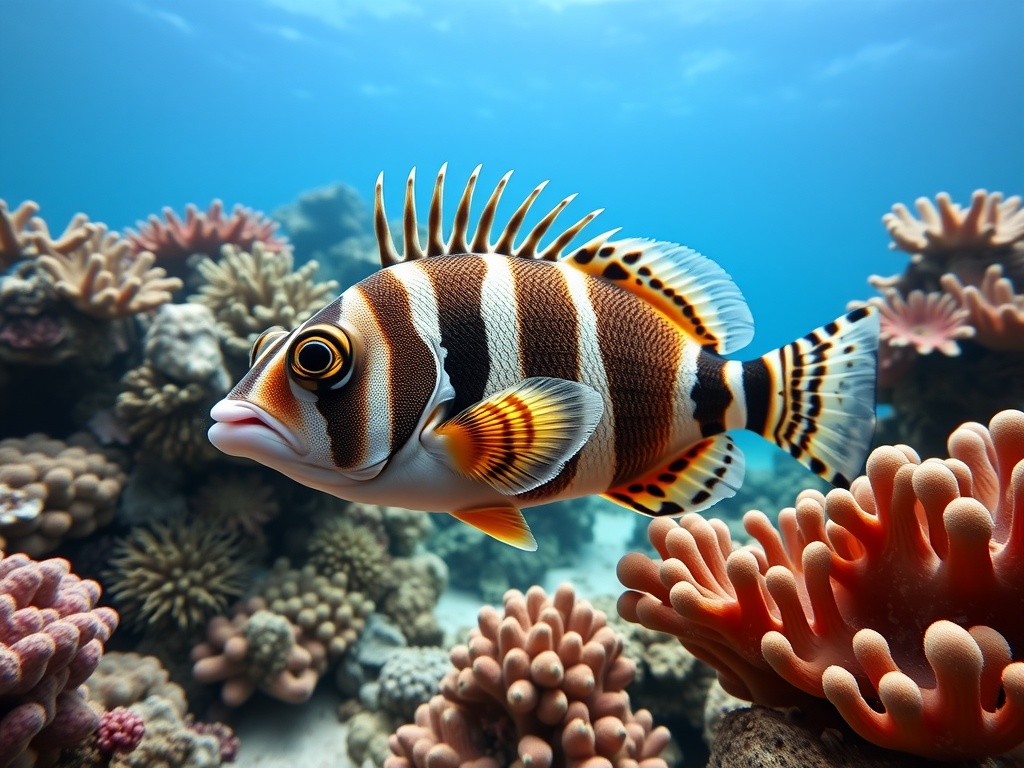
About the Picasso triggerfish
The Picasso triggerfish is a strikingly colorful and uniquely patterned marine fish found in shallow reefs and lagoons throughout the Indo-Pacific region. Its bold geometric markings of blue, yellow, black, and white make it one of the most recognizable species among reef fishes. Known for its territorial behavior, the Picasso triggerfish uses its strong jaws and sharp teeth to feed on a variety of hard-shelled prey. It is also capable of producing a grunting sound when threatened, which is used to deter predators and competitors. Despite its beauty, the Picasso triggerfish can be aggressive, especially when guarding its nest or territory.
Fascinating facts
Artistic colors
The Picasso triggerfish's bright colors and bold patterns resemble abstract artwork, inspiring its common name after the famous painter Pablo Picasso.
Powerful jaws
Their strong teeth and jaw muscles allow them to crush hard-shelled prey such as mollusks, crustaceans, and sea urchins with ease.
Locking spine
This fish can erect and 'lock' its first dorsal spine as a defense mechanism, wedging itself into rocks to avoid being pulled out by predators.
Detailed description
The Picasso triggerfish (Rhinecanthus aculeatus) is a medium-sized marine fish reaching up to 30 cm in length, characterized by a laterally compressed, oval-shaped body and a distinctive coloration pattern of blue, yellow, black, and white geometric markings. Its head is large and angular, with a prominent snout and small, independently moving eyes that provide a wide field of vision. The mouth is terminal and equipped with strong, chisel-like teeth adapted for crushing hard-shelled prey such as mollusks, crustaceans, echinoderms, and occasionally algae. The first dorsal fin contains a robust, erectile spine—an anatomical adaptation that can be locked upright for defense or to wedge itself securely into crevices. The skin is tough and covered with small, plate-like scales, offering protection against predators and abrasive substrates. Picasso triggerfish are diurnal, spending daylight hours actively foraging and patrolling their territories, while seeking shelter in reef crevices at night. They exhibit pronounced territoriality, especially during breeding, aggressively defending their area from intruders. Socially, they are generally solitary or found in loose pairs, with little evidence of complex group structures. Their striking appearance and bold behaviors make them a prominent and easily recognizable inhabitant of Indo-Pacific coral reefs and lagoons.
Did you know?
Picasso triggerfish are known to rearrange objects in their environment, often moving rocks and debris to create or maintain their preferred territory.
Research & sources
Wikipedia summary
The lagoon triggerfish, also known as the blackbar triggerfish, the Picasso triggerfish, or the Picassofish, is a triggerfish, up to 30 cm (12 in) in length, found on reefs in the Indo-Pacific region.
Behaviour & social structure
Picasso triggerfish are highly territorial and will vigorously chase away intruders, including other fish and even divers, especially during nesting periods. Their foraging behavior involves overturning rocks and rubble with their snouts to expose hidden prey, using their strong jaws to crush shells. They are opportunistic carnivores, feeding primarily on benthic invertebrates such as sea urchins, crabs, shrimp, and gastropods, but may also consume detritus and algae. These fish display a daily routine of active foraging during daylight, with periods of rest or sheltering in crevices at night. When threatened, they emit audible grunting sounds by grinding their teeth or using their swim bladder, serving as a warning to potential predators or rivals. Social interactions are mostly antagonistic, with individuals maintaining and patrolling well-defined territories. Juveniles are more secretive, often hiding among coral branches or rubble to avoid predation.
Reproduction & life cycle
Picasso triggerfish are oviparous, with external fertilization. Breeding typically occurs during warmer months, though timing may vary regionally. Courtship involves elaborate displays by males, including color intensification and rapid swimming patterns to attract females. Females lay adhesive eggs in shallow nests excavated in sandy or rubble substrates, often within the male's territory. After spawning, the female guards and aerates the eggs by fanning them with her fins, exhibiting strong parental care until hatching, which usually occurs within 24–48 hours depending on water temperature. Both parents may become highly aggressive during this period, defending the nest from potential egg predators. Larvae are planktonic, drifting in the open ocean before settling onto the reef as juveniles.
Adaptations & survival
Key adaptations of the Picasso triggerfish include its powerful jaw musculature and specialized teeth for crushing hard-shelled prey, and its robust first dorsal spine, which can be locked upright as a defense mechanism or to anchor itself in crevices. The tough, sandpaper-like skin provides protection against abrasion and predation. Its laterally compressed body allows for agile maneuvering among coral branches and tight spaces. The ability to produce sounds serves as both a deterrent to predators and a means of communication. Coloration provides both camouflage among the complex reef environment and aposematic (warning) signals to potential predators. Their territorial aggression is an evolutionary strategy to secure optimal feeding and breeding sites.
Cultural significance
The Picasso triggerfish is renowned for its striking appearance and is a popular species in the marine aquarium trade, valued for its vivid colors and unique patterns. In some Pacific Island cultures, triggerfish are featured in folklore and traditional art, symbolizing protection and territoriality. In Hawaii, the species is known as 'humuhumunukunukuāpuaʻa,' and holds the distinction of being the official state fish. The fish's name and image are often used in tourism marketing and educational materials to represent the biodiversity of coral reefs.
Recent research
Recent research on Rhinecanthus aculeatus has focused on its complex visual system, revealing advanced color vision and polarization sensitivity, which aid in prey detection and social signaling. Studies on their sound production have provided insights into fish acoustic communication and its ecological roles. Ongoing research examines their role in reef ecosystem dynamics, particularly their influence on invertebrate populations and substrate turnover. Genetic studies are investigating population connectivity across the Indo-Pacific, important for conservation management. Behavioral studies have highlighted their cognitive abilities, including problem-solving and spatial memory, which are advanced among reef fishes.
Videos
Habitat
Coral reefs and shallow lagoons

Conservation
The Picasso triggerfish is currently classified as Least Concern on the IUCN Red List.
Threats & challenges
Currently listed as Least Concern by the IUCN, the Picasso triggerfish faces few direct threats due to its wide distribution and adaptability. However, localized threats include habitat degradation from coral reef destruction, pollution, and climate change-induced bleaching events. Overfishing for the aquarium trade may impact some populations, though this is not considered a major threat globally. Their aggressive territoriality can make them resilient to some forms of predation, but juveniles are vulnerable to larger fish and invertebrate predators. Long-term population trends are stable, but ongoing reef decline poses a potential risk to future habitat availability.
Taxonomy
Scientific name
Rhinecanthus aculeatus
- Kingdom
- Animalia
- Phylum
- Chordata
- Class
- Actinopterygii
- Order
- Tetraodontiformes
- Family
- Balistidae
- Genus
- Rhinecanthus
- Species
- aculeatus
Community notes
Share your observations about the Picasso triggerfish.
No community notes yet. Be the first!
Discover more wildlife
More fascinating animals from the encyclopedia.