
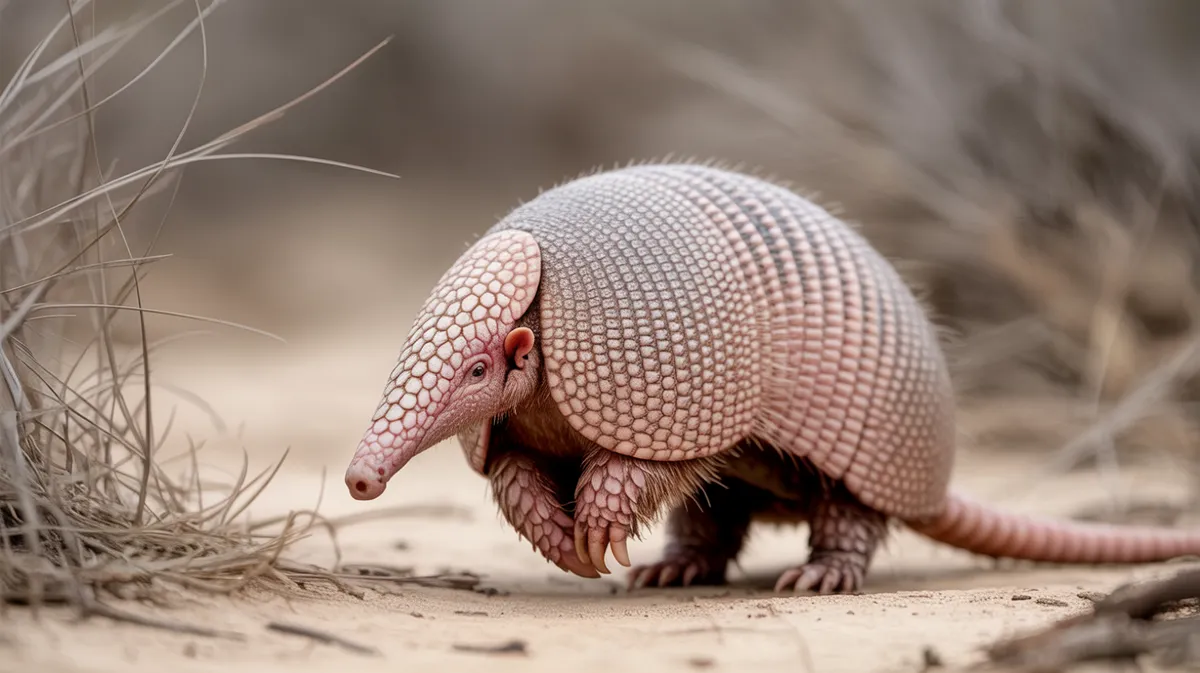
About the Pink Fairy Armadillo
The pink fairy armadillo is the smallest armadillo — roughly the length of a human hand — and it spends almost its entire life underground in the sandy plains of central Argentina. Its shell is unlike any other armadillo's: thin, flexible, and attached to the body only along a narrow membrane down the spine. It is pink because it is thin enough to be translucent, and what shows through is the blood beneath. That is not decoration: the animal appears to regulate its temperature by pumping blood into or out of the shell, dumping or conserving heat as needed. It is a sand-swimmer, hauling itself through loose sand with enormous front claws so quickly it seems to swim, and it uses a flattened, plate-like rear to plug the tunnel behind it and block pursuit. Nearly blind, it navigates by touch and smell. It is so narrowly specialised for its burrow that captured animals almost always die quickly, which is a large part of why so little is known about it — including whether it is threatened.
Fascinating facts
Unique Shell
The Pink Fairy Armadillo’s shell is flexible and only attached by a thin membrane along its spine, unlike other armadillos whose shells are more rigid.
Nocturnal Lifestyle
This species is strictly nocturnal, emerging at night to feed on insects, larvae, and plant matter.
Expert Digger
With powerful front claws, the Pink Fairy Armadillo can 'swim' through loose soil at impressive speeds, quickly escaping predators.
Detailed description
The pink fairy armadillo (Chlamyphorus truncatus) is the smallest and most specialized member of the armadillo family, measuring just 90–115 mm (3.5–4.5 in) in body length and weighing approximately 120 grams (4.2 oz). Its most distinctive feature is its dorsal shell, which is pale pink due to underlying blood vessels and is only loosely attached to the body by a thin membrane, allowing flexibility and protection. The animal's body is covered in fine, silky white fur, providing insulation against the temperature extremes of its arid habitat. The forelimbs are equipped with large, spade-like claws adapted for rapid digging, while the hind limbs are smaller and less robust. The head is small and conical, with reduced eyes and ears, reflecting its subterranean lifestyle. The tail is short and flattened, aiding in stability while burrowing. The pink fairy armadillo is strictly nocturnal and fossorial, spending nearly its entire life underground in self-constructed burrows. Its metabolism and physiology are adapted to conserve water and energy in the harsh, dry environments of central Argentina. Due to its elusive nature, much of its natural history remains poorly understood, but it is believed to play a significant role in soil aeration and ecosystem health.
Did you know?
The Pink Fairy Armadillo is so rarely seen that most of what is known about it comes from captive individuals rather than wild observations.
Research & sources
Wikipedia summary
The pink fairy armadillo is the smallest species of armadillo, first described by Richard Harlan in 1825. The pink fairy armadillo is 90–115 mm (3.5–4.5 in) long, and typically weighs about 120 g (4.2 oz). This solitary, desert-adapted animal is endemic to the deserts and scrub lands of central Argentina. The pink fairy armadillo is closely related to the only other fairy armadillo, the greater fairy armadillo.
Behaviour & social structure
Pink fairy armadillos are solitary and highly secretive, emerging from their burrows only at night to forage. Their diet consists primarily of ants, larvae, and other small invertebrates, but they also consume plant matter such as roots and tubers. Foraging is typically done close to the surface, and the animal uses its sensitive nose and whiskers to locate prey. When threatened, it can rapidly burrow backwards into the soil, effectively disappearing from view within seconds. Unlike other armadillo species, it does not roll into a ball for defense; instead, it relies on its digging ability and the ability to flatten itself against the substrate, using its shell as a shield. Social interactions are rare, with individuals maintaining exclusive territories. Activity patterns are strictly nocturnal, likely as an adaptation to avoid predators and extreme daytime temperatures.
Reproduction & life cycle
Reproductive biology in the wild is poorly documented due to the species' elusive habits. Captive observations suggest that the pink fairy armadillo is likely polygynous, with males seeking out females during a brief breeding season, possibly in the austral spring or summer (October to March). After mating, females give birth to a single offspring following a gestation period estimated at 60–75 days. The young are born with a soft, undeveloped shell that hardens over time. Parental care is provided exclusively by the mother, who nurses the offspring in a secure burrow until it is sufficiently developed to forage independently. Sexual maturity is believed to be reached within one year, but precise data are lacking.
Adaptations & survival
The pink fairy armadillo exhibits several remarkable adaptations for a subterranean lifestyle. Its compact, streamlined body and powerful forelimbs allow for efficient digging and rapid burrow construction. The loosely attached, vascularized shell not only provides protection but may also play a role in thermoregulation by dissipating excess heat. The animal's fur is dense and fine, minimizing water loss and insulating against temperature fluctuations. Reduced eyesight and external ears reflect its adaptation to a life spent mostly underground, while its highly developed olfactory and tactile senses aid in navigation and prey detection. Its metabolic rate is low, an adaptation to the nutrient-poor and unpredictable environment of the Argentinean plains.
Cultural significance
While the pink fairy armadillo is not widely featured in Argentine folklore, its unusual appearance has made it a subject of curiosity and fascination among local communities and naturalists. In some rural areas, it is considered a symbol of good luck or a harbinger of rain, though such beliefs are not widespread. The animal has occasionally been kept as a pet, despite its poor survival in captivity and legal protections. Its rarity and unique adaptations have made it an emblematic species for conservation awareness in the region.
Recent research
Recent research has focused on the species' physiology, particularly its thermoregulatory mechanisms and metabolic adaptations to arid environments. Advances in non-invasive monitoring, such as environmental DNA (eDNA) and camera traps, are beginning to shed light on its distribution and population status. A 2019 study using stable isotope analysis provided new insights into its diet and trophic niche. Ongoing conservation projects are attempting to map suitable habitats and assess the impact of land use changes. However, the pink fairy armadillo remains one of the least studied mammals in South America, and many aspects of its biology and ecology are still unknown.
Videos
Habitat
Dry grasslands and sandy plains


Conservation
The Pink Fairy Armadillo is currently classified as Data Deficient on the IUCN Red List.
Threats & challenges
The pink fairy armadillo faces numerous threats, primarily due to habitat loss from agricultural expansion, livestock grazing, and land conversion in central Argentina. Its specialized habitat requirements make it particularly vulnerable to environmental changes. Additional threats include predation by domestic dogs and cats, accidental drowning during heavy rains (as burrows can flood), and illegal collection for the pet trade or curiosity. The species is classified as Data Deficient by the IUCN due to the paucity of reliable population data, but it is generally considered rare and declining. Conservation efforts are hindered by the animal's secretive nature and the lack of comprehensive field studies.
Taxonomy
Scientific name
Chlamyphorus truncatus
- Kingdom
- Animalia
- Phylum
- Chordata
- Class
- Mammalia
- Order
- Cingulata
- Family
- Chlamyphoridae
- Genus
- Chlamyphorus
- Species
- truncatus
Community notes
Share your observations about the Pink Fairy Armadillo.
No community notes yet. Be the first!
Discover more wildlife
More fascinating animals from the encyclopedia.