
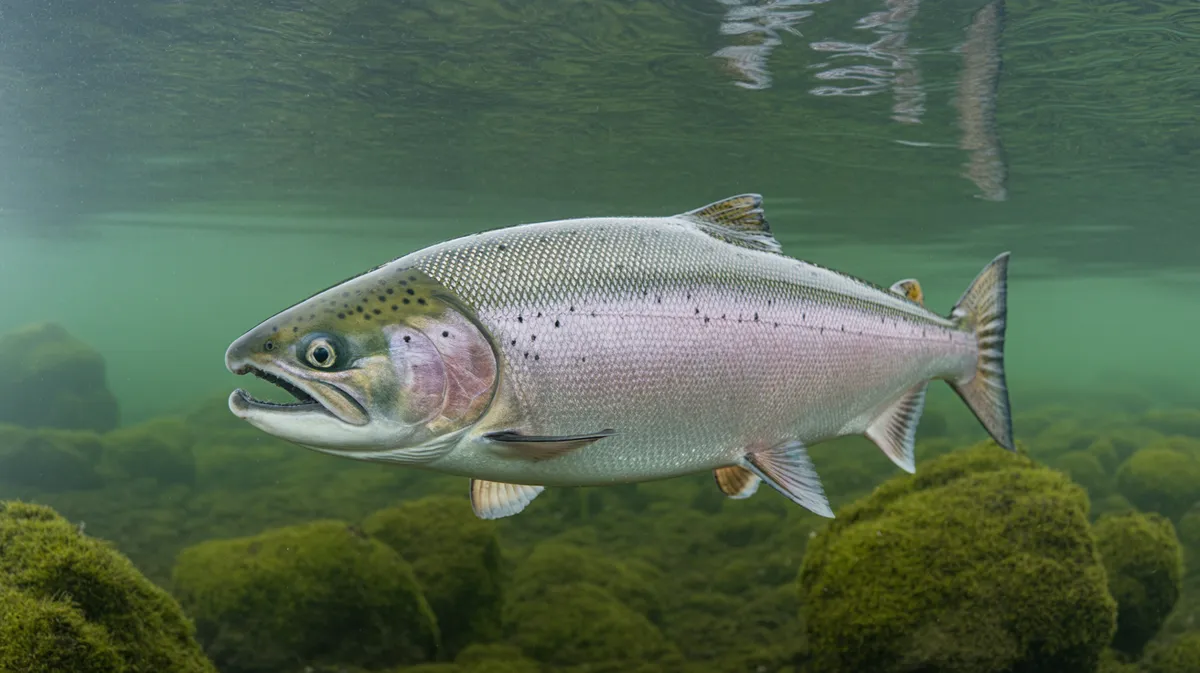
About the Pink Salmon
The pink salmon is the smallest and most abundant of the Pacific salmon species, recognized by its silver sides and distinctive pinkish hue during spawning. These fish are anadromous, spending most of their life in the ocean but migrating to freshwater streams to spawn. Pink salmon have a rapid, fixed two-year lifecycle, with adults dying soon after spawning. Their annual migrations support important commercial and subsistence fisheries in the North Pacific region.
Fascinating facts
Shortest Salmon Lifecycle
Pink salmon have the shortest lifespan of all Pacific salmon, living only two years from hatching to spawning.
Massive Spawning Runs
Spawning runs can number in the millions, making pink salmon the most abundant Pacific salmon species.
Odd and Even Year Lines
Pink salmon populations are split into odd- and even-year lines that rarely interbreed, resulting in genetically distinct groups.
Detailed description
The pink salmon (Oncorhynchus gorbuscha) is a small, streamlined salmonid, typically measuring 40–55 cm (16–22 in) in length and weighing 1.2–2.3 kg (2.6–5.1 lb), though some individuals may reach up to 5 kg. In oceanic phase, they display a silvery body with a white belly and steel-blue to greenish back, marked by large oval-shaped black spots on the back and tail. During spawning, males develop a pronounced dorsal hump, elongated jaws (kype), and their coloration shifts to a pale gray with a pinkish hue along the sides, while females become duller. Pink salmon are anadromous, spending most of their lives in the open ocean but returning to natal freshwater streams to spawn. They are unique among Pacific salmon for their strict two-year lifecycle, resulting in genetically distinct odd- and even-year populations that rarely interbreed. Pink salmon are highly fecund, with females producing 1,200–1,900 eggs per spawning event. Their rapid growth and short lifespan are adaptations to dynamic environments and high predation pressure. Juveniles migrate to sea almost immediately after hatching, minimizing freshwater residency. Pink salmon play a vital ecological role as prey for marine mammals, birds, and larger fish, and as nutrient vectors, transporting marine-derived nutrients into freshwater ecosystems during spawning runs.
Did you know?
Pink salmon are so closely tied to their two-year lifecycle that odd- and even-year populations in the same river are genetically distinct.
Research & sources
Wikipedia summary
Pink salmon or humpback salmon is a species of euryhaline ray-finned fish in the family Salmonidae. It is the type species of the genus Oncorhynchus, and is the smallest and most abundant of the seven officially recognized species of salmon. The species' scientific name is based on the Russian common name for this species gorbúša (горбуша), which literally means humpie.
Behaviour & social structure
Pink salmon exhibit strong homing behavior, returning to the exact stream or river where they hatched to spawn. In the ocean, they form large, loosely organized schools and feed primarily on zooplankton, small crustaceans (such as euphausiids and amphipods), and small fish. Their feeding is most active during daylight hours, with diel vertical migrations observed in some populations. During the spawning migration, feeding ceases, and energy is devoted entirely to reproduction. Social interactions during spawning are characterized by intense competition among males, with dominant individuals defending territories and courting females. Outside of the breeding season, pink salmon are generally non-territorial and exhibit limited social hierarchy.
Reproduction & life cycle
Pink salmon spawn exclusively in freshwater, typically from July to October, depending on latitude and local conditions. Females select gravel-bottomed riffles in shallow streams and construct nests (redds) by digging with their tails. After spawning, females cover the eggs with gravel to protect them from predators and currents. Fertilization is external; males release milt over the eggs as they are deposited. Incubation lasts 3–5 months, depending on water temperature, with hatching occurring in late winter or early spring. Unlike many other salmonids, pink salmon fry emerge from the gravel and migrate to the ocean almost immediately, bypassing an extended freshwater rearing phase. There is no parental care after spawning, and both sexes die (semelparity) shortly after reproduction.
Adaptations & survival
Pink salmon have evolved several key adaptations for survival. Their strict two-year lifecycle minimizes competition between generations and reduces hybridization. The rapid transition of fry to saltwater reduces exposure to freshwater predators and variable stream conditions. Morphological changes during spawning, such as the development of the male's hump and kype, aid in reproductive competition and mate selection. Their silvery coloration in the ocean provides camouflage from predators, while the spawning coloration signals reproductive status. Physiologically, they are highly euryhaline, able to tolerate rapid changes in salinity during migration between freshwater and marine environments.
Cultural significance
Pink salmon are of great economic and cultural importance in the North Pacific region, supporting major commercial fisheries in Russia, Alaska, and Canada. They are a staple in subsistence diets for Indigenous peoples and have featured in traditional stories and ceremonies. In some cultures, pink salmon symbolize abundance and renewal due to their prolific spawning runs. The species is also valued for its role in recreational fishing and as a source of affordable protein, with canned pink salmon being a globally traded commodity.
Recent research
Recent research has focused on the genetic differentiation between odd- and even-year lineages, revealing limited gene flow and adaptations to distinct environmental conditions. Studies are investigating the impacts of ocean acidification and warming on early marine survival and growth rates. There is ongoing interest in the ecological consequences of pink salmon introductions outside their native range, such as in the North Atlantic, where they have established self-sustaining populations. Pink salmon are also used as model organisms for studying anadromy, homing behavior, and the effects of large-scale hatchery supplementation on wild populations.
Videos
Habitat
Coastal and freshwater streams, rivers, and the northern Pacific Ocean


Conservation
The Pink Salmon is currently classified as Least Concern on the IUCN Red List.
Threats & challenges
While pink salmon are currently listed as Least Concern by the IUCN due to their abundance and wide distribution, they face several threats. Climate change is altering ocean temperatures and stream flows, potentially impacting migration timing, spawning success, and marine survival rates. Habitat degradation from logging, dam construction, and urbanization can reduce the availability of suitable spawning grounds. Overfishing and bycatch in commercial fisheries, as well as competition with hatchery-raised salmon and invasive species, may also pose localized risks. Despite these challenges, pink salmon populations are generally resilient, though some southern populations (e.g., in Puget Sound) have experienced declines.
Taxonomy
Scientific name
Oncorhynchus gorbuscha
- Kingdom
- Animalia
- Phylum
- Chordata
- Class
- Actinopterygii
- Order
- Salmoniformes
- Family
- Salmonidae
- Genus
- Oncorhynchus
- Species
- gorbuscha
Community notes
Share your observations about the Pink Salmon.
No community notes yet. Be the first!
Discover more wildlife
More fascinating animals from the encyclopedia.