
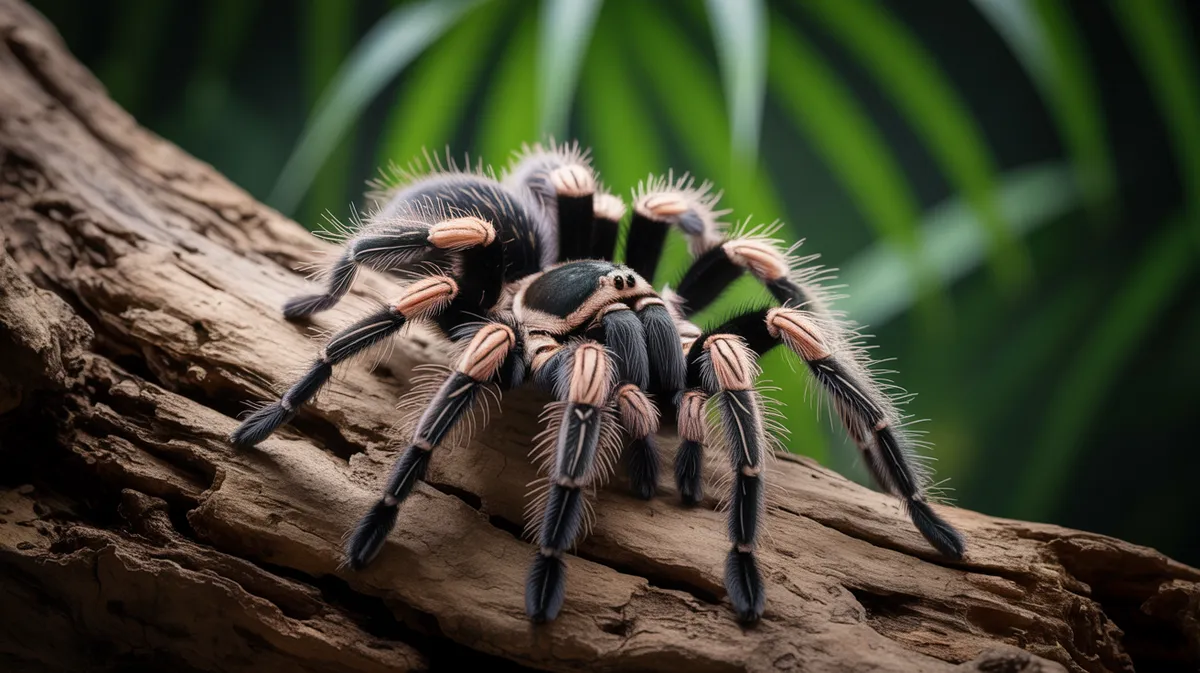
About the Pinktoe Tarantula
The Pinktoe Tarantula is a striking arboreal spider native to the rainforests of South America. Recognizable by its velvety black body and distinctive pinkish tips on its feet, this species is known for its agility and docile temperament. Unlike many terrestrial tarantulas, it spends most of its life in trees, constructing silken retreats among the foliage. Pinktoe Tarantulas are popular in the exotic pet trade due to their unique coloration and relatively gentle disposition.
Fascinating facts
Web Architects
Pinktoe Tarantulas weave intricate, three-dimensional silk retreats in the branches of trees, which they use for shelter and molting.
Pink Toes
The spider’s distinctive pink-tipped feet help distinguish it from other tarantula species and may provide camouflage among tropical flowers.
Arboreal Lifestyle
Unlike ground-dwelling tarantulas, Pinktoe Tarantulas are adapted to a tree-dwelling (arboreal) lifestyle, spending nearly all their time above ground.
Detailed description
The Pinktoe Tarantula (Avicularia avicularia) is a medium-sized arboreal spider, with adult females typically reaching a leg span of 12–15 cm (4.7–6 in) and males slightly smaller. Its most distinctive feature is the vivid pink or salmon-colored tarsi (the 'toes'), contrasting with a velvety dark brown to black body and iridescent green or blue highlights on the carapace and legs. The abdomen is covered in dense setae (hairs), which serve both sensory and defensive functions. Juveniles display a reversed coloration, with pinkish bodies and darker feet, gradually transitioning to adult coloration through successive molts. The species possesses two prominent spinnerets for silk production, which it uses to construct elaborate tubular retreats among tree branches and foliage. Unlike many terrestrial tarantulas, A. avicularia has specialized scopulae (dense tufts of hairs) on its feet, enabling it to climb smooth vertical surfaces and navigate the rainforest canopy. Its chelicerae house potent venom, effective for subduing prey but generally harmless to humans. The species exhibits sexual dimorphism, with males having longer legs and more slender bodies, as well as tibial hooks used during mating. Lifespan varies by sex: females can live 10–12 years, while males typically survive only 2–3 years post-maturity.
Did you know?
Unlike most tarantulas, Pinktoe Tarantulas are more likely to flee or leap away from threats rather than defend themselves aggressively.
Research & sources
Wikipedia summary
Avicularia avicularia, sometimes called the pinktoe tarantula, is a species of tarantula native from Venezuela, Guyana, Suriname, French Guiana and Trinidad and Tobago to Peru, Bolivia and Brazil. This species is sometimes called the Guyana pinktoe, or South American pinktoe.
Behaviour & social structure
Pinktoe Tarantulas are primarily nocturnal and crepuscular, becoming most active at dusk and during the night. They are solitary and territorial, rarely tolerating conspecifics except during mating. In the wild, they construct silken retreats in tree hollows, bromeliads, or among dense foliage, which serve as both shelter and hunting platforms. A. avicularia is an ambush predator, relying on stealth and agility to capture prey such as insects, small lizards, and occasionally tree frogs. It rarely burrows, instead using silk to reinforce and line its arboreal shelters. When threatened, it exhibits a unique defensive behavior: instead of rearing up or flicking urticating hairs (which are less developed in this genus), it may leap away or rapidly escape by climbing. In captivity, individuals are known for their docile temperament but can display defensive postures if provoked. They communicate with conspecifics and potential mates using vibratory signals transmitted through silk.
Reproduction & life cycle
Breeding typically occurs during the wet season, when males reach sexual maturity and begin searching for females by following pheromone trails. Courtship involves the male tapping and vibrating on the female's web to signal his presence. If receptive, the female allows the male to approach and mate, during which he uses his tibial hooks to restrain her fangs and deposits sperm via specialized pedipalps. After mating, the female produces an egg sac containing 50–200 eggs, which she guards vigilantly within her retreat. Incubation lasts approximately 6–8 weeks, after which spiderlings emerge and remain in the maternal web for several days before dispersing. There is no further parental care after dispersal. Sexual maturity is reached in 2–3 years for females and slightly less for males, depending on environmental conditions and food availability.
Adaptations & survival
Avicularia avicularia exhibits several adaptations for arboreal life. The dense scopulae on the tarsi and metatarsi allow for exceptional grip on smooth and vertical surfaces, facilitating movement in the rainforest canopy. Its coloration provides camouflage among mosses and epiphytes, while the pink toes may serve as disruptive coloration or intraspecific signaling. The species produces silk not only for prey capture but also for constructing waterproof retreats that protect against tropical downpours and predators. Behavioral adaptations include rapid escape responses and the ability to leap short distances between branches. Unlike many New World tarantulas, A. avicularia has less developed urticating hairs, relying more on agility and retreat construction for defense.
Cultural significance
Avicularia avicularia holds a modest place in local folklore, often regarded with curiosity or superstition due to its striking appearance. In some South American cultures, large spiders are associated with rain and fertility, though there is little evidence of direct ritual use of this species. Globally, the Pinktoe Tarantula is popular in the exotic pet trade, valued for its docile nature and unique coloration. It is also featured in educational programs and documentaries to promote arachnid conservation and dispel misconceptions about tarantulas.
Recent research
Recent research has focused on the taxonomy and phylogenetics of the Avicularia genus, with molecular studies revealing significant cryptic diversity and prompting taxonomic revisions. Studies on silk properties have highlighted the waterproof and antimicrobial qualities of Avicularia silk, which may have biomimetic applications. Behavioral research has documented the species' complex retreat-building and escape behaviors, as well as its relatively low reliance on urticating hairs compared to terrestrial relatives. Ongoing studies are investigating the impact of habitat fragmentation and climate change on arboreal tarantula populations in the Amazon basin.
Sources
Taxonomic revision and phylogenetic relationships of Avicularia Lamarck, 1818 (Araneae: Theraphosidae: Aviculariinae)
Caroline Sayuri Fukushima & Rogério Bertani (2017)
scientificVideos
Habitat
Tropical rainforest canopy


Conservation
The Pinktoe Tarantula is currently classified as Least Concern on the IUCN Red List.
Threats & challenges
Currently classified as Least Concern by the IUCN, the Pinktoe Tarantula faces localized threats from habitat loss due to deforestation, agricultural expansion, and urbanization in the Amazon and Guiana Shield regions. Collection for the international pet trade is significant but appears sustainable at present, though overharvesting could become problematic in isolated populations. Pesticide use and climate change may also pose future risks by altering prey availability and microhabitat conditions. Despite these pressures, the species remains widespread and adaptable, with stable populations in protected areas. Continued habitat fragmentation and unregulated trade are ongoing conservation challenges.
Taxonomy
Scientific name
Avicularia avicularia
- Kingdom
- Animalia
- Phylum
- Arthropoda
- Class
- Arachnida
- Order
- Araneae
- Family
- Theraphosidae
- Genus
- Avicularia
- Species
- avicularia
Where to see a pinktoe tarantula
1 zoo and aquarium in 1 country are recorded as keeping this species.
Community notes
Share your observations about the Pinktoe Tarantula.
No community notes yet. Be the first!
Discover more wildlife
More fascinating animals from the encyclopedia.