
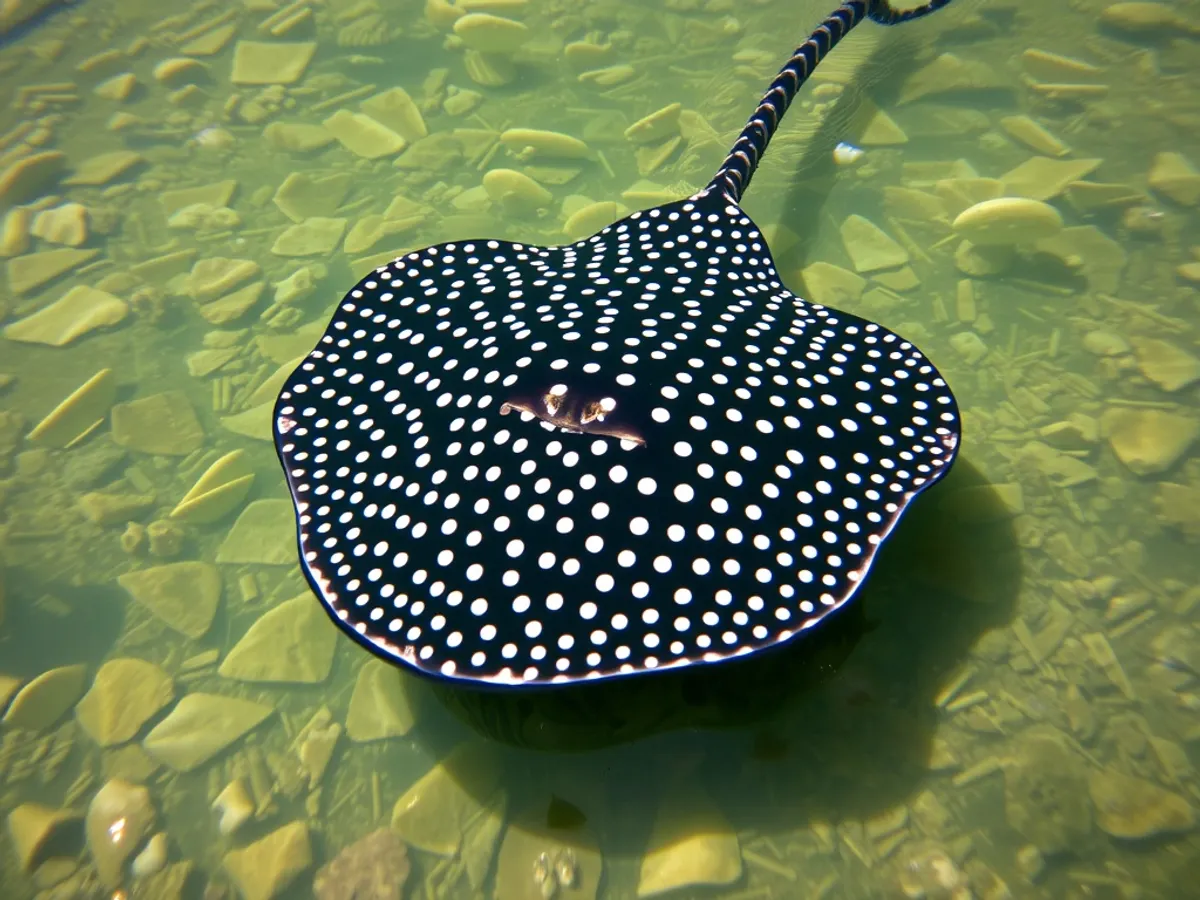
About the Polka-dot stingray
The polka-dot stingray, also known as the Xingu River ray or the white-blotched river stingray, is a striking freshwater ray native to the Xingu River basin in Brazil. It is easily recognized by its distinctive black body adorned with large, bright white spots, making it one of the most visually unique stingrays in the world. This species inhabits clear, fast-flowing rivers with sandy and rocky substrates, where it spends much of its time gliding along the bottom. The polka-dot stingray is highly prized in the aquarium trade due to its beauty but faces numerous threats in the wild.
Fascinating facts
Unique Spot Patterns
Each polka-dot stingray has a distinct arrangement of white spots on its body, allowing individuals to be identified much like human fingerprints.
Freshwater Specialist
Unlike most stingrays, which are marine, the polka-dot stingray is adapted exclusively to freshwater environments in the Xingu River basin.
Live Bearers
Polka-dot stingrays are ovoviviparous, meaning females give birth to fully formed, miniature rays after internal development.
Detailed description
The polka-dot stingray (Potamotrygon leopoldi) is a medium to large freshwater ray, with adults typically reaching disc widths of 40–50 cm, though some individuals may exceed 60 cm. Its striking appearance is characterized by a deep black dorsal surface adorned with prominent, irregular white or cream-colored spots, which serve as camouflage among the rocky riverbeds of its native Xingu River. The ventral side is generally lighter, aiding in countershading. The body is flattened and disc-shaped, with pectoral fins fused to the head, and a slender, whip-like tail equipped with one or more venomous spines used for defense. The eyes are positioned dorsally, allowing the ray to remain partially buried while scanning for prey. Sensory adaptations include electroreceptors (ampullae of Lorenzini) that detect the weak electrical fields produced by prey. The mouth, located on the underside, is equipped with flattened teeth adapted for crushing hard-shelled invertebrates. Polka-dot stingrays are benthic and spend much of their time gliding over or resting on the substrate. Their coloration and body shape provide excellent concealment from both predators and prey. The species is sexually dimorphic, with males possessing claspers (modified pelvic fins) for internal fertilization. They are known for their relatively long lifespan, often living 10–15 years in the wild and longer in captivity.
Did you know?
Despite being a freshwater species, the polka-dot stingray can grow quite large, with some individuals reaching a disc width of up to 40 cm (16 inches) or more.
Research & sources
Wikipedia summary
The Xingu River ray, River stingray, white-blotched river stingray, or polka-dot stingray is a species of freshwater fish in the family Potamotrygonidae. It is endemic to the Xingu River basin in Brazil and as such prefers clear waters with rocky bottoms. It is sometimes kept in aquaria, like its more common relative the Motoro.
Behaviour & social structure
Polka-dot stingrays are primarily nocturnal, becoming most active during dusk and nighttime hours when they hunt for food. They are ambush predators, lying partially buried in sand or gravel and using their electroreceptors to detect hidden prey such as crustaceans, small fish, worms, and mollusks. Their feeding strategy involves sudden lunges to trap prey beneath their disc, followed by manipulation and crushing with their jaws. Socially, they are generally solitary but may be observed in loose aggregations during periods of abundant food or breeding. Stingrays communicate through body postures and tactile interactions, especially during courtship. They exhibit site fidelity, often returning to favored resting or hunting spots. During the day, they remain motionless, conserving energy and reducing predation risk.
Reproduction & life cycle
Potamotrygon leopoldi is ovoviviparous, meaning embryos develop inside eggs that remain within the mother's body until hatching. Mating typically occurs during the rainy season (December to March), when increased water levels facilitate movement and encounters between individuals. Courtship involves the male following and gently biting the female's disc, eventually aligning for internal fertilization using his claspers. Gestation lasts approximately 3–4 months, after which the female gives birth to 2–8 fully formed, miniature rays. Neonates measure about 7–10 cm across and are independent from birth, receiving no parental care. Females may breed annually or biennially, depending on environmental conditions and resource availability.
Adaptations & survival
The polka-dot stingray exhibits several key adaptations for survival in fast-flowing, clearwater habitats. Its dorsoventrally flattened body and broad pectoral fins allow it to hug the substrate, minimizing drag and resisting strong currents. The cryptic coloration provides camouflage among rocks and sandy patches, reducing visibility to predators and prey. Electroreception enables the detection of hidden or buried prey, while robust jaws and flattened teeth are specialized for crushing hard exoskeletons. The venomous tail spine acts as a deterrent against predators, delivering a painful and potentially harmful sting. Behavioral adaptations such as nocturnality and site fidelity further enhance survival in the dynamic riverine environment.
Cultural significance
While not deeply embedded in indigenous mythology, the polka-dot stingray holds economic and aesthetic value in Brazil and internationally, primarily through the ornamental fish trade. Its striking appearance has made it a symbol of the unique biodiversity of the Xingu River. In local communities, stingrays are sometimes regarded with caution due to their venomous spines, but they are not typically targeted for food. The species' popularity in aquaria has spurred captive breeding programs, which may help reduce pressure on wild populations.
Recent research
Recent research on Potamotrygon leopoldi has focused on its population genetics, reproductive biology, and the impacts of habitat fragmentation. Studies have highlighted the species' restricted range and genetic isolation, underscoring its vulnerability to environmental changes. Ongoing research is examining the effects of dam construction on migration patterns and breeding success. Advances in captive breeding techniques have improved survival rates of juveniles and may support future reintroduction efforts. There is also growing interest in the species' venom composition, which could have biomedical applications.
Sources
Videos
Habitat
Freshwater rivers

Conservation
The Polka-dot stingray is currently classified as Endangered on the IUCN Red List.
Threats & challenges
The primary threats to Potamotrygon leopoldi are habitat degradation and overexploitation. Construction of hydroelectric dams on the Xingu River, such as the Belo Monte Dam, has altered water flow, reduced habitat complexity, and fragmented populations. Pollution from mining and agriculture further degrades water quality. Overharvesting for the international aquarium trade also poses a significant risk, as the species is highly prized for its appearance. These pressures have led to a decline in wild populations, resulting in its IUCN listing as Vulnerable and inclusion in CITES Appendix II. Ongoing habitat loss and unsustainable collection practices remain major conservation challenges.
Taxonomy
Scientific name
Potamotrygon leopoldi
- Kingdom
- Animalia
- Phylum
- Chordata
- Class
- Chondrichthyes
- Order
- Myliobatiformes
- Family
- Potamotrygonidae
- Genus
- Potamotrygon
- Species
- leopoldi
Where to see a polka-dot stingray
2 zoos and aquariums in 1 country are recorded as keeping this species.

Community notes
Share your observations about the Polka-dot stingray.
No community notes yet. Be the first!
Discover more wildlife
More fascinating animals from the encyclopedia.