
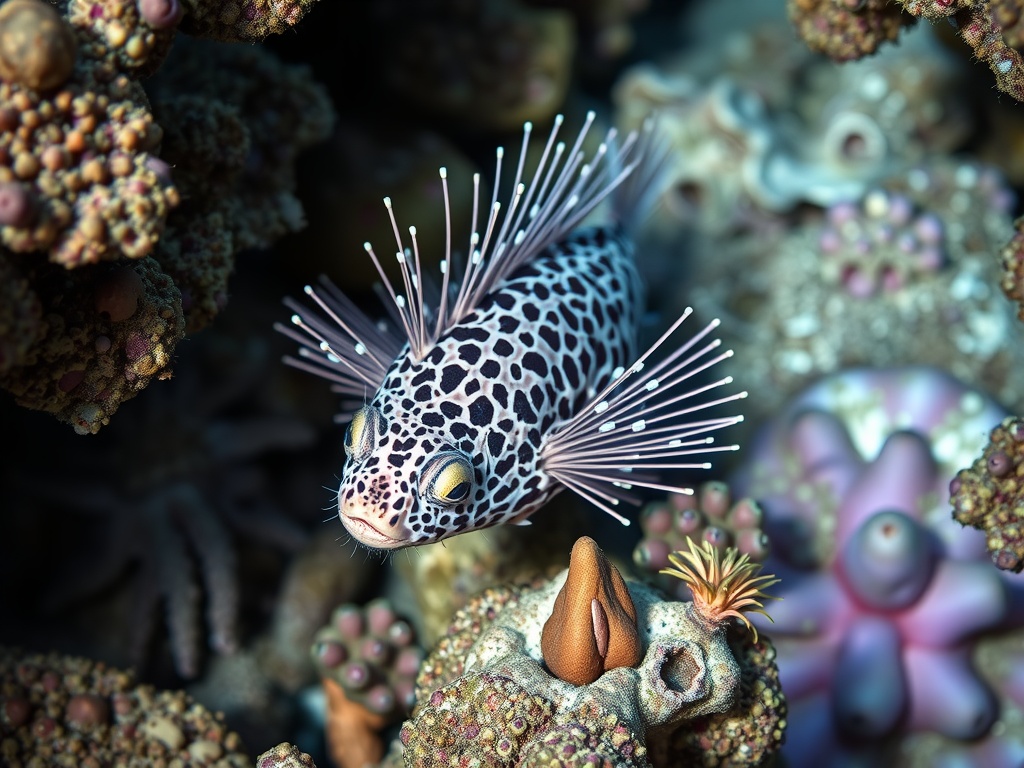
About the Porcupinefish
The porcupinefish takes the pufferfish's defence and adds a second layer to it. Like its relatives it does not inflate with air but gulps water into an enormously elastic stomach, ballooning into a sphere too large for a predator's mouth, and it has no ribs and no pelvic girdle because those bones would fight the expansion. The difference is the spines. Where a pufferfish stays smooth, the porcupinefish is covered in long spines that lie flat against the body when it is relaxed and stand rigidly erect as it inflates, so the finished object is not merely an awkward mouthful but an actively dangerous one. Many species also carry tetrodotoxin, a poison far deadlier by weight than cyanide, which the fish does not manufacture but accumulates from bacteria passed up its food chain. Its teeth are fused into a heavy, parrot-like beak that grows continuously and must be worn down against hard-shelled prey — urchins, crabs and molluscs, which it simply crushes. Inflation is a real emergency measure, and the fish takes time to recover from it.
Fascinating facts
Spiny Defense
When threatened, porcupinefish inflate their bodies and erect long, sharp spines to ward off predators.
Toxic Tissues
Their organs and skin contain tetrodotoxin, a powerful neurotoxin highly toxic to most animals and humans.
Crustacean Crushers
Porcupinefish use their strong, beak-like teeth to crush the shells of crabs, sea urchins, and mollusks.
Detailed description
The Porcupinefish (Diodon hystrix), commonly known as the long-spined porcupinefish, is a robust, medium-to-large marine fish reaching up to 91 cm (36 inches) in length and weighing up to 2.8 kg. Its body is nearly spherical when inflated, covered with long, sharp, erectile spines that lay flat against the skin when the fish is relaxed. The skin is thick and leathery, often mottled with brown or gray spots, providing camouflage among rocks and coral. The head is large with prominent eyes adapted for nocturnal vision, and the mouth is equipped with powerful, beak-like fused teeth forming a parrot-like beak, specialized for crushing hard-shelled prey. Unlike true pufferfish (family Tetraodontidae), porcupinefish have larger, more pronounced spines and lack pelvic fins. Diodon hystrix is primarily nocturnal, hiding in crevices or under ledges during the day and emerging at night to forage. It is generally solitary, though loose aggregations may occur in areas of abundant food. Its most distinctive adaptation is the ability to rapidly ingest water or air, inflating its body to deter predators and erecting its spines for added defense. The tissues and organs of D. hystrix contain tetrodotoxin, a potent neurotoxin, making it unpalatable or dangerous to many potential predators. This species is widely distributed in tropical and subtropical oceans, inhabiting coral reefs, lagoons, and rocky coastal regions at depths from 2 to 50 meters.
Did you know?
Unlike pufferfish, porcupinefish have both spines and toxins as dual defense mechanisms, making them especially difficult for predators to eat.
Research & sources
Wikipedia summary
Porcupinefish are medium-to-large fish belonging to the family Diodontidae from the order Tetraodontiformes which are also commonly called blowfish and, sometimes, balloonfish and globefish. The family includes about 18 species. They are sometimes collectively called pufferfish, not to be confused with the morphologically similar and closely related Tetraodontidae, which are more commonly given this name.
Behaviour & social structure
Porcupinefish are predominantly solitary and nocturnal, spending daylight hours concealed in reef crevices or beneath rocks to avoid predation. At night, they actively forage, using their keen sense of smell and large eyes to locate prey. Their diet consists mainly of hard-shelled invertebrates such as sea urchins, mollusks, crustaceans, and occasionally hermit crabs. They use their strong beak-like jaws to crush shells, often leaving behind piles of broken exoskeletons. Diodon hystrix is generally slow-moving and relies on camouflage and its defensive adaptations rather than speed to evade threats. When threatened, it can inflate its body to several times its normal size within seconds, making it difficult for predators to swallow. Social interactions are minimal outside of breeding, and individuals maintain defined home ranges. Juveniles may exhibit more pelagic behavior, drifting with floating debris or Sargassum mats.
Reproduction & life cycle
Reproduction in Diodon hystrix is oviparous, with external fertilization. Spawning typically occurs in warmer months, often in synchrony with lunar cycles, though precise timing varies by region. During courtship, males and females may engage in brief, close swimming displays near the water surface. Females release thousands of buoyant eggs into the open water, which are fertilized by males. The eggs hatch within 4-7 days, depending on water temperature. Larvae are planktonic and pelagic, drifting with ocean currents for several weeks before settling onto the reef as juveniles. There is no parental care; survival rates are low due to predation and environmental hazards. Sexual maturity is reached at approximately 1-2 years of age, depending on growth rates and environmental conditions.
Adaptations & survival
Porcupinefish possess several remarkable adaptations for survival. The most notable is their ability to inflate their bodies by rapidly ingesting water (or air if removed from water), which both increases their apparent size and erects their spines, deterring most predators. Their skin and internal organs contain tetrodotoxin, a potent neurotoxin, which provides chemical defense and is synthesized by symbiotic bacteria. Their strong, beak-like jaws are highly specialized for crushing hard-shelled prey, allowing them to exploit food resources unavailable to many other reef fish. Their cryptic coloration and nocturnal habits reduce predation risk. Additionally, their large eyes enhance vision in low-light conditions, facilitating nighttime foraging. Juveniles are often pelagic, utilizing floating debris for shelter and dispersal.
Cultural significance
Porcupinefish have featured in various cultures, often admired for their unique appearance and defensive abilities. In some regions, dried, inflated porcupinefish are sold as curios or decorative objects. In Japanese folklore, they are sometimes conflated with fugu (pufferfish), though Diodon species are not typically consumed due to their toxicity. Their striking form and defensive inflation have made them popular subjects in marine art and public aquaria. There are no significant traditional medicinal or culinary uses due to the risk of poisoning.
Recent research
Recent research has focused on the ecological role of Diodon hystrix in reef environments, particularly their influence on invertebrate populations and reef health. Studies have examined the molecular basis and microbial symbionts responsible for tetrodotoxin production in their tissues. Ongoing genetic and phylogenetic work is refining the taxonomy of Diodontidae and clarifying evolutionary relationships within Tetraodontiformes. Behavioral studies using underwater video and telemetry are providing new insights into their nocturnal movements, home range, and habitat preferences. There is growing interest in the potential impacts of climate change on their distribution and reproductive success.
Videos
Habitat
Coral reefs and rocky coastal areas

Conservation
The Porcupinefish is currently classified as Least Concern on the IUCN Red List.
Threats & challenges
While Diodon hystrix is currently listed as Least Concern by the IUCN, it faces several localized threats. Habitat degradation, particularly the loss of coral reefs due to climate change, ocean acidification, and destructive fishing practices, poses significant risks to populations. Bycatch in commercial fisheries and collection for the aquarium trade or as curios (dried, inflated specimens) can also impact local numbers. Pollution and coastal development further threaten their habitats. Despite these challenges, the species’ wide distribution and generalist diet contribute to its resilience, though ongoing monitoring is recommended.
Taxonomy
Scientific name
Diodon hystrix
- Kingdom
- Animalia
- Phylum
- Chordata
- Class
- Actinopterygii
- Order
- Tetraodontiformes
- Family
- Diodontidae
- Genus
- Diodon
- Species
- hystrix
Where to see a porcupinefish
1 zoo and aquarium in 1 country are recorded as keeping this species.

Community notes
Share your observations about the Porcupinefish.
No community notes yet. Be the first!
Discover more wildlife
More fascinating animals from the encyclopedia.