
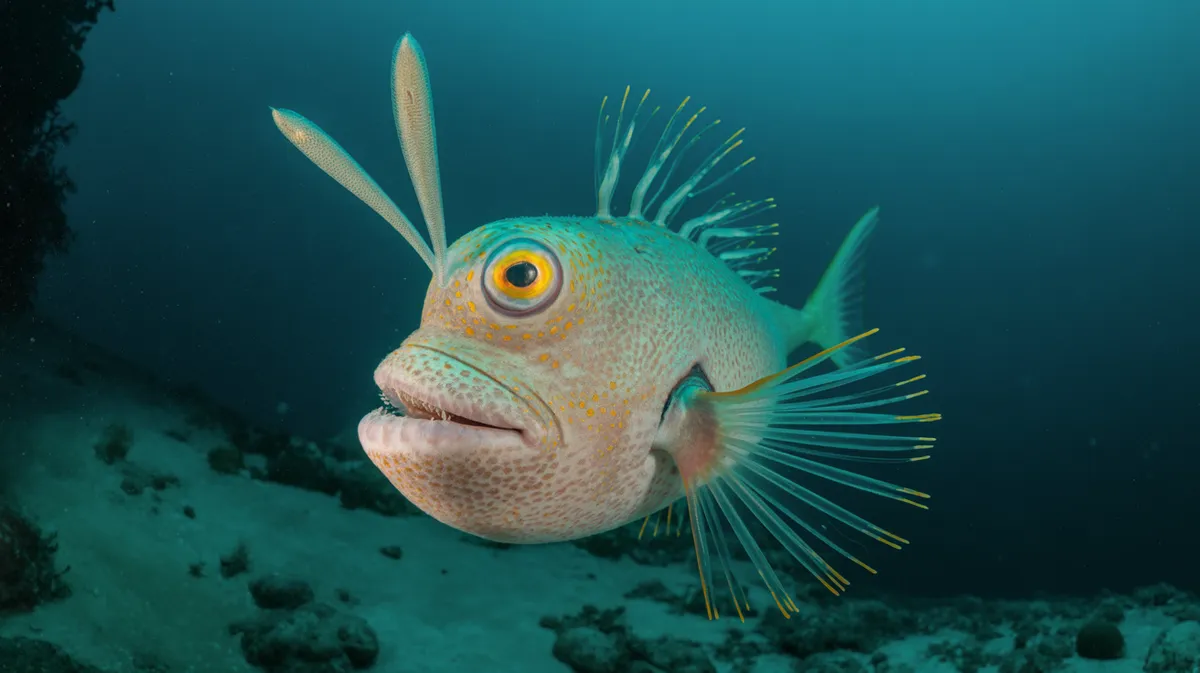
About the Predatory Tunicate
The predatory tunicate, Megalodicopia hians, is a remarkable deep-sea invertebrate known for its unusual method of capturing prey. Unlike most tunicates that filter feed, this species has a large, mouth-like siphon that snaps shut to trap small animals such as copepods and tiny crustaceans. Found in the dark depths of the Pacific Ocean, it anchors itself to the seafloor or underwater cliffs, lying in wait for unsuspecting prey to drift by. Its translucent, sac-like body helps it remain inconspicuous in the dimly lit environment.
Fascinating facts
Venus Flytrap of the Deep
The predatory tunicate catches prey by snapping its oral siphon shut, trapping small animals that swim too close.
Deep Ocean Dweller
Megalodicopia hians lives at depths of 200 to over 3,800 meters, thriving in the cold, dark Pacific Ocean basins.
Almost Transparent
Its body is nearly transparent, which helps it remain hidden from both prey and potential predators in the deep-sea environment.
Detailed description
Megalodicopia hians, commonly known as the predatory tunicate or ghostfish, is a solitary ascidian notable for its highly specialized predatory lifestyle. Its body is translucent and sac-like, typically reaching up to 13 cm (5 inches) across, with a prominent, gaping oral siphon that resembles a mouth. This siphon is lined with sensitive cilia and muscular tissue, allowing it to snap shut rapidly when prey enters. The tunicate's body wall is composed of a tough, cellulose-like tunicin, providing structural support and protection. Internally, it possesses a simple digestive tract and a pharyngeal basket, but unlike filter-feeding relatives, its pharynx is adapted for engulfing rather than filtering. Anchored by a basal stalk, M. hians attaches itself to hard substrates such as canyon walls and rocky outcrops at depths of 200–1,000 meters, where sunlight is minimal and food is scarce. The species is hermaphroditic, possessing both male and female reproductive organs, and can reproduce via broadcast spawning. Its coloration ranges from translucent white to pale lavender, aiding in camouflage within the dimly lit deep-sea environment. The tunicate is sessile as an adult, but its larval stage is free-swimming, allowing for dispersal before settlement. Notably, M. hians is one of the few tunicates to have evolved a carnivorous, ambush-based feeding strategy, making it a unique subject of deep-sea ecological research.
Did you know?
Despite their gelatinous, plant-like appearance, predatory tunicates are more closely related to vertebrates than to most other invertebrates.
Research & sources
Wikipedia summary
The predatory tunicate, also known as the ghostfish, is a species of tunicate which lives anchored along deep-sea canyon walls and the seafloor. It is unique among tunicates in that, rather than being a filter feeder, it has adapted to life as an ambush predator. Its mouth-like siphon is quick to close whenever a small animal such as a crustacean or a fish drifts inside. Once the predatory tunicate catches a meal, it keeps its trap shut until the animal inside is digested. They are known to live in the Monterey Canyon at depths of 200–1,000 metres (660–3,280 ft). They mostly feed on zooplankton and other tiny animals. Their bodies are roughly 5 inches (13 cm) across.
Behaviour & social structure
Megalodicopia hians is an ambush predator, remaining motionless for extended periods with its oral siphon agape, waiting for zooplankton, small crustaceans, or larval fish to drift within reach. Upon detecting prey—likely through mechanosensory or chemosensory cues—the tunicate rapidly contracts its siphon, trapping the animal inside its atrial cavity. Digestion occurs within the pharyngeal basket, after which indigestible remains are expelled. The species is solitary and exhibits no known social behaviors or aggregations, with individuals spaced apart to maximize feeding efficiency. Activity is largely dictated by the availability of drifting prey, and there is no evidence of circadian rhythms due to the perpetual darkness of its habitat. The tunicate does not migrate or change location once settled, relying entirely on water currents to deliver food.
Reproduction & life cycle
Megalodicopia hians is a simultaneous hermaphrodite, capable of producing both eggs and sperm. Reproduction occurs via broadcast spawning, where gametes are released into the water column for external fertilization. Spawning events are likely synchronized with environmental cues such as food availability or seasonal changes in deep-sea currents, though precise timing remains poorly documented. Fertilized eggs develop into free-swimming tadpole-like larvae, which possess a notochord and tail for brief dispersal. After a short planktonic phase, larvae settle onto suitable hard substrates and undergo metamorphosis into the sessile adult form. There is no parental care; all development occurs externally. Longevity is not well studied, but related tunicates can live several years in stable deep-sea environments.
Adaptations & survival
M. hians exhibits several evolutionary adaptations for deep-sea predation. Its large, sensitive oral siphon allows for rapid closure and effective prey capture, a rare adaptation among tunicates. The translucent body provides camouflage against the faint ambient light, reducing predation risk. The tough tunic protects against physical damage and potential predators. Sessile attachment to hard substrates in high-current areas maximizes exposure to drifting prey. The species' hermaphroditism and broadcast spawning increase reproductive success in sparsely populated environments. Additionally, its metabolic rate is likely reduced, an adaptation to the low-energy, food-scarce deep-sea ecosystem.
Cultural significance
Megalodicopia hians has little to no direct significance in human culture, mythology, or traditional uses, primarily due to its inaccessible habitat and cryptic nature. However, it has gained attention in scientific and educational circles as a striking example of deep-sea adaptation and evolutionary innovation. Its unique predatory behavior is often highlighted in documentaries and public aquarium displays focused on deep-sea biodiversity.
Recent research
Recent research on M. hians has focused on its unique feeding mechanism, evolutionary divergence from filter-feeding tunicates, and its ecological role in deep-sea food webs. Studies using remotely operated vehicles (ROVs) in Monterey Canyon have provided high-resolution imagery and behavioral observations, revealing new insights into its predatory tactics and habitat preferences. Molecular phylogenetic analyses have clarified its taxonomic position within the family Octacnemidae. Ongoing research aims to understand its reproductive cycles, larval dispersal mechanisms, and potential responses to environmental changes. The species is also of interest in studies on deep-sea adaptation and the evolution of carnivory among sessile invertebrates.
Videos
Habitat
Deep-sea ocean

Conservation
The Predatory Tunicate is currently classified as Least Concern on the IUCN Red List.
Threats & challenges
Currently, Megalodicopia hians faces minimal direct threats due to its deep-sea habitat, which is largely inaccessible to human activities. However, potential risks include deep-sea trawling, mining, and climate change-induced alterations in ocean currents or food supply. The species is not targeted by fisheries and is considered of Least Concern by conservation authorities. Population trends are unknown due to the logistical challenges of deep-sea monitoring, but habitat stability is crucial for its continued survival. Indirect threats may arise from ocean acidification and pollution, which can affect deep-sea ecosystems over time.
Taxonomy
Scientific name
Megalodicopia hians
- Kingdom
- Animalia
- Phylum
- Chordata
- Class
- Ascidiacea
- Order
- Phlebobranchia
- Family
- Octacnemidae
- Genus
- Megalodicopia
- Species
- hians
Community notes
Share your observations about the Predatory Tunicate.
No community notes yet. Be the first!
Discover more wildlife
More fascinating animals from the encyclopedia.