
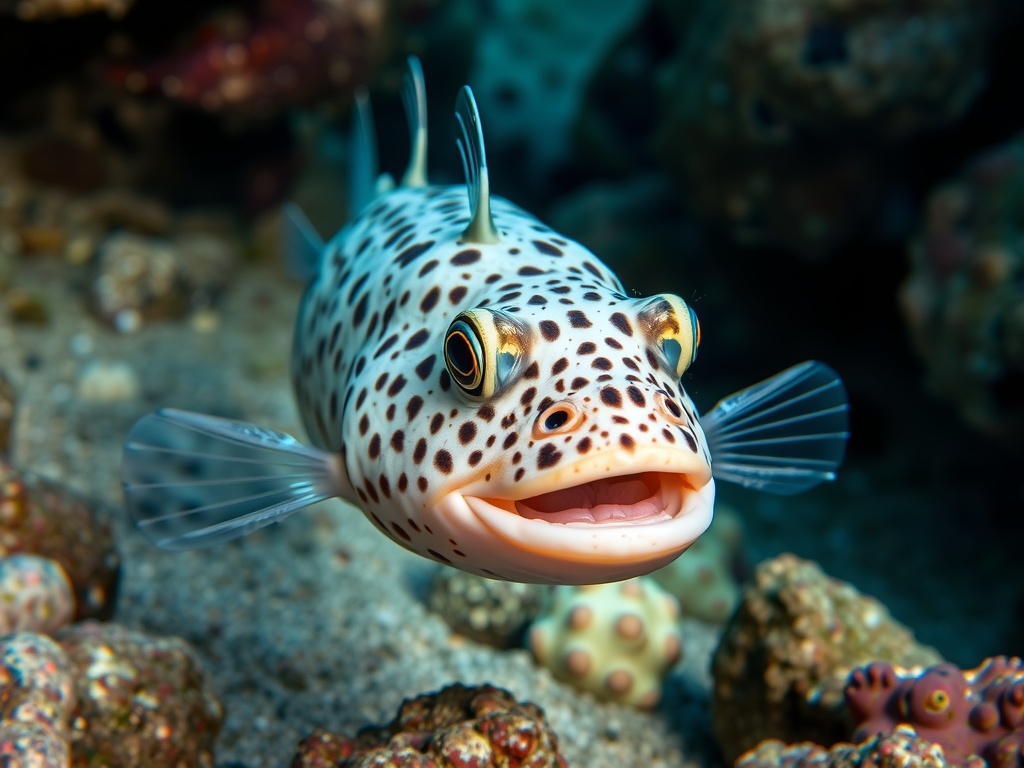
About the Pufferfish
A pufferfish does not inflate with air — it gulps water into a hugely elastic stomach that can expand to many times its resting volume, turning the fish into a sphere far too large and awkward to fit in a predator's mouth. Its body is built to permit it: it has no ribs and no pelvic girdle, structures that in any other fish would fight the expansion. Inflation is a genuine emergency measure rather than a habit — it is stressful and takes time to recover from — and the fish is slow and clumsy to begin with, relying on manoeuvrability instead of speed, which is exactly why such a defence had to evolve. Many species carry tetrodotoxin, one of the most potent natural poisons known and far deadlier by weight than cyanide, concentrated mainly in the liver, gonads and skin. The fish does not make it: the toxin comes from bacteria passed up its food chain, which is why pufferfish raised on a controlled diet are entirely non-toxic. Its teeth are fused into four plates forming a beak that grows continuously and must be worn down on hard-shelled prey. In Japan it is eaten as fugu, prepared only by licensed chefs — a precaution written in the deaths of people who cut corners.
Fascinating facts
Inflation Defense
When threatened, pufferfish rapidly ingest water or air to expand their bodies, making themselves harder for predators to eat.
Potent Toxin
Pufferfish contain tetrodotoxin, a powerful neurotoxin that is lethal to most predators and humans; there is no known antidote.
Fugu Delicacy
In Japan, pufferfish are prepared as 'fugu,' a risky delicacy requiring expert chefs to safely remove toxic organs.
Detailed description
Pufferfish (family Tetraodontidae) are a diverse group of over 190 recognized species, ranging in size from the diminutive dwarf puffer (Carinotetraodon travancoricus) at just 2.5 cm to the giant Mbu puffer (Tetraodon mbu), which can exceed 60 cm in length. Their bodies are typically robust, with a truncated, boxy shape and skin that is often rough or covered in small spines, especially in species that lack scales. Pufferfish are renowned for their unique defense mechanism: when threatened, they rapidly ingest water (or air if out of water), inflating their elastic stomachs to several times their normal size, making them difficult for predators to swallow. Many species possess striking coloration and patterns, which may serve as warning signals (aposematism) to potential predators. Internally, pufferfish have a highly specialized skeleton with fused bones and a beak-like dental structure formed by the fusion of teeth, adapted for crushing hard-shelled prey. Their eyes are large and independently mobile, providing a wide field of vision. Pufferfish are generally solitary, but some species may form loose aggregations during breeding seasons. They are found in a wide range of habitats, from coral reefs and seagrass beds to brackish estuaries and even freshwater rivers in Asia and Africa. Notably, most species contain tetrodotoxin, a potent neurotoxin concentrated in the liver, ovaries, and skin, which is lethal to most predators and humans.
Did you know?
Despite their toxicity, certain species of pufferfish are served as the delicacy 'fugu' in Japan, prepared only by licensed chefs due to the risk of fatal poisoning.
Research & sources
Wikipedia summary
Tetraodontidae is a family of marine and freshwater fish in the order Tetraodontiformes. The family includes many familiar species variously called pufferfish, puffers, balloonfish, blowfish, blowers, blowies, bubblefish, globefish, swellfish, toadfish, toadies, toadle, honey toads, sugar toads, and sea squab. They are morphologically similar to the closely related porcupinefish, which have large external spines.
Behaviour & social structure
Pufferfish are primarily diurnal, spending daylight hours foraging among rocks, coral, and sand for a varied diet that includes mollusks, crustaceans, algae, and occasionally other fish. Their strong, beak-like jaws allow them to crack open hard-shelled prey such as snails and crabs. Most species are solitary and territorial, using visual displays and body postures to ward off intruders. When threatened, they exhibit a rapid inflation response, often accompanied by the erection of dermal spines in some species. Some pufferfish also display cryptic coloration or bury themselves in sand to avoid detection. Social interactions are generally limited outside of the breeding season, although some species may aggregate in specific habitats. Pufferfish have been observed using tools, such as manipulating rocks to open shells, and some Japanese species (Torquigener spp.) are famous for creating intricate circular patterns in the sand as part of courtship displays.
Reproduction & life cycle
Pufferfish exhibit a variety of reproductive strategies, but most are oviparous, with external fertilization. Spawning typically occurs in shallow waters during specific seasons, often triggered by lunar cycles or water temperature changes. Males may court females with visual displays or by constructing nests, as seen in some Torquigener species. Females lay hundreds to thousands of adhesive eggs, which are fertilized externally. In some species, males guard the eggs until hatching, fanning them with their fins to provide oxygen and deter predators. Incubation periods range from several days to a week, depending on water temperature. Larvae are planktonic and undergo several developmental stages before settling to the substrate. Parental care is generally limited, though a few species exhibit nest-guarding behavior.
Adaptations & survival
Pufferfish possess several remarkable adaptations for survival. Their most famous is the inflation mechanism, enabled by highly elastic stomachs and specialized musculature. The presence of tetrodotoxin, produced by symbiotic bacteria and accumulated in their tissues, provides chemical defense against predation. Their fused, beak-like teeth are uniquely adapted for crushing hard-shelled prey, allowing them to exploit ecological niches unavailable to many other fish. Many species exhibit cryptic coloration or disruptive patterns for camouflage, while others display bright warning colors. Their skin is often thick and tough, with some species developing sharp spines that become erect when the fish is inflated. Pufferfish also have highly developed vision, with independently moving eyes that enhance predator detection and prey location.
Cultural significance
Pufferfish hold significant cultural value in East Asia, particularly in Japan, where the preparation and consumption of fugu is both a delicacy and a culinary art requiring licensed chefs due to the risk of tetrodotoxin poisoning. In folklore, pufferfish are often symbols of danger, transformation, or resilience. Their unique appearance and behaviors have inspired art, literature, and mythology in various cultures. In traditional medicine, pufferfish organs have been used (often dangerously) for purported health benefits. The pufferfish's ability to inflate has also made it a popular motif in children's media and aquarium displays worldwide.
Recent research
Recent research has focused on the biosynthesis and ecological role of tetrodotoxin, revealing that the toxin is not produced by the fish themselves but by symbiotic bacteria acquired through diet. Studies of pufferfish genomes have provided insights into their rapid evolutionary radiation and unique adaptations, such as their reduced vertebral numbers and specialized dentition. Behavioral research has documented complex courtship behaviors, including the construction of geometric sand patterns by male Torquigener pufferfish, which are among the most elaborate animal structures known. Conservation genetics studies are ongoing to assess population structure and inform management of threatened species. Additionally, tetrodotoxin is being investigated for potential medical applications, including as a painkiller and in cancer research.
Videos
Habitat
Coastal marine waters, reefs, and estuaries


Conservation
The Pufferfish is currently classified as Least Concern on the IUCN Red List.
Threats & challenges
While many pufferfish populations are stable, several species face localized threats from habitat loss, overfishing (especially for the aquarium trade and for consumption as delicacies), and pollution. Coastal development and coral reef degradation reduce available habitat, while some freshwater species are threatened by water pollution and damming. Bycatch in fisheries and targeted capture for the preparation of fugu (a Japanese delicacy) also impact certain populations. Climate change and ocean acidification pose long-term threats to their habitats. Despite these challenges, most species are currently listed as Least Concern by the IUCN, though some, such as the Chinese puffer (Takifugu chinensis), are considered critically endangered due to overexploitation.
Taxonomy
Scientific name
Tetraodontidae (family includes multiple genera and species)
- Kingdom
- Animalia
- Phylum
- Chordata
- Class
- Actinopterygii
- Order
- Tetraodontiformes
- Family
- Tetraodontidae
- Genus
- Varies (e.g., Tetraodon, Takifugu, Arothron)
- Species
- Varies
Community notes
Share your observations about the Pufferfish.
No community notes yet. Be the first!
Discover more wildlife
More fascinating animals from the encyclopedia.