
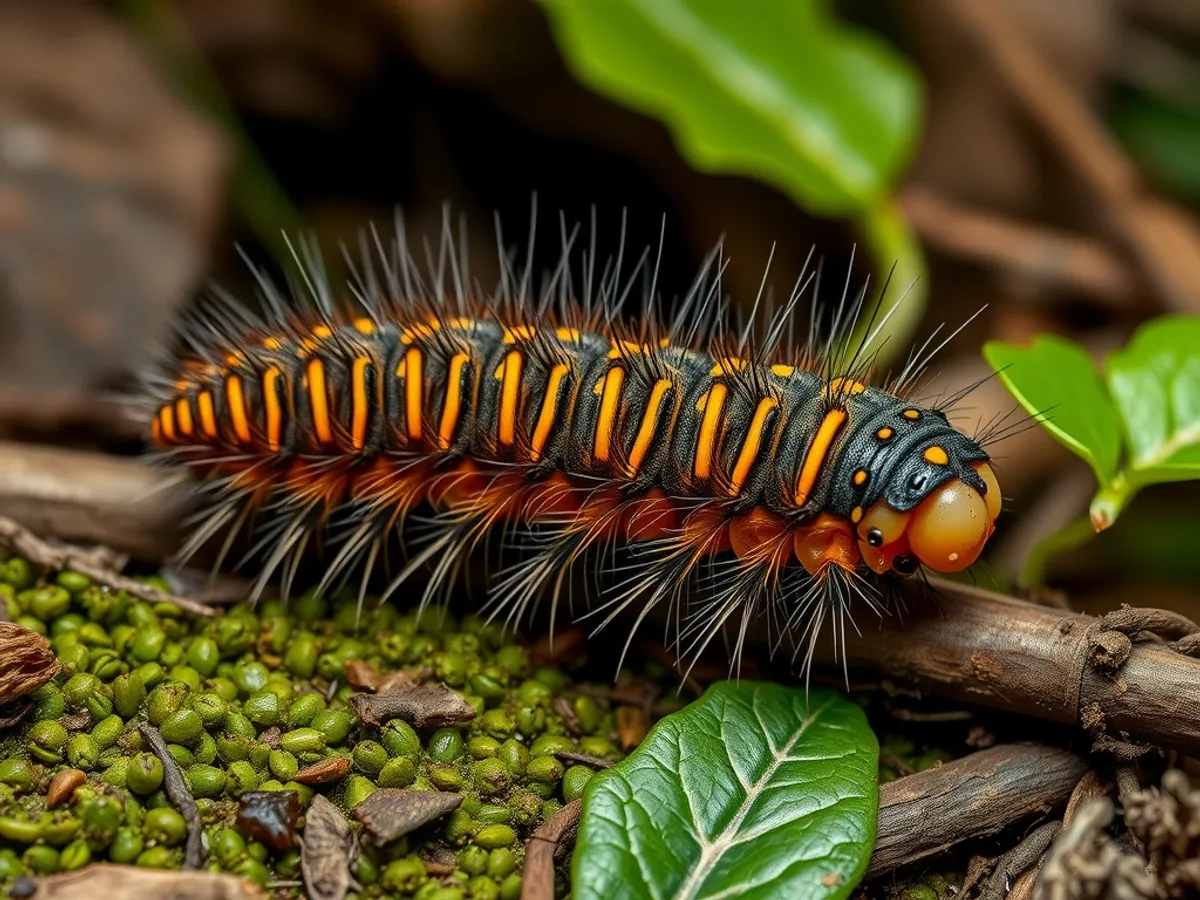
About the Puss caterpillar
The puss caterpillar, also known as the southern flannel moth larva, is one of the most venomous caterpillars in North America. Covered in long, silky hair that resembles a Persian cat, its soft appearance hides venomous spines that can cause severe pain if touched. This caterpillar is typically found on shade trees and shrubs in the southeastern United States, particularly in Texas and Florida. The adult stage is a moth with a furry appearance, but the caterpillar is infamous for its potent sting and unique looks.
Fascinating facts
Venomous Defense
Underneath its soft, hairy exterior, the puss caterpillar has venomous spines that release toxins when touched, causing intense pain and other symptoms.
Tree Dweller
This caterpillar is most often found on oak, elm, and citrus trees in forests and suburban landscapes.
Moth Metamorphosis
The puss caterpillar transforms into the southern flannel moth, which is covered in dense, fuzzy scales and is much less threatening than its larval stage.
Detailed description
The puss caterpillar (Megalopyge opercularis) is the larval stage of the southern flannel moth, notable for its dense, silky setae that give it a plush, furry appearance reminiscent of a Persian cat. Measuring 2–3 cm in length at maturity, the caterpillar’s body is concealed beneath these long hairs, which hide venomous spines capable of delivering a potent sting. The coloration varies from pale yellow to gray or reddish-brown, often with a darker dorsal line. The head is small and retracted, making it difficult to distinguish from the rest of the body. As a larva, it moves slowly and is solitary, feeding on the foliage of a wide range of deciduous trees and shrubs, including oak, elm, sycamore, and citrus. The adult moth, emerging after pupation, is about 2.5–3.5 cm in wingspan, with thick, wavy fur and orange to yellow coloration, especially on the legs and body. The moths are nocturnal and are attracted to lights at night. The species undergoes complete metamorphosis, with the larval stage being the most conspicuous and medically significant due to its venomous spines. The caterpillar's cryptic coloration and soft appearance serve as both camouflage and a deceptive warning to potential predators.
Did you know?
The pain from a puss caterpillar sting has been compared to a broken bone or blunt-force trauma, making it one of the most painful stings of any North American insect.
Research & sources
Wikipedia summary
Megalopyge opercularis is a moth of the family Megalopygidae. It has numerous common names, including southern flannel moth for its adult form, and puss caterpillar, asp, Italian asp, fire caterpillar, woolly slug, opossum bug, puss moth, tree asp, or asp caterpillar.
Behaviour & social structure
Puss caterpillars are primarily solitary and do not exhibit social behaviors such as aggregation or cooperative feeding. They are diurnal feeders, consuming leaves during the day and resting on the undersides of foliage to avoid detection. Their slow, deliberate movement minimizes attention from predators. When threatened or disturbed, the caterpillar does not display warning behaviors but relies on its cryptic appearance and the deterrent effect of its venomous spines. The adult moths are nocturnal, emerging at dusk to mate and lay eggs. Adults do not feed and have a short lifespan, typically living only a few days post-emergence. Larvae are most active during late summer and early fall, coinciding with peak host plant foliage.
Reproduction & life cycle
Megalopyge opercularis undergoes sexual reproduction, with adults mating shortly after emergence. Females lay clusters of 50–150 eggs on the underside of host plant leaves, usually in late spring to early summer. The eggs hatch in 7–10 days, and the larvae pass through 5–7 instars over a period of 4–6 weeks. Pupation occurs in a tough, silken cocoon attached to bark or leaf litter, where the pupa may overwinter, especially in northern parts of its range. There is generally one generation per year in the northern range, but up to two or more in warmer southern areas. There is no parental care; after oviposition, the female moth dies, and the larvae are independent from hatching.
Adaptations & survival
The most distinctive adaptation of the puss caterpillar is its dense covering of urticating hairs, which conceal venomous spines connected to glandular sacs. Upon contact, these spines break off and inject a complex venom containing thermolabile proteins, histamines, and other bioactive compounds, causing intense pain, swelling, and sometimes systemic symptoms in humans and predators. The soft, furry appearance mimics inedible or harmless objects, providing camouflage and a deceptive warning. The caterpillar’s slow movement and cryptic coloration further reduce predation risk. The cocoon is reinforced with silk and urticating hairs, offering protection during the vulnerable pupal stage. Adults possess thick, insulating scales that may help reduce water loss and provide some protection from predators.
Cultural significance
The puss caterpillar has a notable place in regional folklore and public health advisories in the southeastern United States, where its sting is well-known and feared. It is sometimes referenced in local myths as a harbinger of bad luck or as a cautionary example for children. The caterpillar’s sting has led to its inclusion in medical literature and public awareness campaigns. Despite its notoriety, there are no known traditional uses or symbolic roles in indigenous cultures. Its striking appearance has made it a subject of interest for naturalists and educators.
Recent research
Recent research has focused on the biochemical composition of the caterpillar’s venom, revealing a complex mixture of proteins and peptides with neurotoxic and inflammatory effects. Studies have documented the medical outcomes of stings, including rare cases of systemic reactions such as lymphadenopathy, nausea, and difficulty breathing. Ongoing research is investigating the ecological role of the venom in predator deterrence and its potential applications in pharmacology. There is also interest in the species’ response to climate change, with citizen science projects tracking its range expansion. Genetic studies are underway to clarify the phylogenetic relationships within the Megalopygidae family.
Videos
Habitat
Deciduous forests and wooded urban areas


Conservation
The Puss caterpillar is currently classified as Least Concern on the IUCN Red List.
Threats & challenges
Currently, Megalopyge opercularis is not considered threatened and is classified as Least Concern. However, populations can be locally affected by habitat loss due to urban development, pesticide use, and removal of host trees. Outbreaks may occur in urban areas, leading to increased human-caterpillar encounters and subsequent pest control measures. Natural predators include birds, parasitic wasps, and tachinid flies, though the caterpillar’s defenses limit predation. Climate change may influence the range and phenology of the species, potentially expanding its distribution northward. There are no significant conservation programs targeting this species, but monitoring is recommended in areas where outbreaks pose a risk to public health.
Taxonomy
Scientific name
Megalopyge opercularis
- Kingdom
- Animalia
- Phylum
- Arthropoda
- Class
- Insecta
- Order
- Lepidoptera
- Family
- Megalopygidae
- Genus
- Megalopyge
- Species
- opercularis
Community notes
Share your observations about the Puss caterpillar.
No community notes yet. Be the first!
Discover more wildlife
More fascinating animals from the encyclopedia.