
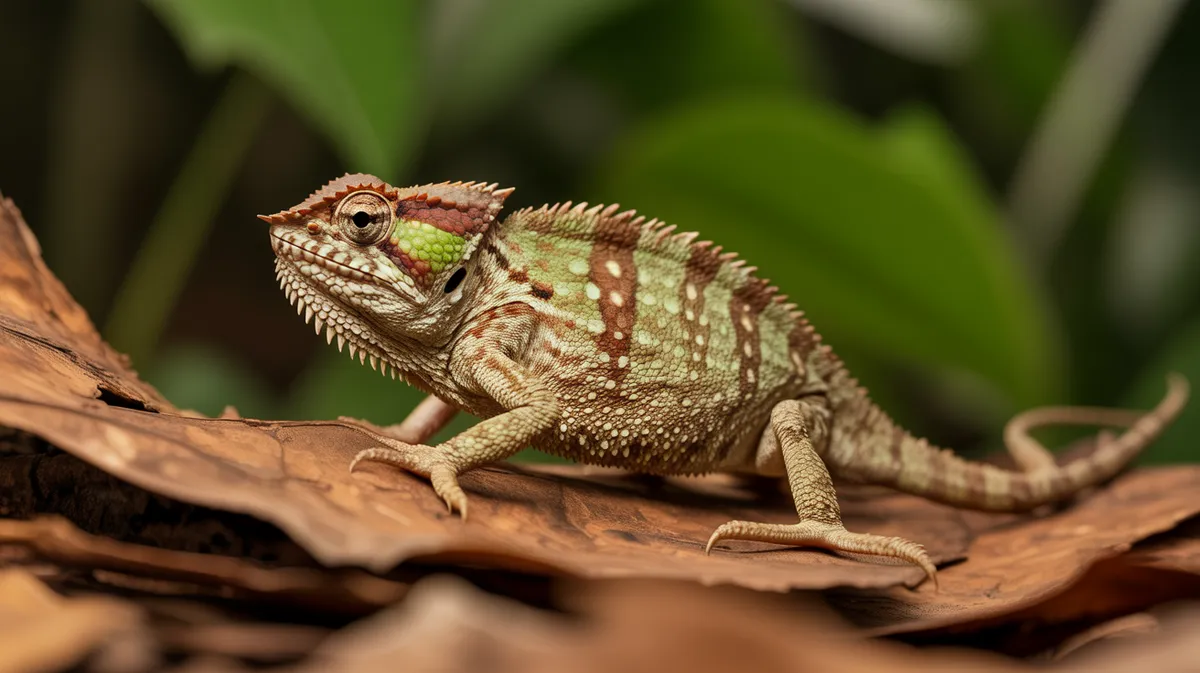
About the Pygmy Leaf Chameleon
The pygmy leaf chameleon is one of the smallest chameleons in the world, native to the rainforests of Madagascar. Its cryptic, leaf-like appearance helps it blend seamlessly into the leaf litter on the forest floor, making it difficult for predators to spot. Unlike other chameleons, it rarely climbs high into trees and spends most of its life scurrying among fallen leaves and twigs. Its diminutive size, intricate camouflage, and calm demeanor make it a fascinating example of adaptation to its unique environment.
Fascinating facts
Master of Disguise
Its flattened, mottled body and tiny size make the pygmy leaf chameleon almost indistinguishable from a dead leaf on the forest floor.
Tiny Predator
It feeds on small insects and invertebrates, ambushing prey with its sticky tongue despite its minuscule size.
Endemic to Madagascar
The pygmy leaf chameleon is found only in Madagascar, where it inhabits limited rainforest patches that are increasingly threatened by deforestation.
Detailed description
The Pygmy Leaf Chameleon (Brookesia minima) is among the smallest chameleons in the world, with adults typically reaching a total length of just 22–30 mm, making it one of the tiniest terrestrial vertebrates. Its body is laterally compressed and covered in granular scales, providing both physical protection and effective camouflage among the rainforest leaf litter. The coloration ranges from various shades of brown to gray, often with subtle patterns that mimic decaying leaves and twigs. Unlike most chameleons, B. minima has a relatively short, non-prehensile tail and reduced cranial ornamentation, reflecting its terrestrial lifestyle. Its eyes are large and independently mobile, allowing for a wide field of vision to detect prey and predators. The limbs are short but robust, adapted for maneuvering through dense ground cover rather than climbing. This species is primarily nocturnal, spending daylight hours hidden beneath leaves or debris and becoming active at dusk. Its small size and cryptic appearance are crucial for avoiding predation by birds, snakes, and small mammals. The Pygmy Leaf Chameleon is endemic to the lowland rainforests of Nosy Be and adjacent areas in northwest Madagascar, where it occupies a highly specialized ecological niche within the forest floor microhabitat.
Did you know?
Despite its tiny size, the pygmy leaf chameleon can hunt and eat insects nearly as large as its own head!
Research & sources
Behaviour & social structure
Brookesia minima exhibits solitary and secretive behavior, rarely interacting with conspecifics outside of the breeding season. It is a sit-and-wait predator, relying on its camouflage to remain undetected while scanning for small invertebrates such as mites, springtails, and tiny insects. When prey is detected, it uses a rapid ballistic tongue projection to capture food, a hallmark of chameleon feeding behavior. Activity peaks during crepuscular and nocturnal hours, with individuals often found perched on low vegetation or leaf litter at night, possibly to avoid ground-dwelling predators and excessive moisture. During the day, they remain motionless and hidden. Territoriality is minimal due to low population densities and limited home ranges, but males may display subtle posturing or color changes when encountering rivals. Defensive behaviors include freezing, color modulation, and, if threatened, dropping to the ground and remaining motionless.
Reproduction & life cycle
Breeding in B. minima is seasonal, typically coinciding with the onset of the rainy season (November to March), which ensures optimal humidity and food availability for hatchlings. Courtship involves subtle head-bobbing and body posturing by males to attract females. After mating, females lay a clutch of 1–2 eggs, which is typical for such a small species. The eggs are deposited in moist leaf litter or under decaying logs, where they are concealed from predators and desiccation. Incubation lasts approximately 60–70 days, depending on ambient temperature and humidity. There is no parental care post-oviposition; hatchlings are fully independent and resemble miniature adults. Sexual maturity is reached within 6–12 months, allowing for rapid population turnover in favorable conditions.
Adaptations & survival
Key adaptations of the Pygmy Leaf Chameleon include extreme miniaturization, which allows exploitation of microhabitats inaccessible to larger predators and competitors. Its cryptic coloration and granular skin texture provide exceptional camouflage among leaf litter, reducing predation risk. The independently mobile eyes offer a panoramic view for detecting prey and threats without moving the body. The reduced, non-prehensile tail and robust limbs are specialized for terrestrial locomotion, contrasting with the arboreal adaptations of most chameleons. Its slow, deliberate movements and tendency to freeze when threatened further enhance its ability to avoid detection. Physiologically, B. minima is adapted to high humidity and stable temperatures typical of rainforest floors.
Cultural significance
Brookesia minima holds limited direct significance in Malagasy culture, largely due to its diminutive size and secretive habits. However, chameleons in general are often regarded with curiosity and sometimes superstition in Madagascar, where they are believed to possess mystical qualities or serve as omens. There is no known traditional use of this species in medicine or folklore, and it is not commonly featured in local art or mythology. Its primary significance today lies in its role as a flagship species for rainforest conservation and as an object of scientific interest due to its extreme miniaturization.
Recent research
Recent research on Brookesia minima and related species has focused on miniaturization and its evolutionary implications, revealing unique morphological and physiological adaptations associated with extreme body size reduction. Molecular phylogenetic studies have clarified the relationships within the Brookesia genus, highlighting the high levels of endemism and cryptic diversity in Madagascar's chameleons. Ongoing field studies are investigating microhabitat preferences, population densities, and responses to habitat disturbance. Notably, a 2012 revision of the Brookesia minima group led to the description of several new microendemic species, underscoring the need for targeted conservation. Advances in imaging and genetic analysis continue to shed light on the developmental biology and evolutionary history of these remarkable reptiles.
Sources
A revision of the genus Brookesia from northern Madagascar, with descriptions of new species (Squamata: Chamaeleonidae)
Frank Glaw, Jörn Köhler, Ted M. Townsend, Miguel Vences (2012)
scientificBrookesia minima: The IUCN Red List of Threatened Species 2014
IUCN SSC Chameleon Specialist Group
conservationA revision of the genus Brookesia from Madagascar, including descriptions of new species
Raxworthy, C.J. & Nussbaum, R.A. (1995)
scientificBrookesia minima: The IUCN Red List of Threatened Species 2020
IUCN SSC Chameleon Specialist Group
conservationVideos
Habitat
Rainforest leaf litter


Conservation
The Pygmy Leaf Chameleon is currently classified as Near Threatened on the IUCN Red List.
Threats & challenges
The primary threats to Brookesia minima are habitat loss and fragmentation due to deforestation, agriculture, and expanding human settlements in Madagascar. Its restricted range and specialized habitat requirements make it particularly vulnerable to environmental changes. Illegal collection for the international pet trade, though less common than for larger chameleons, poses an additional risk. Climate change, leading to altered rainfall patterns and microhabitat conditions, may further threaten its survival. Population trends are difficult to assess due to the species' cryptic nature and limited distribution, but ongoing habitat degradation suggests a declining trend. Conservation efforts focus on habitat protection and regulation of trade, but enforcement remains challenging.
Taxonomy
Scientific name
Brookesia minima
- Kingdom
- Animalia
- Phylum
- Chordata
- Class
- Reptilia
- Order
- Squamata
- Family
- Chamaeleonidae
- Genus
- Brookesia
- Species
- minima
Where to see a pygmy leaf chameleon
1 zoo and aquarium in 1 country are recorded as keeping this species.

Community notes
Share your observations about the Pygmy Leaf Chameleon.
No community notes yet. Be the first!
Discover more wildlife
More fascinating animals from the encyclopedia.