
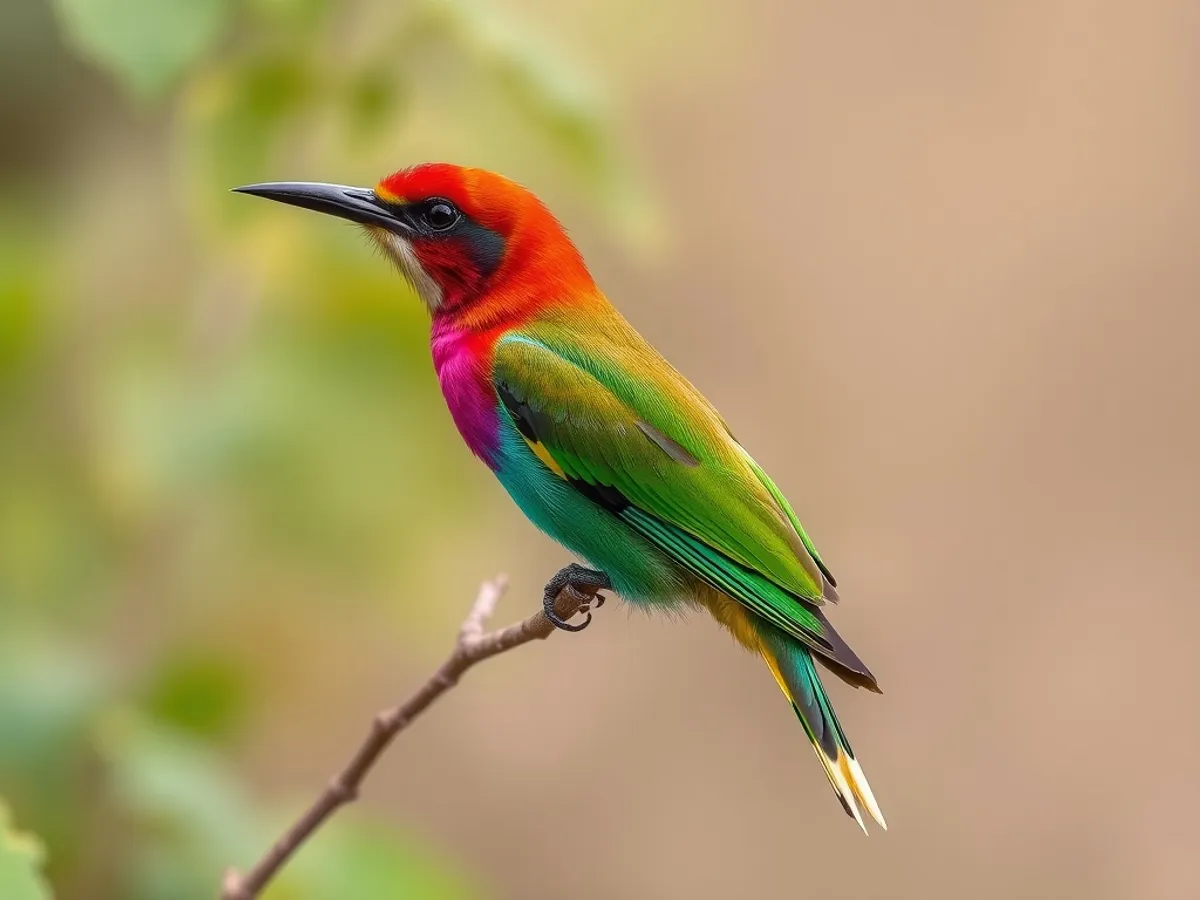
About the Rainbow Bee-eater
The Rainbow Bee-eater is a vividly colored bird known for its striking plumage, featuring a blend of green, blue, orange, and gold. It is slender and graceful, with a long, pointed bill, red eyes, and elongated central tail feathers. Native to Australia and nearby islands, this bird is commonly found in open woodlands, forests, and along riverbanks. Rainbow Bee-eaters are highly social and are often seen perching together or performing acrobatic aerial maneuvers to catch flying insects. Their beauty and agile flight make them a favorite among birdwatchers.
Fascinating facts
Brilliant Plumage
The Rainbow Bee-eater's feathers display a dazzling spectrum of colors, making it one of Australia's most colorful birds.
Diet of Stingers
Their primary diet consists of bees and wasps, which they expertly handle and de-sting before consumption.
Burrow Nesters
They dig tunnels up to a meter long in sandy banks or flat ground to create nests, where both parents share incubation and feeding duties.
Detailed description
The Rainbow Bee-eater (Merops ornatus) is a medium-sized, slender bird measuring 19–24 cm in length, including its distinctive elongated central tail feathers, and weighing approximately 25–30 grams. Its plumage is a striking mosaic of iridescent green on the back and wings, turquoise-blue on the rump and underparts, and golden-orange on the throat and crown, with a prominent black eye-stripe and red eyes. The bill is long, slender, and slightly down-curved, perfectly adapted for catching flying insects. Males and females are similar in appearance, though males typically have longer tail streamers. This species is highly aerial, with pointed wings and a deeply forked tail that facilitate agile, acrobatic flight. Rainbow Bee-eaters are often observed in small flocks, perching conspicuously on wires or branches. Their vocalizations are soft, rolling 'prrreee' or 'trill' calls, used for communication within groups. They are migratory, breeding in southern Australia and migrating northwards to northern Australia, New Guinea, and parts of Indonesia during the austral winter. The species is diurnal and spends much of its day hunting on the wing, returning to communal roosts at dusk.
Did you know?
Before eating a bee or wasp, the Rainbow Bee-eater skillfully removes the sting by repeatedly hitting the insect against a hard surface.
Research & sources
Wikipedia summary
The rainbow bee-eater is a near passerine bird in the bee-eater family Meropidae.
Behaviour & social structure
Rainbow Bee-eaters exhibit complex social behaviors, often forming loose colonies during the breeding season and roosting communally at night. They are highly territorial around nesting sites, engaging in aerial chases to defend their burrows. Their foraging behavior is characterized by 'sallying'—darting from a perch to snatch flying insects, especially bees, wasps, and dragonflies, which they catch with precision in mid-air. Before consumption, they return to a perch and repeatedly strike the insect against a hard surface to remove stingers and venom. Daily routines include periods of sunning and dust-bathing, which help maintain feather condition and control parasites. Vocal communication is frequent, with calls serving to coordinate group movements and alert others to predators. During migration, they travel in flocks, sometimes covering hundreds of kilometers between breeding and non-breeding grounds.
Reproduction & life cycle
Breeding occurs from September to January in southern Australia, with timing varying by latitude. Rainbow Bee-eaters are monogamous for the breeding season, and pairs cooperate in excavating a horizontal tunnel—up to 1 meter long—into sandy banks, riverbanks, or flat ground. The female lays 3–7 spherical white eggs in a chamber at the tunnel's end. Both parents, and occasionally helpers (usually offspring from previous broods), participate in incubation (about 20–24 days) and feeding the chicks. Nestlings are altricial and remain in the burrow for 3–4 weeks after hatching, during which they are fed a diet of insects. Fledglings are dependent on adults for several weeks post-emergence, gradually learning to hunt and integrate into social groups.
Adaptations & survival
Rainbow Bee-eaters possess several adaptations for their aerial insectivorous lifestyle. Their acute binocular vision allows precise targeting of fast-moving prey. The long, pointed wings and forked tail enhance maneuverability and speed in flight. The specialized bill shape aids in seizing and manipulating insects, while behavioral adaptations—such as removing stingers—reduce the risk of injury from venomous prey. Their burrowing nesting strategy provides protection from predators and environmental extremes. Seasonal migration enables them to exploit different habitats and food resources throughout the year, reducing competition and exposure to harsh climates.
Cultural significance
In Australian Aboriginal cultures, the Rainbow Bee-eater is sometimes associated with rainbows and is admired for its vibrant coloration and graceful flight. It features in local folklore as a symbol of beauty and agility. The bird is a favorite among birdwatchers and nature enthusiasts, contributing to ecotourism in regions where it is common. There are no known traditional uses of the species in medicine or crafts, but its presence is often considered an indicator of healthy, insect-rich environments.
Recent research
Recent research on Rainbow Bee-eaters has focused on their migratory connectivity, using geolocator tracking to map long-distance movements between breeding and non-breeding areas. Studies have also examined cooperative breeding behaviors, revealing that helpers at the nest can significantly increase reproductive success. Investigations into their diet have highlighted their role in controlling populations of pest insects, including agricultural pests. Ongoing research is exploring the impacts of climate change and habitat modification on their migration timing and breeding phenology. Genetic studies are providing insights into population structure and dispersal across their range.
Videos
Habitat
Open woodland, forest edges, riverbanks, sand ridges, and farmlands


Conservation
The Rainbow Bee-eater is currently classified as Least Concern on the IUCN Red List.
Threats & challenges
Currently assessed as Least Concern by the IUCN, Rainbow Bee-eater populations are stable and widespread. However, local threats include habitat loss due to land clearing, riverbank erosion, and disturbance of nesting sites by human activity, livestock, and introduced predators such as cats and foxes. Pesticide use can reduce insect prey availability and pose direct toxicity risks. Climate change may alter migration patterns and breeding success by affecting rainfall and habitat quality. Despite these challenges, the species' adaptability and wide range help buffer against significant declines.
Taxonomy
Scientific name
Merops ornatus
- Kingdom
- Animalia
- Phylum
- Chordata
- Class
- Aves
- Order
- Coraciiformes
- Family
- Meropidae
- Genus
- Merops
- Species
- ornatus
Where to see a rainbow bee-eater
1 zoo and aquarium in 1 country are recorded as keeping this species.
Community notes
Share your observations about the Rainbow Bee-eater.
No community notes yet. Be the first!
Discover more wildlife
More fascinating animals from the encyclopedia.