
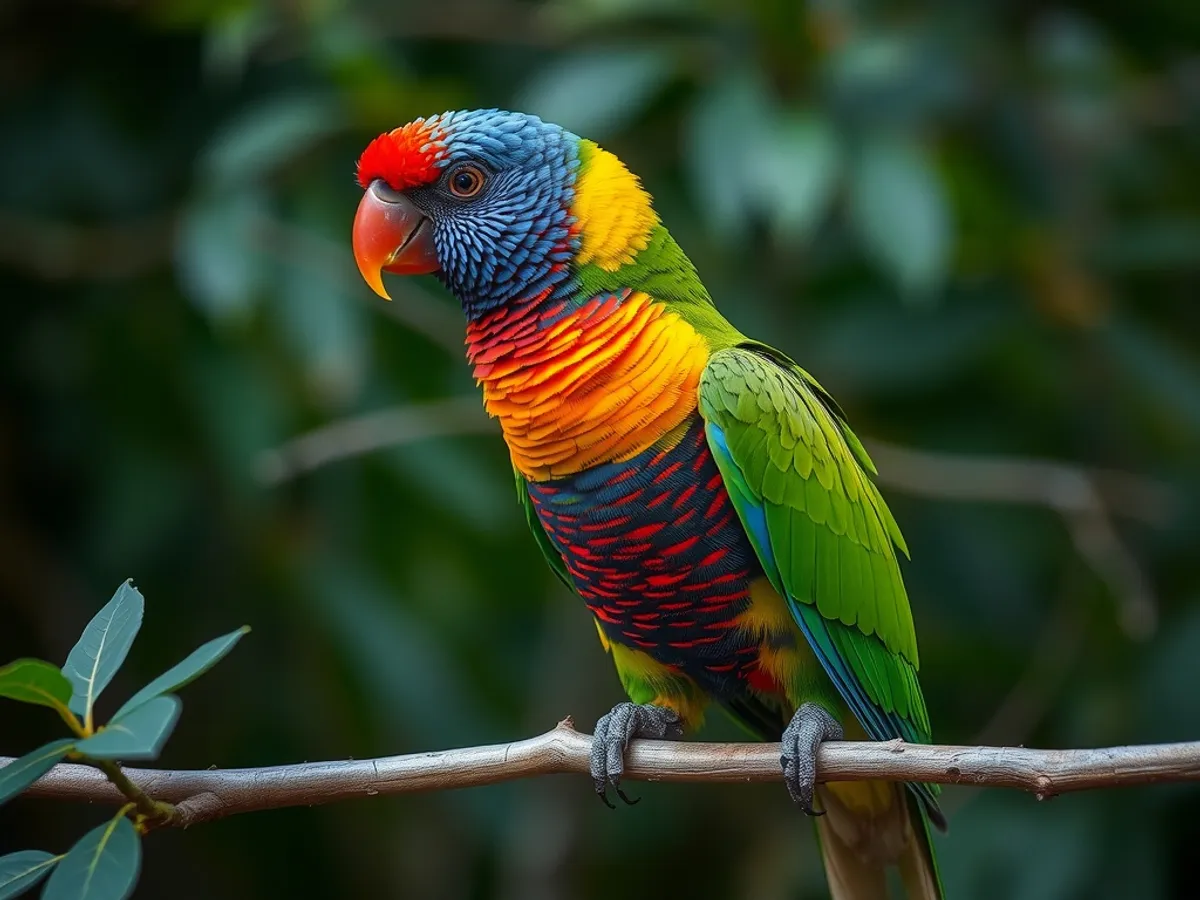
About the Rainbow Lorikeet
Trichoglossus moluccanus does not have the crushing seed-cracking bill of most parrots, and the reason is inside its mouth: the tongue tip carries a brush of erectile papillae that mop up nectar and pollen, and the bird's digestive tract is short, with a thin-walled gizzard, because it processes liquid and pollen rather than hard seeds. Pollen, not nectar, is where it gets protein. This diet makes rainbow lorikeets messy, fast-moving and noisy, and it makes them significant pollinators of eucalypts, banksias and grevilleas along the Australian east coast. Their droppings are correspondingly liquid, which is why keeping one is a notoriously untidy business. They are loud, gregarious and aggressive at flowering trees, chasing off honeyeaters and larger parrots. Feeding them bread and honey water at wildlife parks is now discouraged because it causes nutritional disease and beak deformity. A recurring phenomenon on the east coast is lorikeet paralysis syndrome — birds found unable to fly or blink, in their hundreds, in summer, apparently after eating something not yet definitively identified; most recover with supportive care. Introduced populations are established in Perth, Auckland and Hong Kong, where they are treated as a pest, and they are highly aggressive nest-hollow competitors.
Fascinating facts
Colorful Plumage
Rainbow Lorikeets are named for their brilliant rainbow-colored feathers, which make them one of the most visually striking parrots in the world.
Nectar Feeders
Their brush-tipped tongues are perfectly adapted for feeding on nectar and pollen, setting them apart from most other parrots.
Highly Social
Rainbow Lorikeets are extremely social and are often seen in large, noisy flocks, especially where food is abundant.
Detailed description
The Rainbow Lorikeet (Trichoglossus moluccanus) is a medium-sized parrot, measuring 25–30 cm (10–12 in) in length and weighing approximately 75–157 g (2.6–5.5 oz). Its plumage is among the most vivid of all parrots, with a deep blue head and belly, bright green wings, back, and tail, and an orange-yellow breast band. The bill is orange-red, and the eyes are reddish-brown. Sexual dimorphism is minimal, with males and females appearing nearly identical. Rainbow Lorikeets possess a specialized, brush-tipped tongue (papillae) for efficient nectar and pollen extraction, a unique adaptation among parrots. Their zygodactyl feet (two toes forward, two backward) allow for agile climbing and manipulation of food. Highly vocal and gregarious, they form large, noisy flocks, especially at communal roosts. In flight, they exhibit rapid, direct movement with swift wingbeats. Their diet is primarily nectar and pollen, but they also consume soft fruits, seeds, and occasionally insects. Rainbow Lorikeets are known for their intelligence, playful nature, and ability to learn complex tasks, including mimicry of human sounds.
Did you know?
Unlike many parrots, Rainbow Lorikeets do not eat seeds and instead rely primarily on nectar, making them vital pollinators in their ecosystems.
Research & sources
Wikipedia summary
The rainbow lorikeet is a species of parrot found in Australia. It is common along the eastern seaboard, from northern Queensland to South Australia. Its habitat is rainforest, coastal bush and woodland areas. Six taxa traditionally listed as subspecies of the rainbow lorikeet are now treated as separate species.
Behaviour & social structure
Rainbow Lorikeets are diurnal, with peak activity at dawn and dusk. They spend much of the day foraging, often traveling several kilometers between feeding sites. Their feeding behavior is highly specialized; using their brush-tipped tongues, they lap up nectar and pollen from a wide variety of flowering plants, especially eucalyptus, melaleuca, and grevillea. They supplement their diet with fruit, berries, and seeds, and occasionally feed on cultivated crops, leading to conflicts with farmers. Socially, they are highly interactive, engaging in mutual preening, play, and vocalizations within flocks. They exhibit strong pair bonds, often seen in monogamous pairs even within larger groups. Communal roosting sites can host hundreds of individuals, and their calls are loud, metallic, and varied. Territoriality is pronounced around feeding sites, with aggressive displays and chases to defend resources.
Reproduction & life cycle
Rainbow Lorikeets are seasonally monogamous, typically breeding from August to January in southern Australia, though timing varies with climate and food availability. Courtship involves mutual preening, synchronized movements, and vocalizations. Nests are usually placed in tree hollows, often high above ground, but they may also use artificial structures in urban areas. The female lays 1–3 eggs per clutch, with an incubation period of about 25 days, performed solely by the female. The male provides food during incubation. Chicks are altricial, hatching blind and featherless, and are fed regurgitated food by both parents. Fledging occurs at 7–8 weeks, after which juveniles remain with parents for several weeks before becoming independent. Breeding success is closely tied to the availability of flowering resources.
Adaptations & survival
The most distinctive adaptation of the Rainbow Lorikeet is its brush-tipped tongue, which allows efficient extraction of nectar and pollen from flowers, a trait evolved for their specialized diet. Their strong, curved beak is adapted for manipulating flowers and fruits. Zygodactyl feet enhance climbing ability and dexterity. Their vivid coloration provides camouflage among flowering canopies and may play a role in mate selection. Behavioral adaptations include nomadic movements in response to flowering cycles, communal roosting for predator avoidance, and aggressive defense of feeding territories. Their intelligence and problem-solving skills are advanced, facilitating adaptation to urban environments.
Cultural significance
Rainbow Lorikeets hold a prominent place in Australian culture, celebrated for their beauty and lively presence in urban parks and gardens. They feature in Aboriginal folklore and are often depicted in indigenous art. Their striking appearance and playful behavior have made them popular in aviculture, though wild capture is discouraged. In some urban areas, feeding lorikeets is a popular pastime, though this practice can lead to health issues and dependency. They are symbols of vibrancy and resilience in Australian wildlife, frequently used in tourism and conservation campaigns.
Recent research
Recent research has focused on the lorikeet's role as a pollinator, demonstrating their importance in the reproductive success of native flowering plants. Studies have examined their adaptability to urban environments, revealing behavioral flexibility and dietary shifts. Genetic analyses have clarified the taxonomy of the Trichoglossus genus, leading to the elevation of several former subspecies to full species status. Ongoing research investigates the impact of disease, particularly BFDV, and the effects of supplementary feeding by humans on lorikeet health and population dynamics. Behavioral studies have highlighted their advanced cognitive abilities, including problem-solving and social learning.
Sources
Videos
Habitat
Coastal forests, woodlands, and urban areas


Conservation
The Rainbow Lorikeet is currently classified as Least Concern on the IUCN Red List.
Threats & challenges
Currently classified as Least Concern by the IUCN, Rainbow Lorikeet populations are stable and even increasing in some urban areas. However, they face threats from habitat loss due to deforestation, competition for nesting sites (especially with invasive species like the common myna), and illegal trapping for the pet trade. In some regions, they are considered agricultural pests due to their consumption of commercial fruit crops, leading to culling or exclusion measures. Disease outbreaks, such as beak and feather disease virus (BFDV), pose localized risks. Climate change may alter flowering patterns, impacting food availability. Despite these challenges, their adaptability and generalist feeding habits have facilitated their success in modified landscapes.
Taxonomy
Scientific name
Trichoglossus moluccanus
- Kingdom
- Animalia
- Phylum
- Chordata
- Class
- Aves
- Order
- Psittaciformes
- Family
- Psittaculidae
- Genus
- Trichoglossus
- Species
- moluccanus
Community notes
Share your observations about the Rainbow Lorikeet.
No community notes yet. Be the first!
Discover more wildlife
More fascinating animals from the encyclopedia.