
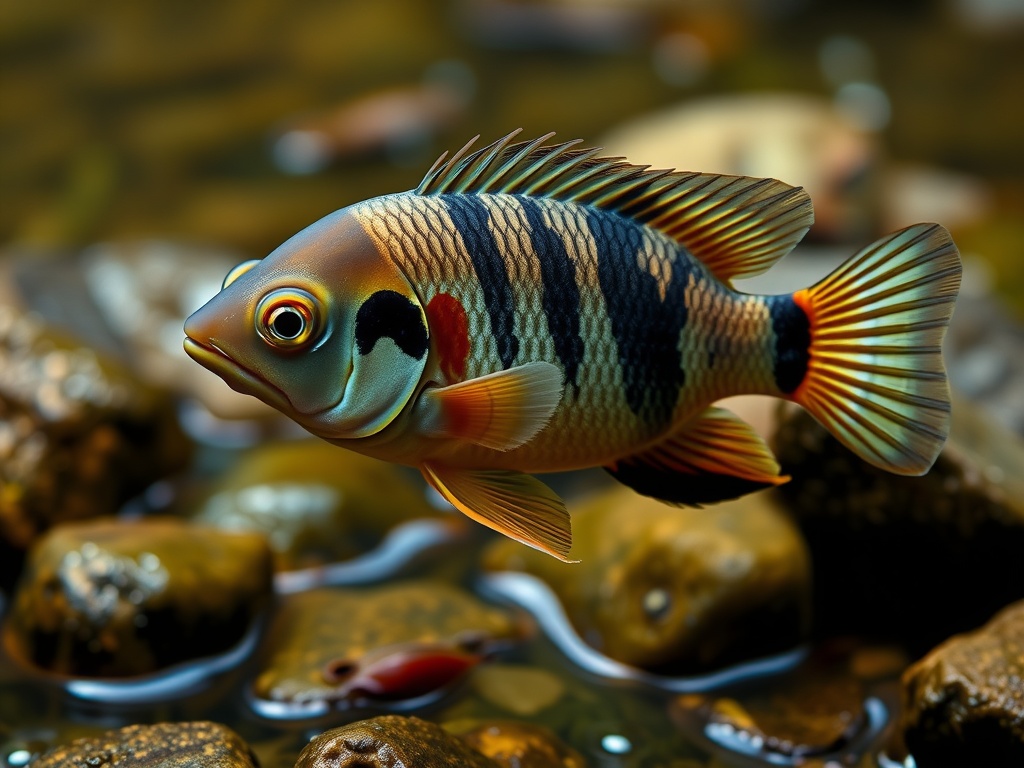
About the Ram cichlid
The Ram cichlid, also known as the German blue ram, is a small, vibrantly colored freshwater fish native to the Orinoco River basin in Venezuela and Colombia. Renowned for its striking blue, yellow, and red hues, it is a popular choice among aquarium enthusiasts due to its peaceful temperament and manageable size. This species prefers densely planted environments with plenty of hiding spots and stable water parameters. Ram cichlids are known for their interesting breeding behaviors, including attentive parental care of their eggs and fry. Despite their beauty, they are sensitive to water quality, making them more suitable for experienced aquarists.
Fascinating facts
Bright Colors
Ram cichlids are famed for their iridescent blue and yellow coloration, making them a standout in home aquariums.
Parental Care
Both male and female Ram cichlids take turns fanning and guarding their eggs, which is unusual among many freshwater fish.
Habitat Preference
They thrive in densely planted tanks that mimic their natural habitat of slow-moving, warm, and slightly acidic waters.
Detailed description
The Ram cichlid (Mikrogeophagus ramirezi) is a small, laterally compressed cichlid, typically reaching 5–7 cm in length, with males generally larger and more elongated than females. Its body exhibits iridescent blue spots, golden-yellow flanks, and a prominent black spot on the mid-body, with red markings on the eyes and fins. Sexual dimorphism is evident: males possess longer dorsal fin extensions and more vivid coloration, while females often display a pinkish belly, especially during breeding. The species is adapted to slow-moving, warm (26–30°C), soft, and slightly acidic waters, reflecting its native Orinoco basin habitat. Ram cichlids are benthopelagic, preferring the lower and mid-water columns of densely vegetated streams and lagoons. Their anatomy features a terminal mouth suited for picking at substrate and aquatic plants, and their laterally compressed bodies facilitate maneuvering through dense aquatic vegetation. Socially, they are generally peaceful but can become territorial during breeding. Their complex courtship and biparental care are notable among cichlids, with both parents guarding eggs and fry. Sensitive to water quality, they require stable, clean conditions, which has implications for both wild populations and aquarium care.
Did you know?
Although popular in aquariums worldwide, wild Ram cichlids are found only in a limited range within the Orinoco River basin of South America.
Research & sources
Wikipedia summary
The ram cichlid is a species of freshwater fish endemic to the Orinoco River basin, in the savannahs of Venezuela and Colombia in South America. The species has been examined in studies on fish behaviour and is a popular aquarium fish, traded under a variety of common names, including ram, blue ram, German blue ram, Asian ram, butterfly cichlid, Ramirez's dwarf cichlid, dwarf butterfly cichlid and Ramirezi. The species is a member of the family Cichlidae and subfamily Geophaginae.
Behaviour & social structure
Ram cichlids are diurnal, exhibiting peak activity during daylight hours. In the wild, they forage for small invertebrates, detritus, and plant matter by sifting through substrate and picking at biofilm. They display complex social behaviors, forming monogamous pairs that defend small territories, especially during breeding. Outside of breeding, they are generally tolerant of conspecifics and other small fish, but males may display ritualized aggression to establish dominance or territory. Courtship involves mutual displays, fin flaring, and substrate cleaning. Their daily routine includes foraging, territory patrol, and, in breeding pairs, tending to eggs or fry. Ram cichlids communicate through body postures, color changes, and fin movements, which play roles in mate selection and social hierarchy.
Reproduction & life cycle
Ram cichlids are oviparous, forming stable monogamous pairs for each breeding cycle. Spawning is typically initiated by the female, who selects and cleans a flat surface (such as a stone or broad leaf) for egg deposition. The female lays 100–300 adhesive eggs, which are immediately fertilized by the male. Both parents guard the eggs, fanning them to ensure oxygenation and removing any unfertilized or fungus-infected eggs. Incubation lasts 40–48 hours at optimal temperatures (27–29°C). After hatching, the fry are moved to shallow depressions excavated by the parents, who continue to guard and guide them for up to two weeks. Parental care is highly developed, with both sexes participating in defense and maintenance of the brood. Breeding can occur year-round in captivity, but in the wild, it may be influenced by seasonal rainfall and water conditions.
Adaptations & survival
Mikrogeophagus ramirezi exhibits several adaptations to its environment. Its laterally compressed body and rounded fins allow for agile movement among dense aquatic vegetation. The species' coloration provides camouflage against dappled light and aquatic plants, while also serving as a signal during social and reproductive interactions. Their terminal mouth and protrusible jaws facilitate efficient foraging on benthic invertebrates and detritus. Behavioral adaptations include monogamous pairing and biparental care, which increase offspring survival in predator-rich environments. Physiologically, they are adapted to soft, acidic water with low mineral content, reflecting the blackwater streams of their native range.
Cultural significance
Ram cichlids have significant cultural and economic value in the global aquarium trade, prized for their vivid coloration and engaging behaviors. Selective breeding has produced numerous color morphs, such as the 'German Blue Ram' and 'Electric Blue Ram,' which are popular among aquarists. The species is also a model organism in behavioral and ecological research, contributing to studies on parental care, mate choice, and social dynamics in cichlids. In their native range, they are not known to have specific roles in folklore or traditional practices.
Recent research
Recent research on Mikrogeophagus ramirezi has focused on its complex social and reproductive behaviors, including the neuroendocrine mechanisms underlying biparental care. Studies have examined the effects of environmental stressors, such as water quality and temperature fluctuations, on reproductive success and immune function. The species is also used in investigations of sexual selection, with experiments demonstrating female preference for males with more intense coloration and larger fin extensions. Genetic studies have explored population structure and the impact of selective breeding on genetic diversity in captive strains. Ongoing research addresses the species' sensitivity to pollutants and its potential as a bioindicator for freshwater ecosystem health.
Videos
Habitat
Slow-moving freshwater streams and pools


Conservation
The Ram cichlid is currently classified as Least Concern on the IUCN Red List.
Threats & challenges
While currently classified as Least Concern by the IUCN, wild populations of Ram cichlids face localized threats from habitat degradation, water pollution, and collection for the aquarium trade. Deforestation and agricultural runoff in the Orinoco basin can alter water chemistry and reduce suitable habitats. Overharvesting for the aquarium industry has historically impacted some populations, though most aquarium specimens are now captive-bred. The species is sensitive to changes in water quality, making it vulnerable to environmental disturbances. Climate change and hydrological alterations in the Orinoco basin may pose future risks.
Taxonomy
Scientific name
Mikrogeophagus ramirezi
- Kingdom
- Animalia
- Phylum
- Chordata
- Class
- Actinopterygii
- Order
- Cichliformes
- Family
- Cichlidae
- Genus
- Mikrogeophagus
- Species
- ramirezi
Community notes
Share your observations about the Ram cichlid.
No community notes yet. Be the first!
Discover more wildlife
More fascinating animals from the encyclopedia.