
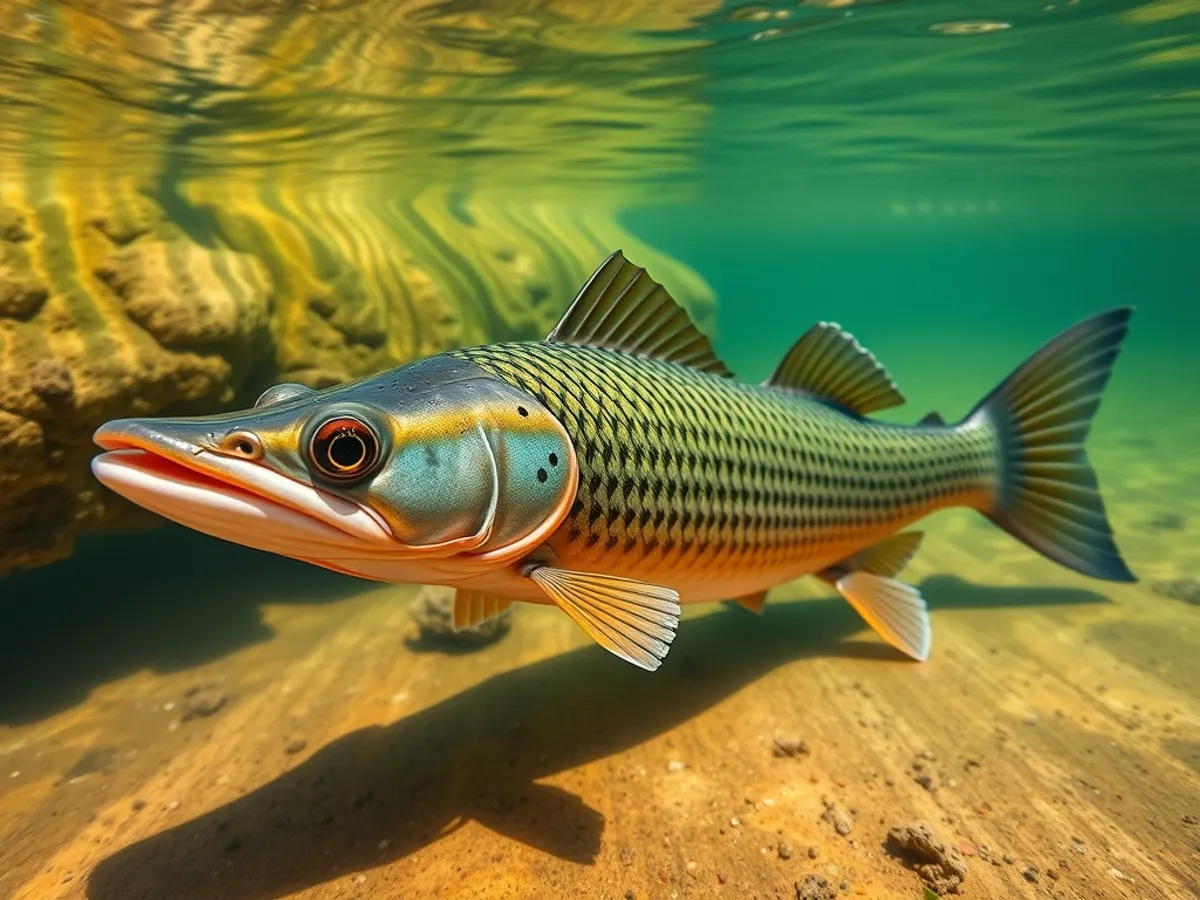
About the Razorback sucker
The razorback sucker is a large, long-lived freshwater fish native to the Colorado River Basin in the southwestern United States and northern Mexico. It is easily recognized by the sharp, keel-like ridge that runs along the top of its back, hence its name. Adapted to large, turbulent rivers, the razorback sucker has a streamlined body, olive to brown coloration, and a ventrally located mouth suited for bottom-feeding. Once abundant, its populations have declined dramatically due to habitat modification, introduction of non-native species, and water diversion. Conservation efforts are ongoing to preserve this unique species.
Fascinating facts
Unique Dorsal Ridge
The razorback sucker gets its name from the pronounced, sharp ridge that runs along the top of its back, making it instantly recognizable among North American freshwater fish.
River Specialist
This species is specially adapted to survive in the swift, muddy waters of large desert rivers, tolerating fluctuating temperatures and salinity.
Ancient Lineage
Razorback suckers have existed for millions of years, with fossil evidence tracing their lineage back at least 3 million years in the Colorado River system.
Detailed description
The razorback sucker (Xyrauchen texanus) is a robust, deep-bodied freshwater fish distinguished by a prominent, sharp dorsal keel located between the nape and dorsal fin, giving the species its common name. Adults typically reach lengths of 40–80 cm (16–31 in), with some individuals growing up to 91 cm (36 in), and can weigh over 6 kg (13 lbs). The body coloration ranges from olive or brown dorsally to yellowish or white ventrally, with mature males developing a brighter yellow or orange hue along the sides and belly during the breeding season. The mouth is ventrally positioned and equipped with thick, fleshy lips, adapted for scraping algae, detritus, and small invertebrates from substrates. Razorback suckers are long-lived, with documented lifespans exceeding 40 years in the wild. Their eyes are relatively small, and the dorsal fin is high and falcate, aiding in stabilization within fast-flowing river currents. The species is primarily benthic, spending much of its time near the bottom of large rivers and reservoirs. Juveniles and adults exhibit different habitat preferences, with young fish utilizing shallow, vegetated backwaters for protection, while adults favor deeper, open channels. Razorback suckers are known for their migratory spawning behavior, often traveling considerable distances to reach suitable gravel bars or shoreline habitats for reproduction. Their unique morphological and physiological adaptations reflect an evolutionary history closely tied to the dynamic, sediment-rich rivers of the Colorado River Basin.
Did you know?
Despite being endangered, some razorback suckers alive today were hatched before the construction of major Colorado River dams in the 1930s and 1940s.
Research & sources
Wikipedia summary
The razorback sucker is a suckerfish found in rivers and lakes in the southwestern United States and formerly northwestern Mexico. It can grow to 91 cm (3 ft) in length and is recognisable by the keel between its head and dorsal fin. It used to inhabit much of the Colorado River Basin but commercial fishing, river damming, and habitat loss have caused great declines in populations. It is now restricted to the Colorado River upstream of the Grand Canyon and to four reservoirs, Lake Mead, Lake Mohave, Lake Havasu, and Lake Powell.
Behaviour & social structure
Razorback suckers are generally solitary but may aggregate in large numbers during spawning periods. They are primarily nocturnal feeders, foraging along the riverbed at night and resting in deeper waters during the day. Their diet is omnivorous and opportunistic, consisting mainly of benthic invertebrates, detritus, algae, and occasionally small crustaceans and zooplankton. Feeding is accomplished by suction and scraping, using their specialized mouthparts to dislodge food from rocks and sediment. Outside of the breeding season, adults are relatively sedentary, exhibiting site fidelity to specific river reaches or reservoir zones. During high-flow events or seasonal flooding, they may move into flooded backwaters or side channels, which provide refuge and abundant food resources. Social interactions are limited outside of spawning, though some loose aggregations may form in areas of high food availability.
Reproduction & life cycle
Spawning occurs from late winter to early spring (typically February to June), triggered by rising water temperatures (10–18°C/50–64°F) and increased river flows. Razorback suckers are broadcast spawners, with females releasing eggs over gravel or cobble substrates in shallow riffles or along gently sloping shorelines, often at night. Males follow closely, fertilizing the eggs externally. Females may produce between 20,000 and 100,000 eggs per season, depending on size and age. There is no parental care; eggs are left to develop on the substrate, hatching after 4–10 days depending on temperature. Larvae drift downstream and seek out calm, vegetated backwaters or inundated floodplains, which serve as critical nursery habitats. Juvenile survival is highly dependent on the availability of these habitats and the absence of non-native predators.
Adaptations & survival
The razorback sucker exhibits several adaptations for life in large, dynamic river systems. The distinctive dorsal keel improves hydrodynamic efficiency and stability in turbulent flows. Their ventrally located, subterminal mouth and fleshy lips are specialized for benthic feeding, allowing them to exploit a wide range of food resources in sediment-rich environments. The species demonstrates high tolerance to fluctuating water temperatures, turbidity, and salinity, reflecting its adaptation to the variable conditions of southwestern rivers. Long lifespans and delayed sexual maturity (often 4–6 years) are evolutionary strategies for surviving unpredictable recruitment years. Their eggs and larvae are adapted to drift with currents, facilitating dispersal but also making them vulnerable to altered flow regimes.
Cultural significance
The razorback sucker holds ecological and cultural importance for Indigenous peoples of the Colorado River Basin, who historically relied on native fish for food and ceremonial purposes. The species is a symbol of the unique biodiversity of the American Southwest and has become an emblematic figure in regional conservation efforts. While not a major target for sport or commercial fisheries today, its decline has spurred collaborative management among federal, state, and tribal agencies. The razorback sucker is featured in educational programs and public outreach to raise awareness about river conservation and native species protection.
Recent research
Recent research has focused on understanding the genetic diversity of remnant populations, the effectiveness of hatchery supplementation, and the ecological requirements for successful recruitment in the wild. Telemetry studies have revealed long-distance movements and habitat use patterns, informing habitat restoration efforts. Experimental rearing of larvae in predator-free floodplain habitats has shown promise for improving survival rates. Ongoing studies are investigating the impacts of climate change on river hydrology and the implications for razorback sucker recovery. Advances in environmental DNA (eDNA) techniques are aiding in the detection and monitoring of wild populations, even at low densities.
Videos
Habitat
Large rivers and associated backwaters in arid and semi-arid regions

Conservation
The Razorback sucker is currently classified as Endangered on the IUCN Red List.
Threats & challenges
Razorback suckers face numerous threats, primarily from habitat alteration due to dam construction, water diversion, and channelization, which have reduced the availability of natural spawning and nursery habitats. The introduction of non-native predatory fish (such as striped bass, smallmouth bass, and channel catfish) has led to high predation rates on eggs, larvae, and juveniles, severely limiting recruitment. Water quality degradation, including increased salinity and pollution, further impacts survival. Fragmentation of populations by dams restricts gene flow and limits access to traditional spawning sites. Despite intensive conservation efforts, including hatchery propagation and reintroduction programs, wild recruitment remains low, and the species is classified as Critically Endangered by the IUCN and Critically Imperiled by NatureServe. Population estimates in the wild are in the low thousands, with most adults originating from hatchery releases.
Taxonomy
Scientific name
Xyrauchen texanus
- Kingdom
- Animalia
- Phylum
- Chordata
- Class
- Actinopterygii
- Order
- Cypriniformes
- Family
- Catostomidae
- Genus
- Xyrauchen
- Species
- texanus
Community notes
Share your observations about the Razorback sucker.
No community notes yet. Be the first!
Discover more wildlife
More fascinating animals from the encyclopedia.