
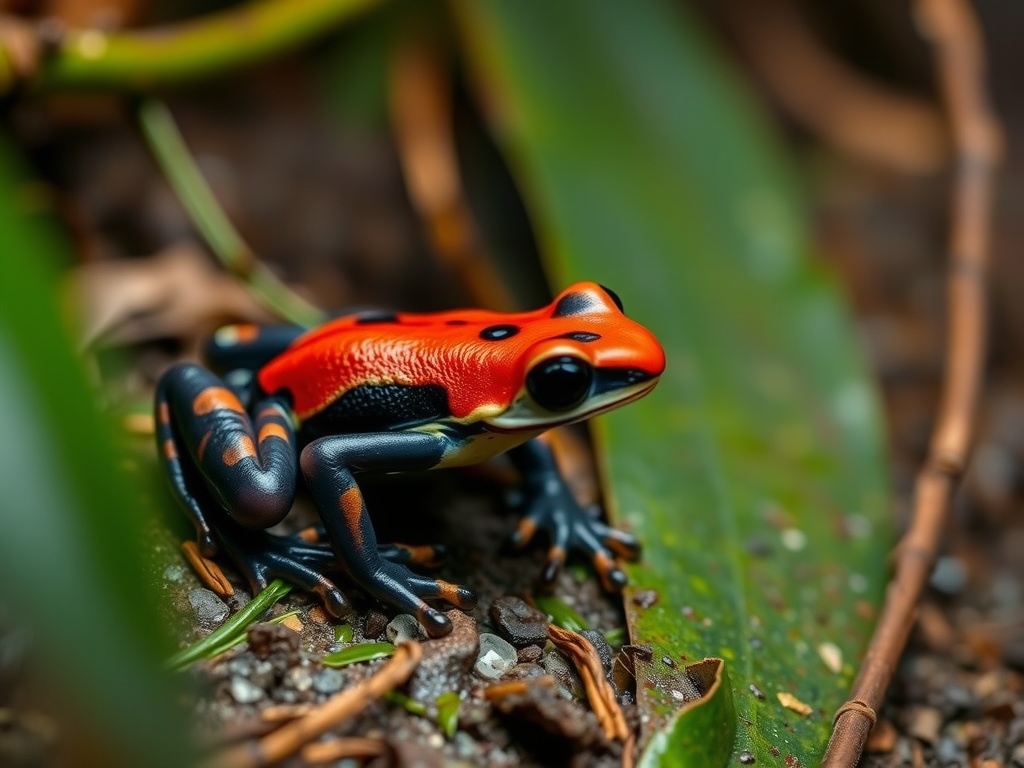
About the Red-backed Poison Frog
The Red-backed Poison Frog is a small, vividly colored amphibian native to the rainforests of northern South America, particularly in Peru and Ecuador. It is easily recognized by its striking red or orange back, often contrasted with black and blue markings on its body and limbs. This species is a member of the poison dart frog group, known for their skin toxins, which serve as a defense against predators. The frogs are highly territorial and exhibit complex parental care, with males guarding eggs and transporting tadpoles to water-filled leaf axils. Despite their bright warning coloration, they are shy and elusive in the wild.
Fascinating facts
Aposematic Coloration
Their bright red or orange backs serve as a warning sign to predators, indicating that they are toxic and should not be eaten.
Parental Care
Male Red-backed Poison Frogs are attentive parents, guarding the eggs and later carrying the hatched tadpoles on their backs to safe water sources.
Microhabitat Specialist
They often depend on bromeliads and other plants that collect small pools of water, which are crucial for their tadpoles’ development.
Detailed description
The Red-backed Poison Frog (Ranitomeya reticulata) is a diminutive dendrobatid, typically measuring 16–19 mm in snout-vent length, making it one of the smaller members of its genus. Its striking coloration consists of a bright red or orange dorsum, often with a reticulated or net-like black pattern, while the flanks and limbs display iridescent blue or turquoise with black spotting. This aposematic coloration serves as a warning to potential predators of its toxicity. The skin is smooth and moist, with a slender, agile body adapted for climbing. The species is primarily arboreal, spending much of its life in the understory and lower canopy of humid lowland rainforests. R. reticulata is diurnal, exhibiting peak activity during early morning and after rainfall. Socially, these frogs are territorial, with males defending small territories against rivals through vocalizations and physical displays. Their complex reproductive behavior includes courtship rituals, egg guarding, and the unique practice of transporting tadpoles on the male's back to phytotelmata (water-filled plant axils). The species possesses specialized toe pads for gripping smooth, wet surfaces, facilitating its arboreal lifestyle. Its moderate toxicity is derived from lipophilic alkaloids sequestered from its diet, providing effective chemical defense. Despite their vivid appearance, these frogs are secretive in the wild, often hiding among dense foliage and bromeliads.
Did you know?
Despite being poisonous in the wild, captive Red-backed Poison Frogs raised without access to their natural diet lose their toxicity and are harmless to touch.
Research & sources
Wikipedia summary
The red-backed poison frog is a species of frog in the family Dendrobatidae. It is an arboreal insectivorous species, and is the second-most poisonous species in the genus, after R. variabilis. Like many species of small, poisonous frogs native to South America, it is grouped with the poison dart frogs, and is a moderately toxic species, containing poison capable of causing serious injury to humans, and death in animals such as chickens. R. reticulata is native to the Amazon rainforest in Peru and Ecuador.
Behaviour & social structure
Red-backed Poison Frogs are highly active during daylight hours, foraging for small arthropods such as ants, mites, and springtails. They use their keen vision to detect prey and employ a sit-and-wait or slow-stalking approach, capturing food with a rapid flick of their sticky tongue. Males establish and defend territories of approximately 1–2 square meters, using soft trilling calls to advertise their presence and deter rivals. Agonistic encounters may involve wrestling or chasing. Social interactions are generally limited outside the breeding season, but temporary aggregations can occur around optimal breeding sites. These frogs exhibit site fidelity, often returning to the same calling or breeding locations. Daily routines include periods of foraging, calling, and retreating to moist refuges to avoid desiccation.
Reproduction & life cycle
Breeding occurs throughout the rainy season, typically from November to April, when humidity and water availability are highest. Males attract females with vocalizations and lead them to suitable oviposition sites, usually on the undersides of leaves above small water bodies. Females lay clutches of 2–6 eggs, which are then guarded by the male. After hatching (in 10–14 days), the male transports each tadpole individually on his back to phytotelmata, such as bromeliad axils or tree holes. Tadpoles are deposited singly to reduce competition and cannibalism. The larval period lasts 40–60 days, during which the male may return periodically to check on the tadpoles and, in some cases, provide unfertilized eggs as food. Metamorphosis yields fully formed froglets, which disperse into the surrounding vegetation.
Adaptations & survival
Ranitomeya reticulata has evolved several adaptations for survival in its niche. Its bright aposematic coloration deters predators by signaling toxicity, while its skin glands secrete potent alkaloids that disrupt nerve and muscle function in would-be attackers. Specialized toe pads with expanded terminal discs enable efficient climbing on smooth, wet surfaces. The species' small size allows it to exploit microhabitats such as bromeliads and leaf axils, which provide both breeding sites and refuge from predators. Behavioral adaptations include complex parental care, territoriality, and vocal communication. Its diet specialization on alkaloid-rich arthropods is crucial for maintaining toxicity. The ability to recognize and return to specific breeding sites demonstrates advanced spatial memory.
Cultural significance
While R. reticulata is not traditionally used by indigenous peoples for poison darts (unlike some larger dendrobatids), it is emblematic of the Amazon's rich biodiversity and is often featured in ecotourism and conservation campaigns. Its vivid appearance has made it a popular species in the exotic pet trade, though this has raised concerns about over-collection. In broader culture, poison dart frogs symbolize the delicate balance of rainforest ecosystems and the importance of chemical ecology in evolutionary biology.
Recent research
Recent studies have focused on the chemical ecology of R. reticulata, revealing a diverse array of alkaloids in its skin, some unique to the species. Research has also examined the genetic structure of populations across its range, highlighting the impact of habitat fragmentation. Behavioral studies have documented the species' sophisticated parental care and spatial learning abilities. Ongoing research aims to understand the mechanisms of alkaloid sequestration and the evolutionary origins of aposematism in dendrobatids. Conservation genetics and captive breeding programs are being developed to support population resilience.
Videos
Habitat
Lowland tropical rainforest
 Tropical Regions
Rainforest
Dense, wet forests with the highest biodiversity on Earth, containing more than half of the world's plant and animal species.
 Global
Forest
Wooded areas with significant tree cover and diverse plant and animal communities.
 Global
Freshwater
Lakes, rivers, and wetlands with diverse aquatic ecosystems.
Conservation
The Red-backed Poison Frog is currently classified as Least Concern on the IUCN Red List.
Threats & challenges
Although currently listed as Least Concern by the IUCN, R. reticulata faces localized threats from habitat loss due to deforestation, agricultural expansion, and illegal collection for the pet trade. Fragmentation of rainforest habitat can isolate populations, reducing genetic diversity and increasing vulnerability to environmental changes. Pollution and climate change also pose emerging threats by altering microhabitats and breeding sites. Despite these challenges, the species remains relatively abundant in protected areas, but ongoing monitoring is essential to detect population declines.
Taxonomy
Scientific name
Ranitomeya reticulata
- Kingdom
- Animalia
- Phylum
- Chordata
- Class
- Amphibia
- Order
- Anura
- Family
- Dendrobatidae
- Genus
- Ranitomeya
- Species
- reticulata
Community notes
Share your observations about the Red-backed Poison Frog.
No community notes yet. Be the first!
Discover more wildlife
More fascinating animals from the encyclopedia.