
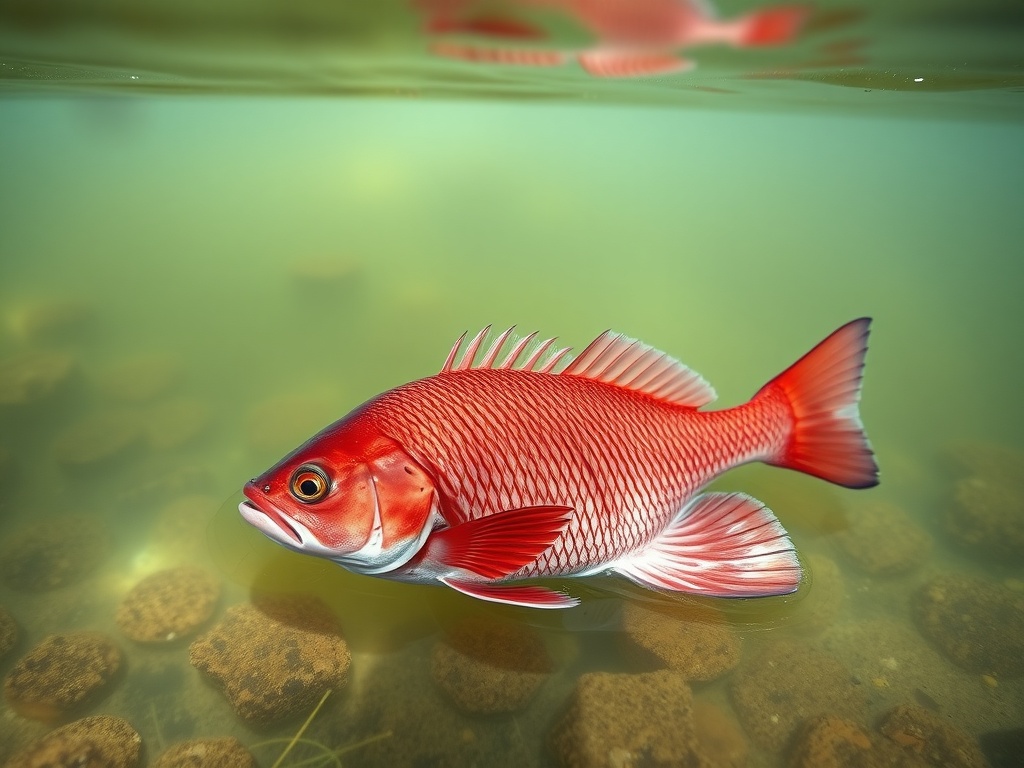
About the Red drum
The red drum, also known as redfish or channel bass, is a large, copper-bronze colored fish native to the western Atlantic Ocean and Gulf of Mexico. It is easily recognized by a distinctive black spot near the base of its tail, which helps confuse predators. Red drums inhabit coastal and estuarine waters, often found in bays, lagoons, and tidal creeks. Highly popular among anglers, they are renowned for their strong fighting ability and are valued both commercially and recreationally. The species is resilient and capable of adapting to a variety of salinities, making it a successful and widespread fish.
Fascinating facts
Popular Game Fish
Red drum are highly sought after by recreational anglers due to their size, strength, and willingness to take bait.
Makes Drumming Sounds
They are named for their ability to produce a drumming sound by vibrating their swim bladder, particularly during spawning season.
Distinctive Tail Spot
Red drum are easily identified by a large black spot near the base of their tail, which is thought to confuse predators.
Detailed description
The red drum (Sciaenops ocellatus) is a robust, deep-bodied fish distinguished by its copper-bronze coloration, which can shift to a silvery sheen on the lower sides and belly. Adults typically measure 50–100 cm (20–39 in) in length, though specimens exceeding 150 cm (59 in) and weighing over 45 kg (99 lb) have been recorded. The most distinctive anatomical feature is the presence of one or more prominent black spots near the base of the caudal fin, a trait thought to confuse predators by mimicking an eye. Red drum possess a slightly arched back, a blunt snout, and a large, downward-sloping mouth suited for bottom feeding. Their lateral line is highly sensitive, aiding in the detection of prey in turbid waters. Juveniles are commonly found in shallow estuaries and marshes, while adults migrate to deeper coastal waters and offshore sandbars. They are euryhaline, tolerating a wide range of salinities, and can thrive in both brackish and fully marine environments. Red drum are long-lived, with individuals documented at over 40 years of age. Their scales are large and cycloid, providing protection and reducing drag during swimming. The species is the sole member of its genus, reflecting a unique evolutionary lineage within the Sciaenidae family.
Did you know?
Some red drums have lived to be over 40 years old in the wild, making them one of the longest-living coastal fish species in North America.
Research & sources
Wikipedia summary
The red drum, also known as redfish, channel bass, puppy drum, spottail bass, or simply red, is a game fish found in the Atlantic Ocean from Massachusetts to Florida and in the Gulf of Mexico from Florida to northern Mexico. It is the only species in the genus Sciaenops.
Behaviour & social structure
Red drum are primarily benthic foragers, using their sensitive barbels and lateral line system to locate prey such as crustaceans (crabs, shrimp), mollusks, and small fish on or near the substrate. They exhibit crepuscular feeding habits, with peak activity during dawn and dusk. Juveniles often form loose schools for protection, while adults may be solitary or aggregate in large spawning groups. Red drum are known for their characteristic 'drumming' sounds, produced by vibrating specialized muscles against the swim bladder, especially during spawning and social interactions. This acoustic communication plays a role in mate attraction and territory establishment. They display site fidelity to productive feeding grounds and may undertake seasonal migrations between estuarine nurseries and offshore spawning sites.
Reproduction & life cycle
Red drum exhibit a distinct spawning season, typically from late summer to early fall (August–October) in the northern hemisphere, although timing varies with latitude. Spawning occurs in nearshore and estuarine waters, often at night, during high tidal flows. Males produce drumming sounds to attract females, who release between 1–3 million pelagic eggs per season. Fertilized eggs hatch within 24–36 hours, and larvae are transported by currents into estuarine nursery habitats. There is no parental care after spawning; survival relies on the productivity and shelter of estuarine environments. Juveniles grow rapidly, reaching sexual maturity at 3–6 years of age, with females generally maturing later and attaining larger sizes than males.
Adaptations & survival
Red drum have evolved several adaptations for survival in dynamic coastal environments. Their euryhaline physiology allows them to osmoregulate across a broad salinity gradient, from freshwater inflows to hypersaline lagoons. The downward-facing mouth and pharyngeal teeth are specialized for crushing hard-shelled prey. Their coloration provides camouflage against sandy or muddy substrates, and the false eyespot near the tail confuses predators, increasing escape chances. The ability to produce drumming sounds is a unique behavioral adaptation for intraspecific communication. Additionally, their robust immune system and tolerance for variable water quality contribute to their resilience in disturbed habitats.
Cultural significance
Red drum hold significant cultural and economic value along the U.S. Atlantic and Gulf coasts. They are a prized target for recreational anglers due to their fighting ability and are the focus of numerous fishing tournaments. In Louisiana and Texas, red drum are celebrated in local cuisine, notably as 'blackened redfish.' The species has also featured in regional folklore and is a symbol of coastal heritage. Commercial harvest is now tightly regulated, with most fisheries shifting to aquaculture and catch-and-release practices to ensure sustainability.
Recent research
Recent research has focused on the genetic population structure of red drum, revealing distinct stocks between the Atlantic and Gulf populations, which has important implications for management. Studies on their acoustic communication have advanced understanding of fish social behavior and reproductive ecology. Ongoing research addresses the impacts of coastal habitat restoration on juvenile recruitment and the potential effects of climate change on distribution and spawning phenology. Advances in aquaculture techniques have improved stock enhancement programs and reduced pressure on wild populations.
Videos
Habitat
Coastal and estuarine waters


Conservation
The Red drum is currently classified as Least Concern on the IUCN Red List.
Threats & challenges
While the red drum is currently classified as Least Concern by the IUCN, localized populations face pressures from overfishing, habitat loss (especially degradation of estuarine nurseries), and water pollution. Historic overexploitation in the 1980s led to stringent management measures, including size and bag limits, which have aided recovery. Bycatch in shrimp trawl fisheries and coastal development remain ongoing concerns. Climate change impacts, such as altered salinity regimes and increased frequency of hypoxic events, may also pose future challenges. Population trends are stable or increasing in well-managed regions, but continued monitoring is necessary.
Taxonomy
Scientific name
Sciaenops ocellatus
- Kingdom
- Animalia
- Phylum
- Chordata
- Class
- Actinopterygii
- Order
- Perciformes
- Family
- Sciaenidae
- Genus
- Sciaenops
- Species
- ocellatus
Community notes
Share your observations about the Red drum.
No community notes yet. Be the first!
Discover more wildlife
More fascinating animals from the encyclopedia.