
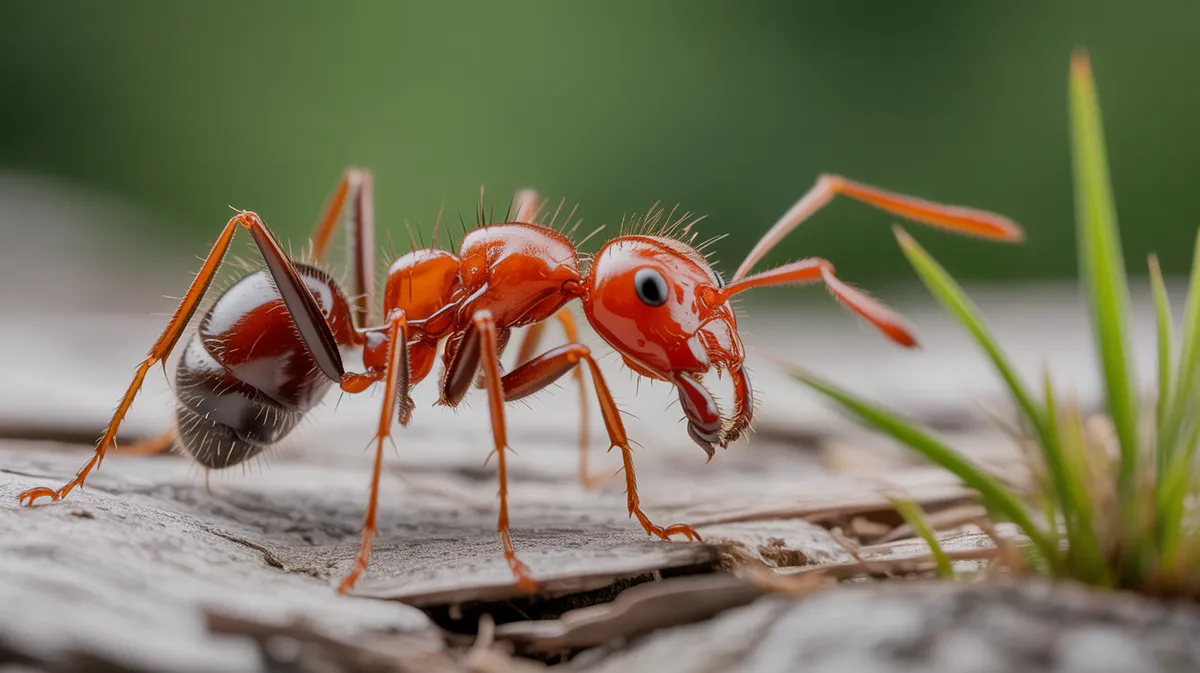
About the Red Imported Fire Ant
The Red Imported Fire Ant (Solenopsis invicta) is a highly aggressive, stinging ant native to South America but now widespread in the southern United States and other parts of the world due to accidental introduction. These ants are notorious for their painful stings, which can cause severe allergic reactions in sensitive individuals. They are reddish-brown in color, live in large colonies with a complex social structure, and are capable of building impressive mounds in open, sunny areas. Red Imported Fire Ants are considered a significant invasive species, impacting agriculture, wildlife, and human activities wherever they establish.
Fascinating facts
Painful Sting
Their sting injects venom that causes a burning sensation and can result in itchy, pus-filled blisters.
Flood Survivors
Fire ants can link their bodies together to form floating rafts, allowing entire colonies to survive floods.
Queen Power
A single queen can lay up to 1,500 eggs per day, ensuring rapid colony growth.
Detailed description
The Red Imported Fire Ant (Solenopsis invicta) is a medium-sized ant species, with polymorphic workers ranging from 2.4 to 6 mm in length. Their bodies are typically reddish-brown with a darker, almost black gaster, while males are entirely black and queens are larger, measuring up to 8 mm. The exoskeleton is covered with fine setae and features a distinctive two-segmented petiole. S. invicta colonies are highly organized, often containing hundreds of thousands of individuals and exhibiting either monogyne (single queen) or polygyne (multiple queen) social structures. Colonies construct large, dome-shaped mounds up to 40 cm high and 60 cm wide, often with no visible entrance, as foraging tunnels radiate outward underground. These ants are aggressive defenders of their nests, using a potent venom delivered via stings that can cause intense pain, pustules, and, in rare cases, severe allergic reactions in humans. S. invicta is omnivorous, feeding on seeds, insects, small vertebrates, and human food waste. Their reproductive strategy involves nuptial flights, during which winged males and females mate, and newly fertilized queens establish new colonies. The species is renowned for its ecological plasticity, thriving in disturbed habitats, agricultural fields, urban environments, and even electrical equipment. Their invasive success is attributed to rapid colony growth, aggressive foraging, and the ability to outcompete native ant species.
Did you know?
A single Red Imported Fire Ant colony can contain up to 250,000 worker ants and multiple queens, making them extremely difficult to eradicate.
Research & sources
Wikipedia summary
Solenopsis invicta, the fire ant, or red imported fire ant (RIFA), is a species of ant native to South America. A member of the genus Solenopsis in the subfamily Myrmicinae, it was described by Swiss entomologist Felix Santschi as a variant of S. saevissima in 1916. Its current specific name invicta was given to the ant in 1972 as a separate species. However, the variant and species were the same ant, and the name was preserved due to its wide use. Though South American in origin, the red imported fire ant has been accidentally introduced in Australia, New Zealand, several Asian and Caribbean countries, Europe and the United States. The red imported fire ant is polymorphic, as workers appear in different shapes and sizes. The ant's colours are red and somewhat yellowish with a brown or black gaster, but males are completely black. Red imported fire ants are dominant in altered areas and live in a wide variety of habitats. They can be found in rainforests, disturbed areas, deserts, grasslands, alongside roads and buildings, and in electrical equipment. Colonies form large mounds constructed from soil with no visible entrances because foraging tunnels are built and workers emerge far away from the nest.
Behaviour & social structure
Red Imported Fire Ants are highly social and exhibit complex cooperative behaviors. Workers are divided into minor, media, and major castes, each specializing in tasks such as foraging, brood care, nest maintenance, and defense. Foraging occurs both day and night, with trails extending up to 100 meters from the nest. S. invicta employs both recruitment pheromones and tactile communication to coordinate mass attacks on prey or threats. They are opportunistic feeders, preying on insects, small vertebrates, and scavenging carrion, but will also harvest seeds and tend aphids for honeydew. When disturbed, workers swarm rapidly and deliver multiple stings in a coordinated defense. In flooded environments, colonies can form living rafts by linking their bodies, allowing them to survive and relocate. Social interactions are tightly regulated by chemical cues, with queens producing pheromones that suppress worker reproduction and maintain colony cohesion.
Reproduction & life cycle
Reproduction in S. invicta is characterized by synchronized nuptial flights, typically occurring in warm, humid conditions after rain. Winged males and virgin queens (alates) emerge from mature colonies and mate in mid-air. Males die shortly after mating, while fertilized queens shed their wings and seek suitable sites to found new colonies. A founding queen lays her first batch of eggs within 24 hours, and the initial brood develops into workers in about 20-30 days, depending on temperature. Queens are highly fecund, capable of laying up to 1,500 eggs per day at peak production. In polygyne colonies, multiple queens coexist, enhancing colony growth and survival. There is no parental care beyond the queen's initial brood-rearing; subsequent care is performed by workers. Breeding can occur year-round in favorable climates, but is often seasonal in temperate regions.
Adaptations & survival
Solenopsis invicta exhibits several key adaptations for survival and invasion. Their venom contains alkaloid compounds (mainly solenopsin) with potent insecticidal and antimicrobial properties, aiding in both defense and predation. The polymorphic worker caste system allows for division of labor and efficient resource exploitation. Their ability to form floating rafts during floods enables survival in variable environments. S. invicta can rapidly relocate colonies in response to disturbance, and their subterranean foraging tunnels reduce exposure to predators and environmental extremes. The species displays high reproductive potential and flexible social organization (monogyne vs. polygyne), facilitating rapid population expansion. Their tolerance for a wide range of temperatures, soil types, and moisture levels further contributes to their ecological success.
Cultural significance
The Red Imported Fire Ant is notorious in many countries for its painful sting and aggressive behavior, making it a symbol of invasive species and pest management challenges. In the southern United States, S. invicta has influenced public health campaigns, agricultural practices, and even inspired local folklore about 'fire ant mounds.' There are no known traditional uses, but their presence has prompted extensive research and public education efforts. The species has become a model organism for studying invasion biology, social insect behavior, and chemical ecology.
Recent research
Recent research has focused on the genetic basis of social organization, particularly the Gp-9 gene, which determines monogyne versus polygyne colony structure. Studies on venom composition have identified novel alkaloids with potential pharmaceutical applications. Biological control efforts include the introduction of phorid fly parasitoids and entomopathogenic fungi. Genomic analyses have revealed high genetic diversity in invasive populations, contributing to their adaptability. Ongoing research addresses the impacts of S. invicta on native ecosystems, pollinators, and agricultural productivity, as well as the development of more targeted and sustainable control methods.
Videos
Habitat
Grasslands, open fields, urban areas


Conservation
The Red Imported Fire Ant is currently classified as Least Concern on the IUCN Red List.
Threats & challenges
While S. invicta is not threatened globally, it faces natural predation and competition in its native range from phorid flies (Pseudacteon spp.), pathogens, and other ant species. In introduced regions, the lack of natural enemies has allowed populations to explode, resulting in significant ecological and economic impacts. They displace native ants, reduce biodiversity, and damage crops, livestock, and electrical infrastructure. Human efforts to control S. invicta include chemical baits, biological control agents, and quarantine measures, but eradication is challenging due to their reproductive capacity and colony mobility. Climate change may expand their potential range. Population trends are stable or increasing in invaded areas, with ongoing spread in parts of Asia, Australia, and the southern United States.
Taxonomy
Scientific name
Solenopsis invicta
- Kingdom
- Animalia
- Phylum
- Arthropoda
- Class
- Insecta
- Order
- Hymenoptera
- Family
- Formicidae
- Genus
- Solenopsis
- Species
- invicta
Community notes
Share your observations about the Red Imported Fire Ant.
No community notes yet. Be the first!
Discover more wildlife
More fascinating animals from the encyclopedia.