
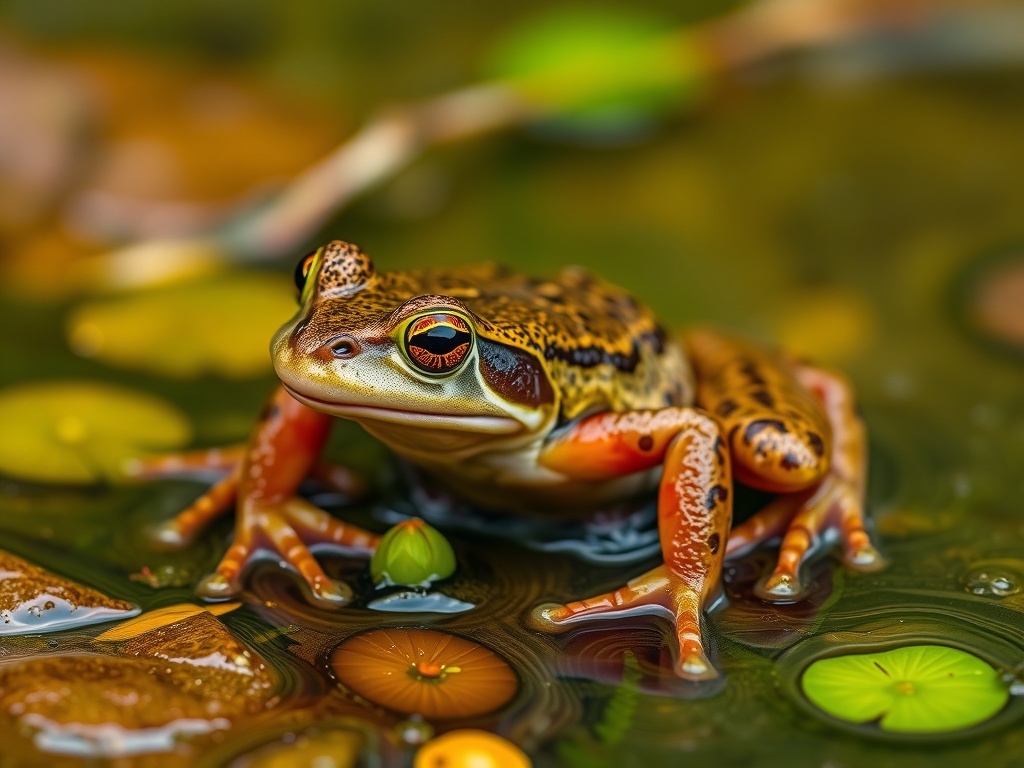
About the Red-legged Frog
The Red-legged Frog is a medium-sized amphibian native to the western United States, particularly California. It is recognized by its distinctive reddish coloring on the underside of its legs and its dorsally spotted, olive-brown skin. This species prefers aquatic habitats like streams, ponds, and marshes with dense vegetation. Due to habitat loss and the introduction of invasive species, its populations have declined significantly in recent decades. The Red-legged Frog plays an important ecological role as both predator and prey within its freshwater ecosystems.
Fascinating facts
Impressive Jumpers
Red-legged Frogs can leap more than 6 feet, which is over 10 times their body length.
Habitat Specialists
They rely on slow-moving freshwater habitats with dense vegetation for breeding and shelter.
Literary Fame
This species gained fame as the subject of Mark Twain’s short story, which helped bring attention to its conservation.
Detailed description
The California Red-legged Frog (Rana draytonii) is the largest native frog in the western United States, with adult snout-vent lengths typically ranging from 4.4 to 13.5 cm (1.75–5.4 in), and females generally larger than males. Its dorsal coloration varies from brown, gray, or olive to reddish, often with dark flecks or spots and a distinctive pale dorsolateral fold running from behind the eye to the hip. The undersides of the hind legs are characteristically red or salmon-pink, a feature that gives the species its common name. The skin is granular and moist, with the belly often yellowish or cream. Rana draytonii is primarily nocturnal and semi-aquatic, spending much of its time in or near slow-moving freshwater bodies with abundant emergent vegetation. It is an ambush predator, feeding on a variety of invertebrates, small vertebrates, and occasionally even conspecific tadpoles. The species is generally solitary outside of the breeding season but may aggregate in suitable aquatic habitats. Its vocalizations are soft and low-pitched compared to other ranid frogs, making them less conspicuous during mating choruses. The California Red-legged Frog is highly sensitive to environmental changes, relying on both aquatic and terrestrial habitats for different life stages. Its life cycle includes aquatic eggs and tadpoles, with metamorphosis occurring after three to seven months, depending on environmental conditions.
Did you know?
The California Red-legged Frog is federally listed as a threatened species and has disappeared from over 70% of its original range.
Research & sources
Wikipedia summary
Red-legged frog is a common name for several species of frog:California red-legged frog, Rana draytonii, a frog endemic to California, United States La Selle red-legged frog, Eleutherodactylus furcyensis, a frog found in the Dominican Republic and Haiti Northern red-legged frog, Rana aurora, a frog found in Canada and the United States Red-legged running frog, Kassina maculata, a frog endemic to Africa
Behaviour & social structure
California Red-legged Frogs are primarily crepuscular and nocturnal, becoming most active at dusk and during the night. They spend daylight hours concealed under vegetation, logs, or in burrows near water to avoid desiccation and predation. Their hunting strategy is largely sit-and-wait, preying on insects, crustaceans, snails, and occasionally small mammals or amphibians. Feeding occurs both in water and on land, with frogs using a rapid tongue flick to capture prey. Social interactions are limited outside the breeding season, with individuals maintaining loose territories. During the breeding season, males congregate in shallow water and emit a series of short, low-frequency calls to attract females. Aggressive interactions between males are rare but may occur when competition for mates is high. The species is known to disperse considerable distances (up to 2 km) between breeding and non-breeding habitats, especially during wet periods.
Reproduction & life cycle
Breeding occurs from late November to April, with timing influenced by rainfall and temperature. Males arrive at breeding sites first and call to attract females, who select mates based on call characteristics and physical condition. Amplexus (the mating embrace) is axillary, with the male grasping the female behind her forelimbs. Females lay clusters of 2,000 to 5,000 eggs, attached to submerged vegetation or debris in calm, shallow water. Embryonic development lasts 6–14 days, depending on water temperature. Tadpoles are herbivorous, feeding on algae and detritus, and undergo metamorphosis after 3–7 months. There is no parental care after egg deposition. Juveniles may remain in aquatic habitats or disperse into adjacent terrestrial areas. Sexual maturity is typically reached at 2–3 years of age.
Adaptations & survival
Rana draytonii exhibits several adaptations for survival in Mediterranean climates. Its granular skin helps reduce water loss, and behavioral thermoregulation (seeking shade or burrowing) minimizes desiccation. The species can tolerate a wide range of aquatic conditions, including temporary pools, and is capable of long-distance terrestrial movements to exploit ephemeral habitats. Its cryptic coloration and patterning provide camouflage against predators. The red pigmentation on the legs may serve as a warning or distraction to predators. Tadpoles possess keratinized mouthparts for scraping algae, and their long larval period allows flexibility in response to variable hydroperiods. The frog's low-frequency calls are adapted to travel efficiently through dense vegetation and over water.
Cultural significance
The California Red-legged Frog holds a unique place in American cultural history, being immortalized in Mark Twain's 1865 short story 'The Celebrated Jumping Frog of Calaveras County.' This association has made the species a symbol of California's natural heritage and a focus of local conservation efforts. The frog is featured in educational programs and is the official state amphibian of California. While not traditionally used for food or medicine, its presence in literature and folklore has contributed to public awareness and support for wetland conservation.
Recent research
Recent research on Rana draytonii has focused on population genetics, habitat connectivity, and the impacts of invasive species. Studies using environmental DNA (eDNA) have improved detection and monitoring of populations, aiding conservation planning. Research on disease ecology, particularly the effects of chytrid fungus, has provided insights into amphibian declines and potential mitigation strategies. Ongoing habitat restoration projects, including the removal of invasive bullfrogs and the creation of artificial breeding ponds, have shown promising results in supporting population recovery. Genetic studies have also clarified the species' relationship to other North American ranids, supporting its distinction from the closely related Rana aurora.
Videos
Habitat
Freshwater streams, ponds, and marshes


Conservation
The Red-legged Frog is currently classified as Vulnerable on the IUCN Red List.
Threats & challenges
The California Red-legged Frog faces numerous threats, including habitat loss and fragmentation due to urbanization, agriculture, and water management practices. The introduction of non-native predators such as American Bullfrogs (Lithobates catesbeianus) and predatory fish has led to significant declines, as these species compete for resources and prey on eggs, tadpoles, and juveniles. Pesticide runoff and water pollution further impact reproductive success and larval survival. Climate change poses additional risks by altering precipitation patterns and reducing the availability of suitable breeding habitats. Disease, particularly chytridiomycosis caused by the chytrid fungus (Batrachochytrium dendrobatidis), has also been documented in some populations. The species is listed as Vulnerable by the IUCN, and populations have declined by over 70% from historical levels, with extirpation from much of its former range.
Taxonomy
Scientific name
Rana draytonii
- Kingdom
- Animalia
- Phylum
- Chordata
- Class
- Amphibia
- Order
- Anura
- Family
- Ranidae
- Genus
- Rana
- Species
- draytonii
Community notes
Share your observations about the Red-legged Frog.
No community notes yet. Be the first!
Discover more wildlife
More fascinating animals from the encyclopedia.