
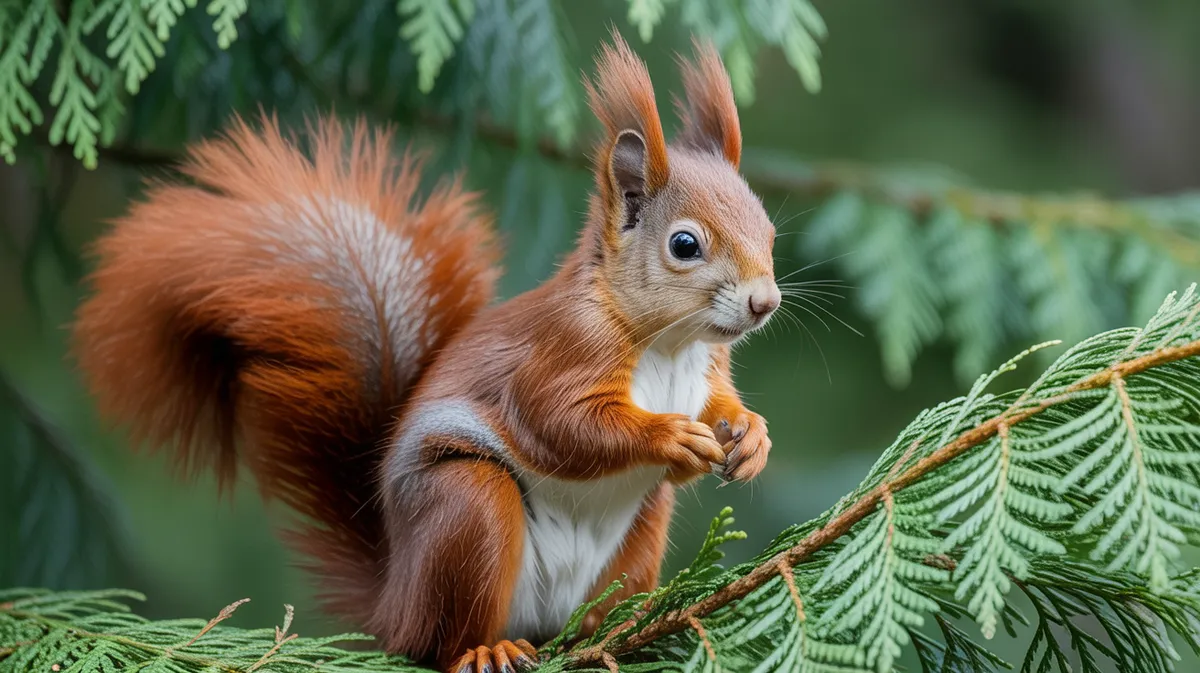
About the Red Squirrel
The Red Squirrel is a small, agile rodent native to Eurasia, recognized by its distinctive reddish-brown fur and tufted ears. It is an arboreal animal that spends most of its time in coniferous and mixed forests, skillfully leaping between tree branches. Red Squirrels feed mainly on seeds from pine cones, nuts, berries, and fungi, playing an important role in forest ecology by dispersing seeds and spores. Once common across the UK and much of Europe, their populations have declined in some regions due to competition from the introduced Eastern Grey Squirrel and habitat loss.
Fascinating facts
Forest Dwellers
Red Squirrels are most commonly found in coniferous forests but can also inhabit mixed and broadleaf woodlands.
Food Caching
They cache seeds and nuts in autumn, using their excellent spatial memory to recover them throughout winter.
Winter Ear Tufts
Their iconic ear tufts grow longer and thicker during winter, helping to keep them warm.
Detailed description
The red squirrel (Sciurus vulgaris) is a small, arboreal rodent distinguished by its rich reddish-brown fur, bushy tail, and prominent ear tufts, especially visible in winter. Adults typically measure 19–23 cm in body length, with tails adding an additional 15–20 cm, and weigh between 250–350 grams. Their underparts are usually white or cream-colored, and fur coloration can vary regionally from deep red to dark brown or even black, a polymorphism influenced by habitat and genetics. Red squirrels possess sharp, curved claws and strong hind limbs, adaptations that enable agile climbing and leaping between branches. Their incisors grow continuously, suited for gnawing hard seeds and nuts. Primarily diurnal, they are most active at dawn and dusk, spending much of their time foraging and caching food. Red squirrels are solitary outside of breeding season, maintaining overlapping home ranges but defending core territories. They construct spherical nests called dreys from twigs, moss, and leaves, typically situated in tree forks or hollows. Their ecological role is significant, as they disperse seeds and fungal spores, contributing to forest regeneration and health.
Did you know?
Red Squirrels can swim and occasionally cross rivers to reach new habitats.
Research & sources
Wikipedia summary
The red squirrel, also called Eurasian red squirrel, is a species of tree squirrel in the genus Sciurus. It is an arboreal and primarily herbivorous rodent and common throughout Eurasia.
Behaviour & social structure
Red squirrels are primarily solitary and territorial, with individuals marking their home ranges using scent glands located on their feet and flanks. They exhibit crepuscular activity, foraging most intensively in the early morning and late afternoon. Their diet is seasonally variable: in spring and summer, they consume buds, flowers, shoots, and fungi, while in autumn and winter, they rely heavily on seeds from conifer cones, hazelnuts, acorns, and cached food stores. Red squirrels are scatter-hoarders, burying food in numerous locations to retrieve during scarce periods. They use spatial memory and olfactory cues to relocate caches. Social interactions are limited, but vocalizations (chattering, squeaks) and tail flicking serve as communication, especially in territorial disputes or alarm situations. They rarely descend to the ground except to forage or move between trees in fragmented habitats.
Reproduction & life cycle
Red squirrels breed once or twice annually, with peak mating seasons in late winter (January–March) and occasionally in summer (June–August). Females are polyestrous and receptive for only one day per cycle, attracting multiple males that may engage in competitive chases. After successful mating, gestation lasts approximately 38–39 days. Litters typically consist of 3–4 kits (range 1–6). Young are born altricial—blind, hairless, and weighing about 10–15 grams. The mother alone provides care, nursing the kits in the drey for 7–8 weeks. Eyes open at 3–4 weeks, and juveniles begin exploring outside the nest at 6–7 weeks, reaching independence by 10–12 weeks. Sexual maturity is attained at 9–12 months, but not all individuals breed in their first year.
Adaptations & survival
Red squirrels possess several adaptations for arboreal life: strong, dexterous forelimbs and sharp claws for climbing; long, bushy tails for balance and warmth; and excellent binocular vision for depth perception. Their ear tufts may help with thermoregulation and species recognition. Seasonally, they undergo a molt, developing thicker, darker fur and more pronounced ear tufts in winter for insulation. Their digestive system is adapted to a high-fiber, seed-based diet, and they can detoxify certain plant secondary compounds. Behavioral adaptations include scatter-hoarding and the ability to remember cache locations for months. They are also capable of exploiting ephemeral food sources and shifting diet composition according to availability.
Cultural significance
The red squirrel has a prominent place in European folklore and culture, symbolizing agility, resourcefulness, and the changing seasons. In Norse mythology, the squirrel Ratatoskr runs up and down the world tree Yggdrasil, carrying messages between an eagle and a serpent. In the UK, the red squirrel is an emblem of native wildlife and conservation efforts, featured in literature, art, and as a mascot for woodland campaigns. Historically, their fur was used for clothing and trade, and they appear in various regional legends as clever or mischievous creatures.
Recent research
Recent research has focused on the impacts of squirrelpox virus and the genetic basis of resistance in red squirrel populations. Studies in Scotland have shown that pine marten recovery can indirectly benefit red squirrels by suppressing grey squirrel numbers. Ongoing work includes habitat management strategies, translocation projects, and the use of immunocontraception to control grey squirrel populations. Genetic studies are investigating population structure, gene flow, and adaptive variation across the species' range. Long-term monitoring programs track population dynamics, disease prevalence, and the effectiveness of conservation interventions.
Videos
Habitat
Coniferous and mixed woodlands


Conservation
The Red Squirrel is currently classified as Near Threatened on the IUCN Red List.
Threats & challenges
Major threats to red squirrels include habitat fragmentation, loss of mature woodland, and competition with the invasive Eastern grey squirrel (Sciurus carolinensis), particularly in the UK and parts of Italy. Grey squirrels outcompete reds for food and habitat, and are carriers of squirrelpox virus, which is lethal to red squirrels but asymptomatic in greys. Other threats include predation by pine martens, birds of prey, and domestic cats, as well as road mortality. Climate change may alter forest composition, affecting food availability. Conservation challenges involve maintaining and restoring suitable coniferous habitats, controlling grey squirrel populations, and monitoring disease outbreaks. Population trends are stable in some parts of Eurasia but declining in Western Europe, especially the British Isles.
Taxonomy
Scientific name
Sciurus vulgaris
- Kingdom
- Animalia
- Phylum
- Chordata
- Class
- Mammalia
- Order
- Rodentia
- Family
- Sciuridae
- Genus
- Sciurus
- Species
- vulgaris
Where to see a red squirrel
1 zoo and aquarium in 1 country are recorded as keeping this species.
Community notes
Share your observations about the Red Squirrel.
No community notes yet. Be the first!
Discover more wildlife
More fascinating animals from the encyclopedia.