
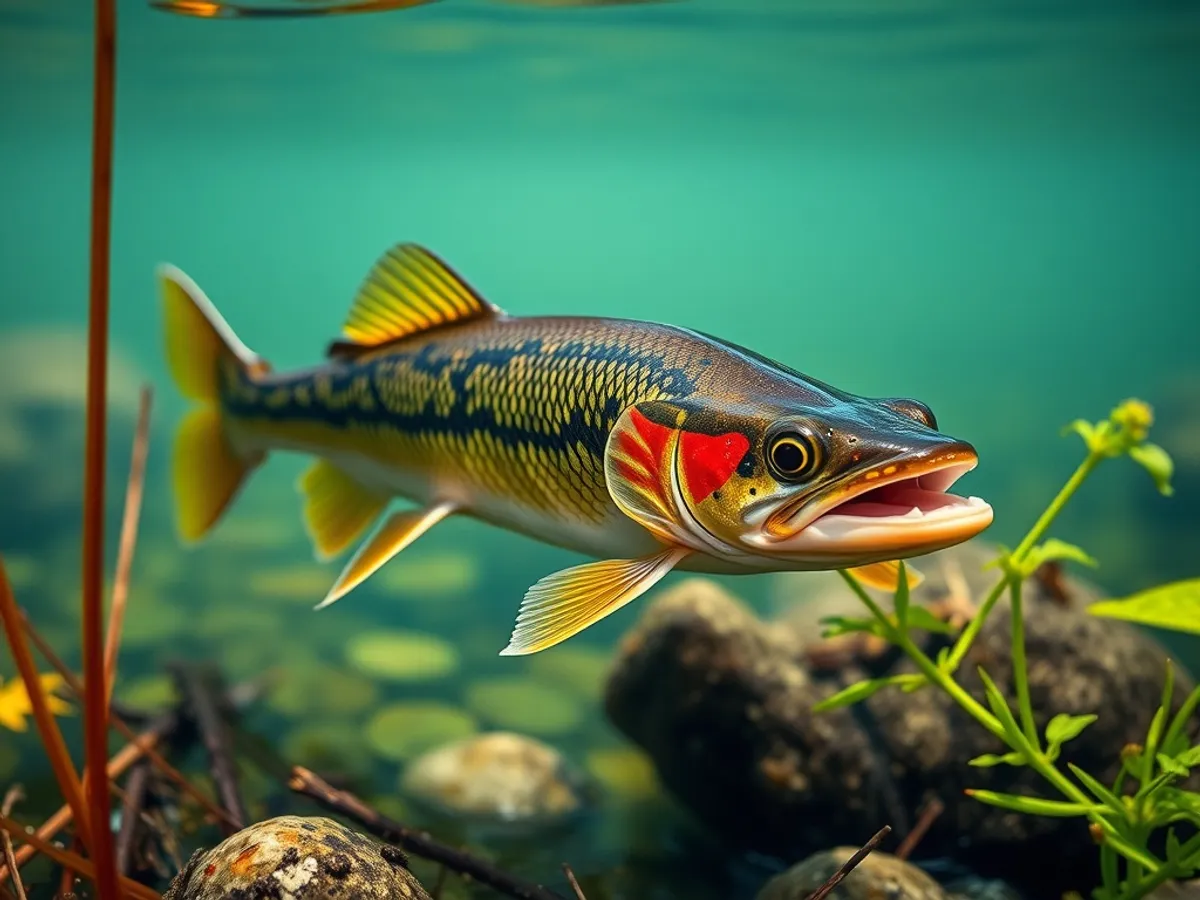
About the Redfin pickerel
The Redfin pickerel is a small freshwater fish native to the eastern United States, easily recognized by its slender, elongated body and distinctive bright red or orange fins. It features a long, pointed snout and a light-colored body adorned with dark, wavy vertical bars along the sides. Preferring slow-moving or still waters like swamps, ponds, and sluggish streams, this ambush predator uses its remarkable camouflage to stalk and capture smaller fish, insects, and amphibians. The Redfin pickerel is valued by anglers for its fighting spirit, despite its relatively modest size.
Fascinating facts
Ambush Predator
Redfin pickerel use stealth and sudden bursts of speed to capture unsuspecting prey, making them expert ambush hunters.
Habitat Specialist
These fish are most commonly found in densely vegetated waters, where their coloration helps them blend in with aquatic plants.
Small Yet Fierce
Despite rarely growing longer than 30 cm (12 inches), Redfin pickerel are aggressive predators within their ecosystems.
Detailed description
The redfin pickerel (Esox americanus americanus) is a small, slender member of the pike family, typically reaching adult lengths of 20–30 cm (8–12 in), though some individuals may grow slightly larger. Its body is laterally compressed, with a long, pointed snout and a large mouth filled with sharp, backward-pointing teeth adapted for grasping slippery prey. The most distinctive feature is its vivid red to orange pelvic and anal fins, which contrast with the olive to yellowish-green body marked by irregular, dark vertical bars and mottling along the flanks. The dorsal fin is set far back on the body, a trait common to all esocids, aiding in sudden bursts of speed during ambush attacks. The eyes are positioned high on the head, providing a wide field of vision for detecting prey and predators. Redfin pickerels possess a lateral line system that enhances their ability to sense vibrations in the water, crucial for hunting in low-visibility habitats. They are solitary and highly territorial, often occupying dense aquatic vegetation or submerged woody debris where they remain motionless, relying on camouflage. Unlike larger pike species, redfin pickerels rarely exceed 500 g (1.1 lb) in weight and are considered non-migratory, maintaining small home ranges throughout their lives.
Did you know?
The Redfin pickerel can use rapid sideways lunges to snatch prey in the blink of an eye, thanks to its streamlined body and powerful tail.
Research & sources
Wikipedia summary
The redfin pickerel is a subspecies of freshwater fish belonging to the pike family (Esocidae) of the order Esociformes. Not to be confused with its close relatives, the grass pickerel and the chain pickerel, this fish is unique in the fact that it has brightly colored red fins. Like all pikes, the redfin pickerel is an ambush predator, lying amongst thick vegetation in wait for smaller, more agile prey to enter within its range of attack.
Behaviour & social structure
Redfin pickerels are quintessential ambush predators, spending much of their time motionless among aquatic plants, waiting for unsuspecting prey to pass within striking distance. Their hunting strategy involves rapid acceleration and a sideways lunge, facilitated by their streamlined bodies and posteriorly placed dorsal and anal fins. They primarily feed on small fish, aquatic insects, and occasionally amphibians or crustaceans. Feeding activity peaks during dawn and dusk (crepuscular), although they may hunt opportunistically throughout the day. Social interactions are minimal outside of the breeding season; individuals are highly territorial and may exhibit aggressive displays or even cannibalism if territories overlap. Juveniles are more gregarious, often forming loose aggregations in shallow, vegetated areas for protection. Redfin pickerels are generally sedentary, with daily movements confined to short distances within their chosen cover.
Reproduction & life cycle
Spawning occurs in early spring, typically from March to April, when water temperatures rise to 8–14°C (46–57°F). Redfin pickerels are broadcast spawners: females scatter adhesive eggs over submerged vegetation or detritus in shallow, slow-moving waters. There is no nest building or parental care; fertilization is external, with males accompanying females during spawning runs. A single female can lay several thousand eggs, depending on her size. Incubation lasts 7–14 days, after which the larvae are free-swimming and immediately begin feeding on zooplankton and small invertebrates. High egg and larval mortality is common due to predation and environmental fluctuations, but rapid early growth helps survivors avoid predation.
Adaptations & survival
The redfin pickerel's cryptic coloration and patterning provide effective camouflage among aquatic vegetation, reducing detection by both prey and predators. Its elongated, torpedo-shaped body and posterior fin placement enable explosive acceleration for ambush predation. The large mouth and recurved teeth are specialized for capturing and holding slippery, agile prey. The lateral line system is highly developed, allowing detection of minute water movements—a key advantage in turbid or vegetated habitats. Physiologically, redfin pickerels can tolerate low-oxygen conditions often found in swamps and backwaters, giving them access to habitats less suitable for competitors. Their reproductive strategy of high fecundity and lack of parental care is typical of species in variable environments, maximizing reproductive output in unpredictable conditions.
Cultural significance
While not a major game fish due to its modest size, the redfin pickerel is appreciated by anglers for its aggressive strikes and spirited resistance. It is sometimes used as a baitfish for larger predatory species. The species has limited direct cultural or economic significance, but it plays an important ecological role as both predator and prey in freshwater ecosystems. There is little evidence of traditional or mythological importance, though its striking appearance and behavior make it a subject of interest for naturalists and educators.
Recent research
Recent research on Esox americanus americanus has focused on its ecological role in controlling populations of smaller fish and aquatic invertebrates, as well as its responses to habitat modification. Genetic studies have clarified its relationship to other pickerel subspecies, particularly the grass pickerel (Esox americanus vermiculatus), with which it hybridizes in some areas. Ongoing studies are examining the effects of wetland restoration and management on pickerel populations, as well as the impacts of climate-driven changes in hydrology. Stable isotope analysis has been used to investigate dietary shifts across different habitats and seasons. There is also interest in the species as a bioindicator for freshwater ecosystem health due to its sensitivity to water quality and habitat structure.
Videos
Habitat
Freshwater streams, ponds, and swamps


Conservation
The Redfin pickerel is currently classified as Least Concern on the IUCN Red List.
Threats & challenges
Currently, the redfin pickerel is considered secure (NatureServe G5), with stable populations across its range in the eastern United States. However, localized threats include habitat loss from wetland drainage, water pollution, and the removal of aquatic vegetation. Introduction of non-native predatory fish and habitat fragmentation may also impact some populations. Climate change poses potential long-term risks by altering hydrological regimes and water temperatures. Despite these pressures, the species' adaptability and broad habitat tolerance have so far mitigated major declines. Ongoing monitoring is necessary to detect any emerging threats, particularly in regions experiencing rapid land-use change.
Taxonomy
Scientific name
Esox americanus americanus
- Kingdom
- Animalia
- Phylum
- Chordata
- Class
- Actinopterygii
- Order
- Esociformes
- Family
- Esocidae
- Genus
- Esox
- Species
- americanus americanus
Community notes
Share your observations about the Redfin pickerel.
No community notes yet. Be the first!
Discover more wildlife
More fascinating animals from the encyclopedia.