
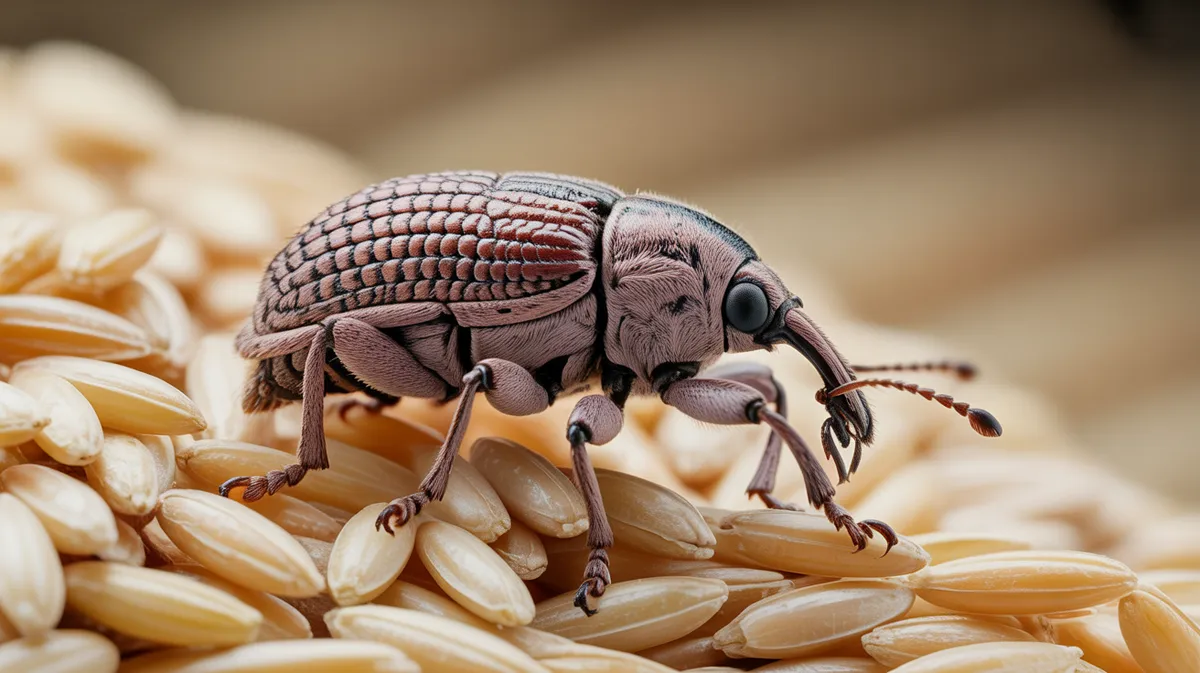
About the Rice weevil
The rice weevil is a small, reddish-brown beetle known for infesting stored grains such as rice, wheat, and corn. Adults typically measure 2-3 mm in length and feature a distinctive elongated snout. Rice weevils are capable flyers and can rapidly infest stored food products, causing significant damage. Both adults and larvae feed on grains, making them a major pest in agricultural and household settings. Despite their pest status, rice weevils are fascinating for their adaptation to human environments and effective dispersal abilities.
Fascinating facts
Tiny Invader
Rice weevils are only 2-3 mm long but can infest entire warehouses of stored grain.
Grain Nursery
A female rice weevil lays her eggs inside individual grains, where the larvae develop hidden from view.
Capable Flyers
Unlike many other grain pests, rice weevils can fly, helping them disperse quickly to new food sources.
Detailed description
The rice weevil (Sitophilus oryzae) is a small, cylindrical beetle measuring 2.0–3.5 mm in length, with a characteristic elongated snout (rostrum) that is about one-third of its body length. Its body is reddish-brown to nearly black, often marked with four pale reddish or yellowish spots on the elytra (wing covers). The antennae are geniculate (elbowed) and clubbed, adapted for detecting chemical cues from grains. The legs are well-developed, and adults are capable of flight, facilitating rapid dispersal between storage sites. The exoskeleton is hard and provides protection against desiccation and predation. Rice weevils are holometabolous insects, undergoing complete metamorphosis with egg, larval, pupal, and adult stages. Larvae are legless, creamy-white grubs that develop entirely within a single grain kernel, hollowing it out as they feed. Adults are long-lived for beetles of their size, surviving up to 4–5 months under favorable conditions. They are primarily nocturnal, seeking shelter in grain masses during the day and becoming more active at night. Their ability to infest a wide range of stored cereals and processed products, combined with high reproductive potential, makes them one of the most significant pests in global post-harvest agriculture.
Did you know?
Rice weevils have developed resistance to several common insecticides, making them especially challenging to control in large-scale grain storage.
Research & sources
Wikipedia summary
The rice weevil is a stored product pest which attacks seeds of several crops, including wheat, rice, and maize.
Behaviour & social structure
Rice weevils exhibit cryptic behavior, spending most of their life cycle concealed within grain kernels. Adults are strong fliers and can disperse over considerable distances in search of new food sources or mates. They are primarily solitary, with limited social interaction beyond mating. Feeding occurs both in larvae and adults; larvae feed internally on the endosperm of grains, while adults chew small holes in grains to feed and oviposit. Adults are attracted to the odors of damaged or moist grains, which signal suitable sites for egg-laying. Activity peaks at temperatures between 27–30°C and relative humidity above 60%. In cooler conditions, development slows and adults may enter a state of quiescence. Rice weevils are sensitive to vibrations and light, often retreating deeper into grain masses when disturbed.
Reproduction & life cycle
Female rice weevils lay between 300 and 400 eggs during their lifespan, depositing each egg individually inside a grain kernel. Using their rostrum, females bore a small hole into the grain, insert a single egg, and seal the opening with a gelatinous secretion. The incubation period is temperature-dependent, typically lasting 3–6 days at optimal conditions (around 27°C). Larvae develop inside the grain for 18–32 days, pupate within the hollowed kernel, and emerge as adults after 3–6 days of pupation. There is no parental care; the entire development is concealed and protected within the grain. Multiple generations can occur per year, with up to 5–7 generations in warm, humid climates. Reproduction occurs year-round in tropical regions, while in temperate zones, breeding may be limited to warmer months or heated storage facilities.
Adaptations & survival
Sitophilus oryzae has evolved several adaptations for survival in stored grain environments. The elongated rostrum allows precise boring into hard grains for oviposition. The cryptic larval development within kernels provides protection from predators, parasitoids, and environmental hazards. Adults possess well-developed flight muscles, enabling colonization of new storage sites. Their cuticle is resistant to desiccation, allowing survival in relatively dry storage conditions. Chemoreceptors on the antennae detect specific volatiles from grains, aiding in host location. The ability to enter quiescence or diapause in response to adverse conditions enhances survival during periods of scarcity or cold.
Cultural significance
Rice weevils have a largely negative cultural significance due to their impact on food security and economic losses in agriculture. They are often cited in literature and folklore as symbols of waste or loss. In some traditional societies, the presence of weevils in stored grain has prompted the development of indigenous storage techniques, such as the use of botanical repellents or hermetic storage. However, there are no known positive symbolic or ritual uses of the rice weevil in human culture.
Recent research
Recent research has focused on the molecular genetics of Sitophilus oryzae, including the sequencing of its genome to better understand resistance mechanisms and potential targets for biocontrol. Studies have examined the microbiome of rice weevils, revealing symbiotic bacteria (notably Sodalis pierantonius) that contribute to nutrient synthesis and insecticide resistance. Advances in pheromone biology have led to the development of monitoring and mass-trapping strategies. Research into alternative control methods, such as the use of diatomaceous earth, inert dusts, and biological agents, is ongoing. The impact of climate change on weevil population dynamics and post-harvest losses is a growing area of study.
Videos
Habitat
Stored grain environments


Conservation
The Rice weevil is currently classified as Least Concern on the IUCN Red List.
Threats & challenges
Rice weevils are not threatened in the wild; instead, they are a major pest species. Their populations are controlled primarily through human intervention, including sanitation, chemical insecticides, fumigation, and improved storage practices. Resistance to certain insecticides and fumigants (e.g., phosphine) has been documented, posing challenges for pest management. Climate change may influence their distribution and population dynamics, potentially expanding their range. Biological control using parasitoids and entomopathogenic fungi is under investigation, but large-scale implementation remains limited. There are no significant natural predators in storage environments, making human management crucial.
Taxonomy
Scientific name
Sitophilus oryzae
- Kingdom
- Animalia
- Phylum
- Arthropoda
- Class
- Insecta
- Order
- Coleoptera
- Family
- Curculionidae
- Genus
- Sitophilus
- Species
- oryzae
Community notes
Share your observations about the Rice weevil.
No community notes yet. Be the first!
Discover more wildlife
More fascinating animals from the encyclopedia.