
About the Ringed Caecilian
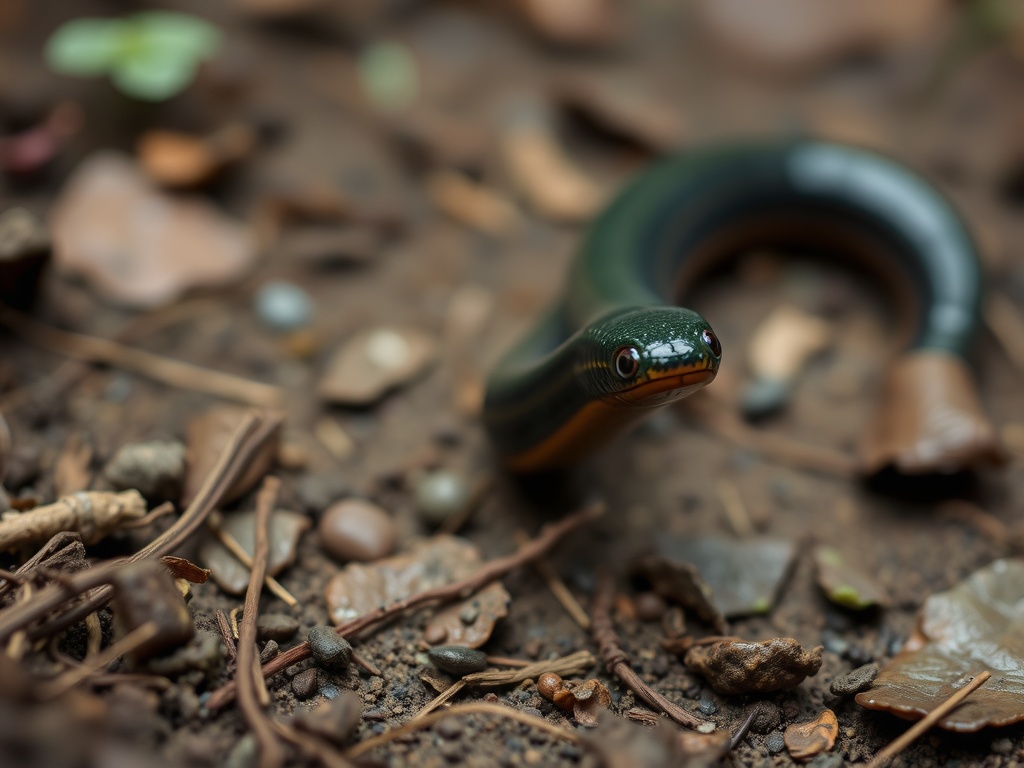
The Ringed Caecilian is a limbless, burrowing amphibian native to South America, easily recognized by its segmented, ring-like markings across its body. Living mainly underground, it has a cylindrical, elongated shape reminiscent of an earthworm or snake but is neither. This elusive creature relies on its strong skull for digging through moist soil and has reduced or absent eyes, depending mostly on sensory tentacles for navigation. Its secretive lifestyle and unique appearance make it one of the lesser-known but fascinating amphibians.
Fascinating facts
Rainforest Dweller
Ringed Caecilians are primarily found in the moist soils of tropical rainforests, where they spend much of their lives underground.
Tentacled Senses
They possess unique tentacles between their eyes and nostrils, which help them detect chemical cues in the soil to find prey.
Unusual Parental Care
Females lay eggs in moist burrows and provide their young with nourishing skin, which the larvae consume during early development.
Detailed description
The Ringed Caecilian (Siphonops annulatus) is a medium-sized, limbless amphibian typically measuring 28–40 cm in length, with a maximum recorded length of about 45 cm. Its body is cylindrical and segmented by 70–110 conspicuous annular grooves, giving it a banded, worm-like appearance. The skin is smooth, moist, and dark bluish-gray to violet, with lighter rings that are more prominent in juveniles. Eyes are greatly reduced and covered by skin, rendering them nearly functionless; instead, the species relies on a pair of protrusible tentacles located between the eye and nostril for chemosensory navigation. The skull is compact and reinforced, adapted for head-first burrowing through loose, moist soils. Siphonops annulatus possesses a unique dual jaw musculature, allowing it to exert strong bite forces for capturing and subduing prey. Internally, the lungs are well-developed, but cutaneous respiration is also significant due to its moist habitat. This species is fossorial, spending most of its life underground, emerging only during heavy rains or when soil is disturbed. Its secretive lifestyle, cryptic coloration, and specialized anatomy make it a prime example of evolutionary adaptation to subterranean life among amphibians.
Did you know?
Ringed Caecilian mothers feed their newly hatched young with a special skin that the babies peel and eat—a phenomenon known as maternal dermatotrophy.
Research & sources
Behaviour & social structure
Ringed Caecilians are solitary and primarily nocturnal, spending daylight hours deep within the soil or under decaying logs and leaf litter. They are active burrowers, using their reinforced skulls to tunnel through soft substrates. Their diet consists mainly of soil invertebrates such as earthworms, termites, ants, insect larvae, and occasionally small vertebrates. Prey is located using the sensitive tentacles, which detect chemical cues in the environment. Feeding involves rapid strikes and swallowing prey whole. Social interactions are minimal outside of breeding, and individuals maintain exclusive burrow systems. During periods of high humidity or after heavy rainfall, they may be found closer to the surface or even above ground, but otherwise remain hidden. They exhibit thigmotaxis, preferring close contact with solid surfaces, which aids in navigation and predator avoidance.
Reproduction & life cycle
Siphonops annulatus is oviparous, laying eggs in moist underground chambers. Breeding typically coincides with the onset of the rainy season, when soil moisture is optimal for egg development. Females lay clutches of 5–16 eggs, which are elongated and encased in a gelatinous envelope. Remarkably, the female exhibits maternal care by coiling around the eggs to protect them from desiccation and predators. After hatching, the larvae remain with the mother for several weeks. During this period, the young feed on the outer layer of the mother's skin, which becomes nutrient-rich and thickened—a phenomenon known as dermatotrophy. This unique form of parental investment provides essential nutrients and immune factors to the developing larvae until they are capable of independent foraging. Metamorphosis is direct, with no free-swimming larval stage, and juveniles resemble miniature adults upon dispersal.
Adaptations & survival
The Ringed Caecilian exhibits a suite of adaptations for a fossorial lifestyle. Its robust, pointed skull and strong axial musculature facilitate efficient burrowing. The skin secretes copious mucus, reducing friction and preventing desiccation underground. The reduced eyes, protected by skin, minimize injury during tunneling, while the tentacles serve as specialized chemosensory organs for detecting prey and environmental cues. The annular grooves increase flexibility and may aid in locomotion through confined spaces. Dermatotrophy is a rare reproductive adaptation among vertebrates, enhancing offspring survival in subterranean habitats. Additionally, S. annulatus can tolerate low-oxygen environments due to its ability to respire cutaneously as well as pulmonarily.
Cultural significance
Caecilians, including Siphonops annulatus, are generally little known in local folklore due to their secretive, subterranean habits. In some rural South American communities, they are occasionally mistaken for snakes or large worms and may be feared or killed on sight. There are no significant records of traditional medicinal or culinary use. Their unusual appearance and reproductive behaviors have, however, attracted scientific curiosity and are sometimes referenced in educational materials about amphibian diversity and parental care strategies.
Recent research
Recent research on Siphonops annulatus has focused on its reproductive biology, particularly the dermatotrophic feeding of larvae, which has provided insights into the evolution of parental care in amphibians (Kupfer et al., 2006). Molecular studies have clarified its phylogenetic relationships within the Siphonopidae family, supporting its placement as a basal lineage among Neotropical caecilians. Ongoing ecological studies are investigating its role in soil ecosystems, where it contributes to invertebrate population control and soil aeration. There is also growing interest in the antimicrobial properties of its skin secretions, which may have biomedical applications. Conservation genetics research is limited but recommended to monitor genetic diversity across its wide range, especially in fragmented habitats.
Sources
Reproductive biology of Siphonops annulatus: maternal dermatotrophy and direct development
Wilkinson, M., Nussbaum, R.A. (1998)
scientificPhylogeny and classification of caecilians (Amphibia: Gymnophiona)
Wilkinson, M., San Mauro, D., Sherratt, E., Gower, D.J. (2011)
scientificSiphonops annulatus: The IUCN Red List of Threatened Species 2020
IUCN SSC Amphibian Specialist Group
conservationParental investment by skin feeding in a caecilian amphibian
Alexander Kupfer, Mark Wilkinson, Hendrik Müller, et al. (2006)
scientificVideos
Habitat
Moist tropical and subtropical forests, often in loose, damp soil
 Tropical Regions
Rainforest
Dense, wet forests with the highest biodiversity on Earth, containing more than half of the world's plant and animal species.
 Global
Forest
Wooded areas with significant tree cover and diverse plant and animal communities.
 Global
Freshwater
Lakes, rivers, and wetlands with diverse aquatic ecosystems.
Conservation
The Ringed Caecilian is currently classified as Least Concern on the IUCN Red List.
Threats & challenges
Currently assessed as Least Concern by the IUCN, Siphonops annulatus has a wide distribution across northern and central South America, including Brazil, Bolivia, Colombia, Ecuador, French Guiana, Guyana, Peru, Suriname, and Venezuela. Its populations are considered stable, largely due to its adaptability to disturbed habitats and agricultural lands. However, localized threats include habitat loss from deforestation, soil pollution, and the use of agrochemicals. The species is also susceptible to soil compaction from heavy machinery and urbanization, which can disrupt burrow systems. While not currently threatened at a global scale, ongoing habitat degradation and climate change could pose future risks, especially in fragmented landscapes.
Taxonomy
Scientific name
Siphonops annulatus
- Kingdom
- Animalia
- Phylum
- Chordata
- Class
- Amphibia
- Order
- Gymnophiona
- Family
- Siphonopidae
- Genus
- Siphonops
- Species
- annulatus
Community notes
Share your observations about the Ringed Caecilian.
No community notes yet. Be the first!
Discover more wildlife
More fascinating animals from the encyclopedia.