
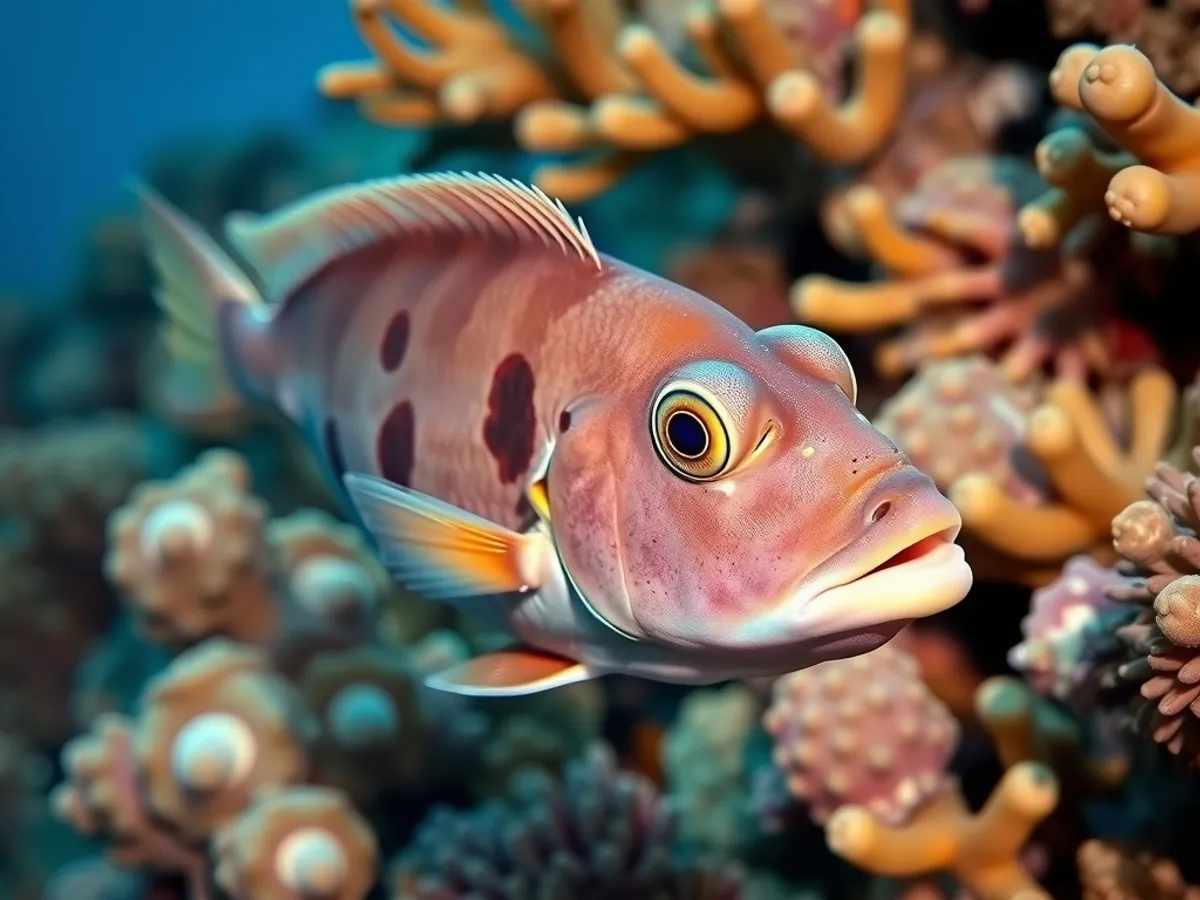
About the Rockmover wrasse
The Rockmover wrasse is a striking marine fish known for its unique behavior and dramatic coloration. It is easily recognized by its elongated body, striking pattern of dark and light bands, and distinctive long, filamentous dorsal fins, especially in juveniles. Found in coral reefs throughout the Indo-Pacific, this wrasse is famous for its habit of flipping over rocks and debris in search of prey. Agile and resourceful, it often works in pairs and can be seen 'walking' along the substrate using its pectoral fins. The Rockmover wrasse plays an important ecological role by aerating the substrate and controlling populations of invertebrates.
Fascinating facts
Rock Flipper
Rockmover wrasses use their snouts and mouths to flip over rocks and coral rubble in search of crustaceans, snails, and worms hiding underneath.
Juvenile Mimicry
Juvenile rockmover wrasses have long, trailing dorsal fins and sway their bodies to resemble floating algae, which helps them avoid being noticed by predators.
Teamwork Hunters
These wrasses often work in pairs, coordinating their movements to move larger rocks and improve their hunting success.
Detailed description
The Rockmover wrasse (Novaculichthys taeniourus) is a medium-sized marine fish, typically reaching lengths of 28–30 cm, though some individuals may grow slightly larger. It is distinguished by a laterally compressed, elongated body adorned with alternating dark brown to black and pale cream or olive bands, providing effective camouflage among coral rubble. Juveniles are particularly striking, with elongated, filamentous dorsal and caudal fin rays that resemble drifting algae or debris, a form of mimicry that offers protection from predators. Adults lose these filaments and develop a more robust, streamlined appearance. The head is wedge-shaped with a pointed snout and strong jaws equipped with canine-like teeth, adapted for prying prey from crevices. The eyes are set high on the head, aiding in scanning the substrate. The species exhibits sexual dimorphism, with males often displaying more vivid coloration and slightly larger size. Rockmover wrasses are diurnal, actively foraging during the day and seeking shelter in crevices or under rocks at night. Their scales are relatively large and tough, providing protection from abrasive environments and potential predators. This species is the sole member of its genus, reflecting its unique evolutionary lineage within the Labridae family.
Did you know?
Despite their small size, Rockmover wrasses can move rocks and rubble several times their own body weight to find food.
Research & sources
Wikipedia summary
Novaculichthys taeniourus, also known as the rockmover wrasse, carpet wrasse, dragon wrasse, bar-cheeked wrasse, olive-scribbled wrasse or reindeer wrasse, is a species of wrasse mainly found in coral reefs and lagoons in the Indo-Pacific region. These include habitats in the Gulf of California to Panama; tropical Pacific Ocean islands including Hawaii; the Philippines, Indonesia and Australia; and the Indian Ocean to the east coast of Africa. The common name, "rockmover wrasse", comes from their behavior of upending small stones and reef fragments in search of prey. This species is the only known member of its genus.
Behaviour & social structure
Rockmover wrasses are renowned for their cooperative foraging behavior, often observed in pairs—frequently a mated pair—working together to overturn rocks, coral fragments, and debris in search of hidden prey such as crustaceans, mollusks, echinoderms, and small fish. This behavior not only exposes prey but also aerates the substrate, benefiting the reef ecosystem. They use their strong jaws and pectoral fins to manipulate objects, and their agility allows them to 'walk' along the substrate. Juveniles are solitary and secretive, relying on their filamentous fins for camouflage, while adults are more conspicuous and may establish small territories. Social interactions include ritualized displays during territorial disputes and courtship, involving color changes and body posturing. They are known to follow larger fish or even divers, exploiting disturbances to access concealed prey. At night, they wedge themselves into crevices or under rocks, sometimes secreting a mucous cocoon to mask their scent from nocturnal predators.
Reproduction & life cycle
Rockmover wrasses are oviparous, engaging in broadcast spawning where eggs and sperm are released into the water column, typically at dusk or during high tides. Spawning is often synchronized with lunar cycles, maximizing fertilization success and larval dispersal. Courtship involves elaborate displays, including circling, color intensification, and rapid swimming. Pairs may ascend in the water column to release gametes simultaneously. There is no parental care; fertilized eggs are pelagic and drift with currents. Larvae are planktonic for several weeks, undergoing significant morphological changes before settling onto the reef as juveniles. Sexual maturity is reached at approximately 1–2 years of age. Like many wrasses, the species is protogynous hermaphroditic—individuals may start life as females and transition to males as they grow larger, although this has not been as extensively documented in N. taeniourus as in some other wrasses.
Adaptations & survival
The Rockmover wrasse exhibits several notable adaptations: its strong, canine-like teeth and robust jaws are specialized for prying prey from hard substrates. The elongated, filamentous fins of juveniles provide effective mimicry of drifting algae, reducing predation risk. Adults' cryptic coloration and banded patterns break up their outline among rocks and coral. Their behavior of flipping rocks is a unique foraging adaptation, allowing access to otherwise hidden prey. The ability to secrete a mucous cocoon at night (reported in some populations) helps mask their scent from nocturnal predators such as moray eels. Their laterally compressed body aids in maneuvering through tight reef crevices, and their sharp vision is well-suited for detecting movement among rubble.
Cultural significance
While the Rockmover wrasse is not a major figure in traditional mythology, it holds some significance in local fisheries and the marine aquarium trade due to its striking appearance and interesting behavior. In some Pacific cultures, wrasses in general are recognized as important reef cleaners and are occasionally referenced in local folklore as resourceful or clever fish. Their unique foraging behavior makes them popular subjects for underwater photographers and ecotourism guides.
Recent research
Recent research has focused on the ecological role of the Rockmover wrasse in reef substrate turnover and its impact on invertebrate community dynamics. Studies have documented its cooperative foraging strategies and the mutual benefits of pair-bonded hunting. Genetic analyses have confirmed its status as the sole member of the genus Novaculichthys, highlighting its evolutionary distinctiveness. Ongoing studies are examining the effects of reef degradation on its population structure and reproductive success. There is also interest in its potential as a bioindicator species for reef health due to its sensitivity to habitat complexity.
Videos
Habitat
Coral reefs

Conservation
The Rockmover wrasse is currently classified as Least Concern on the IUCN Red List.
Threats & challenges
Currently classified as Least Concern by the IUCN, the Rockmover wrasse faces localized threats from habitat degradation, particularly coral reef destruction due to climate change, ocean acidification, and destructive fishing practices. Collection for the aquarium trade is a minor concern, but not at levels threatening global populations. Overfishing and reef dynamite fishing can indirectly impact their populations by reducing habitat complexity and prey availability. Despite these pressures, the species' wide distribution and adaptability to various reef habitats contribute to its resilience. Ongoing monitoring is recommended, especially in regions experiencing rapid reef decline.
Taxonomy
Scientific name
Novaculichthys taeniourus
- Kingdom
- Animalia
- Phylum
- Chordata
- Class
- Actinopterygii
- Order
- Labriformes
- Family
- Labridae
- Genus
- Novaculichthys
- Species
- taeniourus
Community notes
Share your observations about the Rockmover wrasse.
No community notes yet. Be the first!
Discover more wildlife
More fascinating animals from the encyclopedia.