
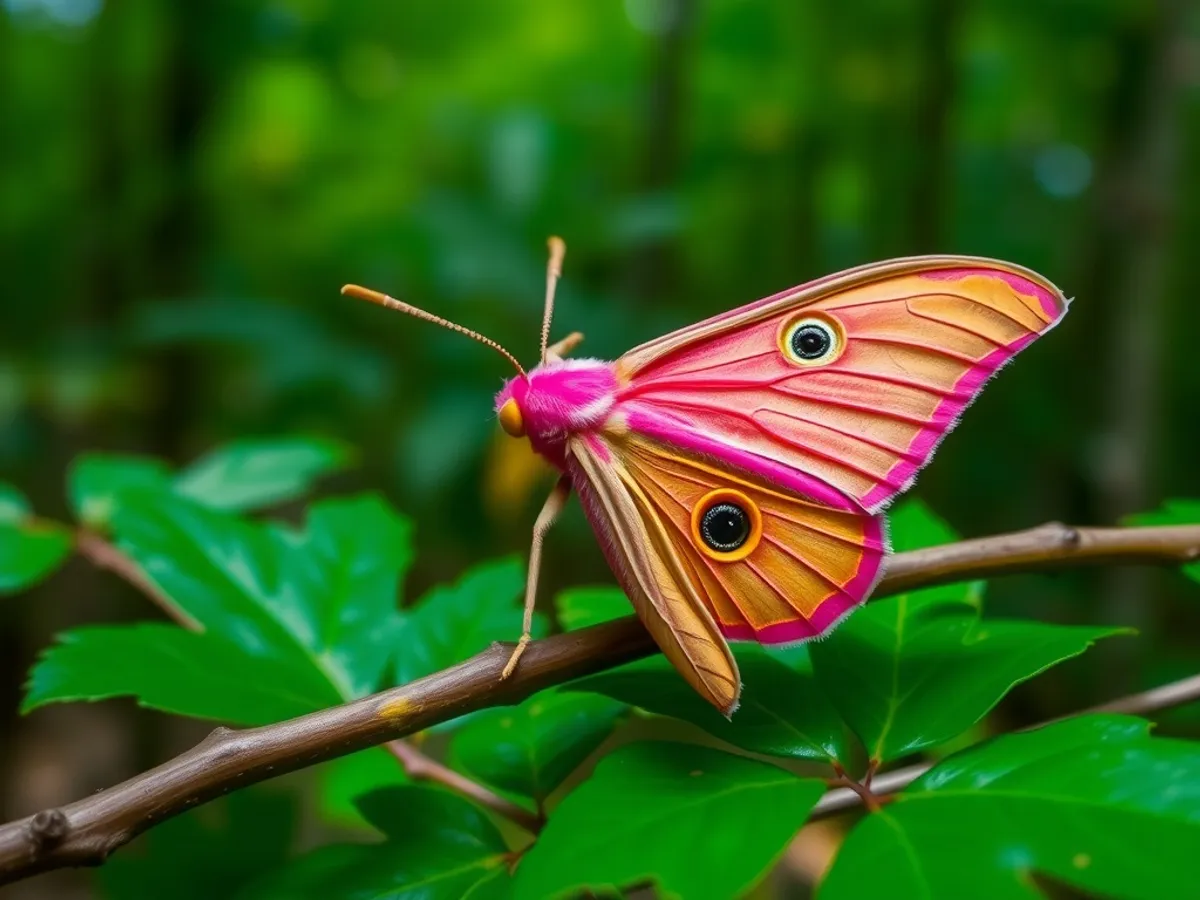
About the Rosy Maple Moth
The Rosy Maple Moth is a striking North American moth known for its vibrant pink and yellow coloration. Adults are relatively small, with fuzzy bodies and broad wings displaying a unique pastel pattern that provides camouflage among maple trees. They are mostly nocturnal and are commonly found near forests or suburban areas where their host maple trees grow. The moth's larvae, known as greenstriped mapleworms, feed primarily on the leaves of maple trees, especially red and silver maples. Despite their bright appearance, adult rosy maple moths live only a short time, focusing solely on reproduction.
Fascinating facts
Cotton Candy Colors
The Rosy Maple Moth is instantly recognizable by its vivid pink and yellow wings, which resemble the colors of cotton candy.
Maple Tree Specialist
The larvae, called greenstriped mapleworms, feed almost exclusively on the leaves of maple trees, making them highly specialized feeders.
Nocturnal Lifestyle
Rosy Maple Moths are nocturnal, flying and mating at night while spending their days hidden among foliage.
Detailed description
The Rosy Maple Moth (Dryocampa rubicunda) is a visually striking member of the Saturniidae family, notable for its compact size, with adult wingspans typically ranging from 32 to 50 mm. Its body is densely covered in fine, woolly scales, and the forewings display a distinctive pastel pattern of pink and yellow, sometimes with cream or white variations. The head is small with large, black compound eyes, and the antennae are bipectinate (comb-like), with males exhibiting much bushier antennae than females—a sexual dimorphism that aids in pheromone detection. The thorax and abdomen are robust, supporting strong flight muscles, although adults are weak fliers and tend to remain close to their emergence sites. The legs are short and adapted for clinging to leaves and bark. Larvae, known as greenstriped mapleworms, are cylindrical and green with longitudinal white stripes and small black spots, reaching up to 35 mm in length. Adults are primarily nocturnal, attracted to artificial lights, and are most active during warm, humid nights. Their coloration provides camouflage among the samaras and leaves of maple trees, aiding in predator avoidance. The adult lifespan is brief, typically lasting only one to two weeks, during which feeding ceases and the focus shifts entirely to reproduction.
Did you know?
Despite their flamboyant appearance, Rosy Maple Moths are rarely noticed because they are most active at night and often rest high in the tree canopy.
Research & sources
Wikipedia summary
Dryocampa rubicunda, the rosy maple moth, is a small North American moth in the family Saturniidae, also known as the great silk moths. It was first described by Johan Christian Fabricius in 1793. The species is known for its wooly body and pink and yellow coloration, which varies from cream or white to bright pink or yellow. Males have bushier antennae than females, which allow them to sense female pheromones for mating.
Behaviour & social structure
Rosy Maple Moths exhibit crepuscular to nocturnal activity, emerging at dusk to seek mates. Adults do not feed, relying on fat reserves accumulated during the larval stage. Males are highly sensitive to female sex pheromones and can locate potential mates over considerable distances using their bushy antennae. Courtship and mating occur shortly after emergence, often within the canopy of host maple trees. Larvae are gregarious in early instars, feeding in groups on the undersides of maple leaves, which can lead to localized defoliation. As they mature, larvae become more solitary. When threatened, larvae may drop from foliage on silk threads to escape predators. Pupation occurs in shallow soil or leaf litter, where the pupa remains until eclosion. Adults are generally solitary, with limited social interaction beyond mating.
Reproduction & life cycle
Breeding occurs from late spring through summer, with timing varying by latitude—southern populations may produce up to three generations per year, while northern populations are typically univoltine. After mating, females lay clusters of 10–40 eggs on the underside of maple leaves. The eggs are small, oval, and pale yellow, hatching within 1–2 weeks depending on temperature. Larvae pass through five instars over a period of 2–4 weeks, feeding voraciously on maple foliage. Upon reaching maturity, larvae descend to the ground to pupate in shallow subterranean chambers or leaf litter. There is no parental care; all development occurs independently. In colder regions, the species overwinters in the pupal stage, with adults emerging the following spring.
Adaptations & survival
The Rosy Maple Moth's vivid coloration serves as both camouflage among the colorful samaras and leaves of maples and as a potential aposematic signal to predators, suggesting unpalatability. The woolly scales on the body and wings may help insulate against temperature fluctuations and reduce predation by making the moth harder to grasp. Males' highly developed antennae are specialized for detecting female pheromones, enhancing reproductive success. Larvae possess cryptic coloration and behavioral adaptations, such as group feeding and silk-dropping, to evade predators. The ability to overwinter as a pupa allows the species to survive harsh climates and synchronize adult emergence with optimal environmental conditions.
Cultural significance
The Rosy Maple Moth is admired for its unique and vibrant appearance, making it a favorite among moth enthusiasts and naturalists. It is often featured in educational programs and citizen science projects such as National Moth Week. While not prominent in folklore or traditional uses, its striking coloration has inspired artwork and photography, contributing to public appreciation of moth biodiversity. The species serves as a charismatic representative for the importance of native moths in North American ecosystems.
Recent research
Recent research on Dryocampa rubicunda has focused on its pheromone communication, host plant specificity, and responses to environmental changes. Studies have examined the genetic basis of its coloration and the ecological impacts of larval feeding on maple tree health. Ongoing monitoring efforts track population trends in relation to climate change and urbanization. The species is also used as a model for understanding Saturniidae life history strategies and the evolution of sexual dimorphism in antennae morphology.
Videos
Habitat
Deciduous forests, especially those with abundant maple trees

Conservation
The Rosy Maple Moth is currently classified as Least Concern on the IUCN Red List.
Threats & challenges
Currently, Dryocampa rubicunda is classified as Least Concern, with stable populations across its range. However, localized threats include habitat loss due to urbanization, reduction of host maple trees from logging or disease (e.g., maple decline), and pesticide use in suburban environments. Light pollution may disrupt nocturnal behaviors and mating. Climate change could alter the distribution and phenology of both the moth and its host plants, potentially impacting population dynamics. Natural predators include birds, bats, and parasitic wasps, but the species' rapid lifecycle and reproductive output help maintain population stability.
Taxonomy
Scientific name
Dryocampa rubicunda
- Kingdom
- Animalia
- Phylum
- Arthropoda
- Class
- Insecta
- Order
- Lepidoptera
- Family
- Saturniidae
- Genus
- Dryocampa
- Species
- rubicunda
Community notes
Share your observations about the Rosy Maple Moth.
No community notes yet. Be the first!
Discover more wildlife
More fascinating animals from the encyclopedia.