
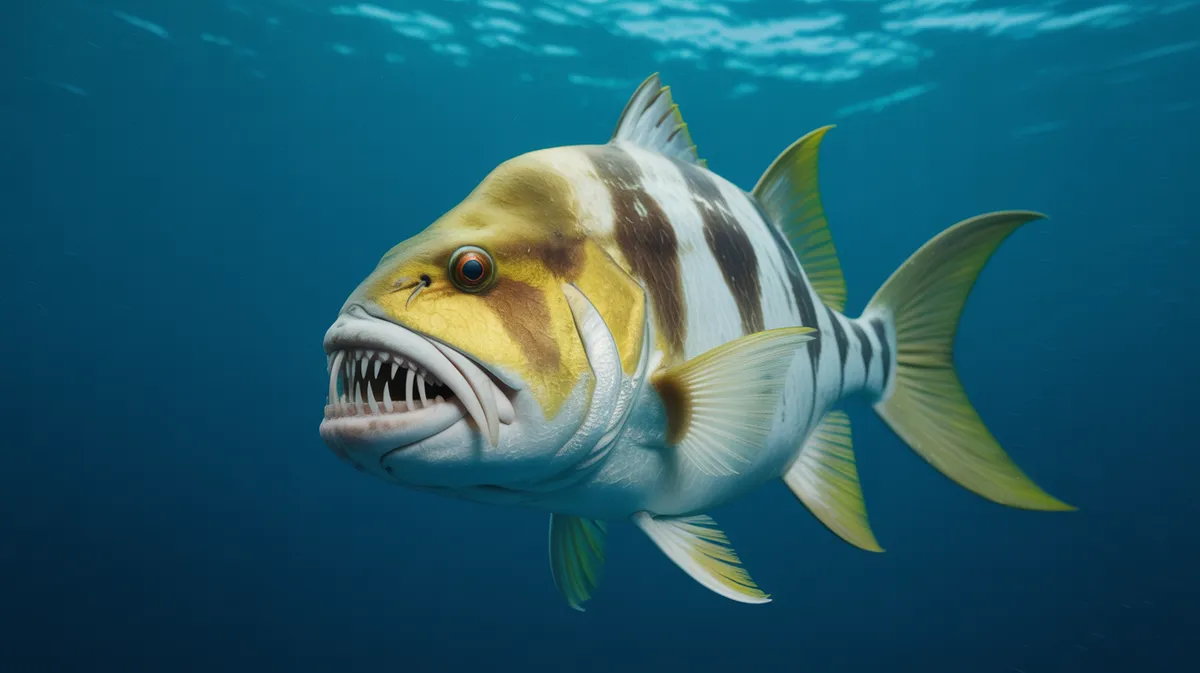
About the Sabertooth Fish
The Sabertooth Fish is a deep-sea predator renowned for its enormous, curved fangs that protrude forward from its lower jaw. These fish inhabit the dark depths of the world's oceans, where sunlight never penetrates, relying on keen senses and an expandable stomach to capture and consume large prey. Sabertooth Fish have slender, elongated bodies, silvery coloration, and large eyes adapted for the faintest glimmers of light. Their formidable teeth are so long that the fish cannot close its mouth completely, a unique adaptation for snaring elusive prey. Little is known about their reproductive habits due to the inaccessibility of their environment.
Fascinating facts
Giant Teeth
Sabertooth Fish have two enormous fangs on their lower jaw, sometimes longer than half the length of their head.
Deep Dwellers
They inhabit ocean depths typically between 500 and 4,000 meters, far below the reach of sunlight.
Big Appetites
Their highly expandable stomachs allow them to swallow prey nearly as large as themselves.
Detailed description
The Sabertooth Fish (Coccorella atrata) is a striking deep-sea predator belonging to the family Evermannellidae, commonly known as sabertooth fishes. Adults typically reach lengths of 15–22 cm, with a slender, laterally compressed body that is well-suited for rapid bursts of movement in the mesopelagic and bathypelagic zones (depths of 400–2,000 meters). The most distinctive anatomical feature is its disproportionately large, recurved fangs, which can measure up to half the length of the head and are visible even when the mouth is closed. These teeth are hinged and fit into special grooves in the upper jaw, allowing the fish to impale and securely hold onto slippery prey. The eyes are large and tubular, oriented upwards to maximize the detection of silhouettes against the faint downwelling light, an adaptation for spotting prey above in the perpetual twilight. The skin is covered in small, silvery scales that reflect minimal ambient light, providing camouflage from both predators and prey. Internally, the Sabertooth Fish possesses a highly distensible stomach, enabling it to consume prey nearly as large as itself, a vital adaptation in the food-scarce deep sea. Despite their formidable appearance, these fish are solitary ambush predators, relying on stealth and sudden lunges rather than pursuit. Little is known about their reproductive biology, but they are presumed to be oviparous, releasing eggs into the water column. The overall morphology and physiology of Coccorella atrata reflect a suite of adaptations to the extreme pressures, low temperatures, and minimal light of the deep ocean.
Did you know?
The Sabertooth Fish’s teeth are so large that they must fit into special grooves on the outside of the head when the mouth is closed.
Research & sources
Behaviour & social structure
Sabertooth Fish are primarily solitary and exhibit nocturnal activity patterns, although the deep-sea environment is in perpetual darkness. They are ambush predators, remaining motionless or slowly drifting in the water column until prey—typically small fish, crustaceans, or cephalopods—comes within striking distance. Using their sensitive lateral line system and large, upward-facing eyes, they detect subtle movements and bioluminescent cues. When hunting, they employ a rapid upward lunge, impaling prey on their elongated fangs before swallowing it whole. There is no evidence of social or schooling behavior; individuals maintain wide spacing, likely due to the scarcity of food resources. Daily routines are dictated by the availability of prey, and vertical migrations appear limited compared to some other deep-sea fishes. Sabertooth Fish are opportunistic feeders and may go extended periods without eating, relying on their expandable stomachs to maximize intake when food is available.
Reproduction & life cycle
Reproductive habits of Coccorella atrata remain poorly documented due to the logistical challenges of deep-sea research. It is believed that they are oviparous, with females releasing buoyant eggs into the water column, where external fertilization occurs. The eggs likely develop into pelagic larvae that drift with ocean currents before descending to deeper waters as they mature. There is no evidence of parental care; larvae are independent from hatching. Breeding seasonality is unknown, but related species in the Evermannellidae family show asynchronous spawning, with reproduction possibly occurring year-round to maximize chances of larval survival in the unpredictable deep-sea environment. Maturity is reached at relatively small sizes, an adaptation to the high predation risk and low food availability in their habitat.
Adaptations & survival
Coccorella atrata exhibits several remarkable adaptations for deep-sea survival. Its enormous, recurved fangs are specialized for seizing and holding large, agile prey, while the hinged jaw and expandable stomach allow ingestion of prey items up to 50% of the fish's own body length. The large, tubular eyes are highly sensitive to low light and are oriented upwards, optimizing detection of prey silhouetted against the faint glow from above. The silvery, reflective body provides counter-illumination camouflage, reducing visibility to both predators and prey. Biochemical adaptations include enzymes and cell membranes that function efficiently at low temperatures and high pressures. The lateral line system is highly developed, enabling detection of minute vibrations and movements in the water. These evolutionary specializations allow the Sabertooth Fish to thrive in one of the planet’s most extreme environments.
Cultural significance
The Sabertooth Fish has little direct cultural significance due to its remote habitat and rarity in human encounters. However, its fearsome appearance and dramatic dentition have inspired fascination among deep-sea researchers and occasionally feature in popular science media and documentaries about deep-ocean life. There are no known traditional uses, folklore, or symbolic associations with Coccorella atrata in indigenous or maritime cultures.
Recent research
Recent advances in deep-sea exploration, including remotely operated vehicles (ROVs) and deep-sea trawling, have provided new insights into the distribution, morphology, and diet of Coccorella atrata. Stable isotope analysis has confirmed its role as a mid-level predator in the deep-sea food web. Ongoing research focuses on the biomechanics of its jaw and teeth, which may inspire biomimetic engineering applications. Genetic studies are underway to clarify its phylogenetic relationships within Evermannellidae and to assess population connectivity across ocean basins. Despite these advances, many aspects of its life history, including reproduction and larval development, remain enigmatic due to the logistical difficulties of deep-sea sampling.
Videos
Habitat
Deep ocean

Conservation
The Sabertooth Fish is currently classified as Least Concern on the IUCN Red List.
Threats & challenges
Currently, Coccorella atrata faces few direct threats due to its deep-sea habitat, which is largely inaccessible to commercial fisheries and human activities. The IUCN lists the species as Least Concern, with stable population trends. However, potential threats include deep-sea trawling, which can cause incidental bycatch, and the impacts of climate change, such as ocean deoxygenation and warming, which may alter prey availability and habitat suitability. Pollution, particularly microplastics and chemical contaminants, is an emerging concern even in deep ocean ecosystems. The species' reliance on a low-energy, food-scarce environment makes it vulnerable to any significant changes in the deep-sea food web.
Taxonomy
Scientific name
Coccorella atrata
- Kingdom
- Animalia
- Phylum
- Chordata
- Class
- Actinopterygii
- Order
- Aulopiformes
- Family
- Evermannellidae
- Genus
- Coccorella
- Species
- atrata
Community notes
Share your observations about the Sabertooth Fish.
No community notes yet. Be the first!
Discover more wildlife
More fascinating animals from the encyclopedia.