
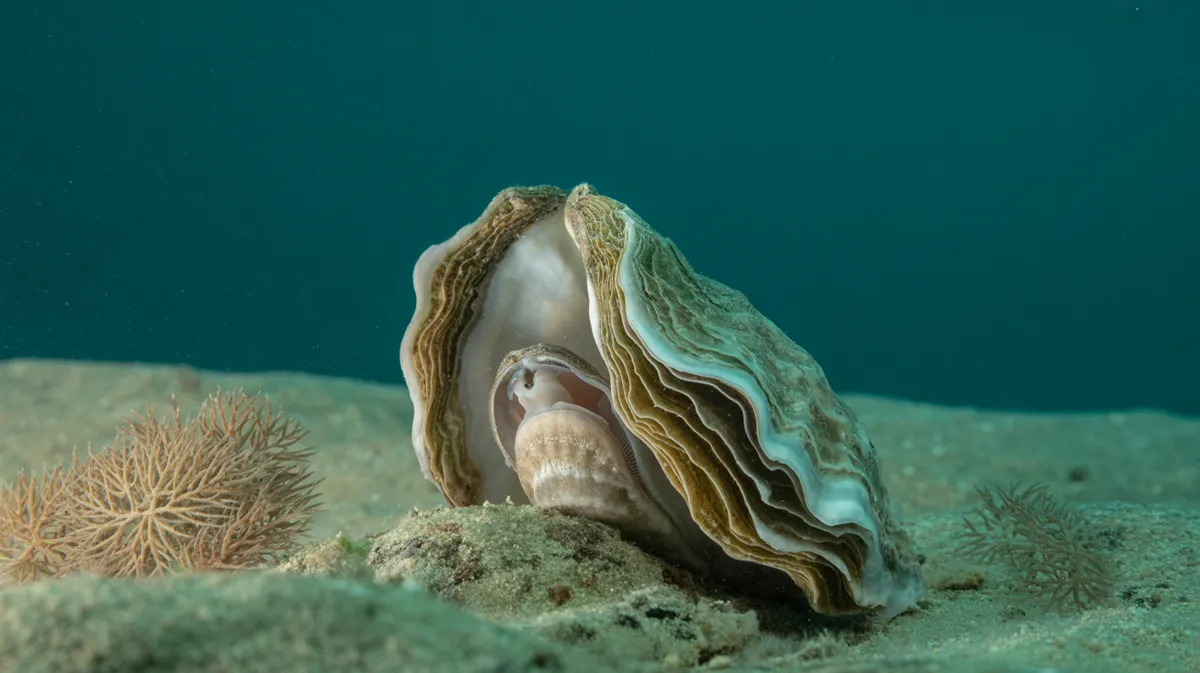
About the Saddle Oyster
The Saddle Oyster is a small, thin-shelled bivalve mollusk known for its translucent, irregularly shaped shell that often features a saddle-like depression. These mollusks attach themselves to hard substrates such as rocks, shells, and man-made structures in shallow marine environments using a unique byssal thread. Their shells often mirror the contours of the surface they are attached to, providing camouflage and protection. Saddle Oysters filter feed by drawing in plankton and organic particles from the surrounding water. They are widely distributed in temperate and subtropical coastal waters.
Fascinating facts
Shell Shape
The shell of the Saddle Oyster is often highly irregular and adapts to the contours of whatever surface it is attached to.
Habitat
Saddle Oysters are commonly found in shallow coastal waters, often in estuarine and intertidal zones.
Attachment Mechanism
They use a byssus thread, which passes through a natural hole in their lower shell, to firmly anchor themselves to substrates.
Detailed description
The Saddle Oyster (Anomia ephippium) is a small marine bivalve mollusk, typically measuring between 20 and 50 mm in length, with a shell that is notably thin, fragile, and translucent. The shell is highly irregular in outline, often adopting the contours of the substrate to which the animal is attached, resulting in a saddle-like depression that gives the species its common name. The upper (left) valve is convex and free-moving, while the lower (right) valve is flatter and cemented to the substrate via a calcified byssal foramen, through which the byssus passes. The shell coloration ranges from pale yellow to orange or pinkish hues, sometimes with iridescent patches. Internally, the shell is nacreous, providing some protection against boring organisms. The mantle edges are fringed with sensory papillae, and the gills are large and adapted for efficient filter feeding. Anomia ephippium lacks a true foot in adulthood, as it is sedentary after initial settlement. Its internal anatomy is specialized for a sessile lifestyle, with reduced mobility and a highly efficient ctenidial system for water filtration. The species is found from the intertidal zone down to depths of about 100 meters, favoring hard substrates in temperate and subtropical coastal waters of the eastern Atlantic, Mediterranean, and parts of the North Sea.
Did you know?
Unlike true oysters, Saddle Oysters are not harvested for food due to their small size and thin shells.
Research & sources
Behaviour & social structure
Saddle Oysters are sessile as adults, permanently attached to hard surfaces such as rocks, shells, or artificial structures. They are solitary but may occur in dense aggregations where suitable substrate is abundant. Their primary behavior is filter feeding: they draw water into the mantle cavity via ciliary action on their gills, trapping phytoplankton and suspended organic particles. Feeding activity is continuous, but rates may vary with tidal cycles, water temperature, and food availability. Juvenile Anomia are free-swimming larvae (veligers) before settling. There is little evidence of complex social interaction, though proximity to conspecifics can increase local reproductive success. They are preyed upon by starfish, crabs, and certain gastropods, and their thin shells provide limited defense, relying instead on camouflage and rapid growth to reduce predation risk.
Reproduction & life cycle
Anomia ephippium is dioecious, with separate male and female individuals. Spawning typically occurs in spring and early summer, though timing can vary with latitude and local conditions. Fertilization is external: both sexes release gametes into the water column, where fertilization occurs. The resulting planktonic larvae (veligers) remain in the water for several weeks, feeding on microalgae and drifting with currents. After reaching a suitable size, larvae settle onto hard substrates and undergo metamorphosis into the adult form, secreting byssal threads to anchor themselves. There is no parental care after spawning. Sexual maturity is usually reached within the first year, depending on environmental conditions.
Adaptations & survival
Saddle Oysters exhibit several notable adaptations for a sessile, filter-feeding lifestyle. Their shells are highly plastic, conforming to the shape of the substrate for camouflage and stability. The lower valve is perforated by a byssal foramen, allowing the secretion of strong, proteinaceous byssal threads that anchor the animal securely. The large, ciliated gills serve both for respiration and efficient particle capture. The thin, translucent shell reduces metabolic costs and allows rapid growth, while the nacreous interior provides some resistance to boring predators. The ability to settle on a wide range of substrates, including artificial structures, enhances their ecological success in coastal environments.
Cultural significance
Saddle Oysters have limited direct cultural or economic significance compared to true oysters. However, their translucent shells have occasionally been used in decorative arts and jewelry. In some regions, they are considered indicators of healthy benthic communities and are studied for their role in biofouling and as part of the marine epifaunal assemblage. There is no known role in mythology or folklore.
Recent research
Recent research has focused on the biomineralization processes in Anomia shells, which exhibit unique microstructural adaptations for strength and flexibility. Studies have also examined their role in biofouling communities on artificial substrates such as ship hulls and offshore platforms. Genetic studies are ongoing to clarify phylogenetic relationships within the Anomiidae family. Additionally, Anomia ephippium is used as a model organism for studying the effects of ocean acidification and heavy metal accumulation in coastal ecosystems.
Videos
Habitat
Shallow coastal ocean waters

Conservation
The Saddle Oyster is currently classified as Least Concern on the IUCN Red List.
Threats & challenges
Currently, Anomia ephippium is not considered threatened and is listed as Least Concern. However, local populations may be impacted by habitat loss due to coastal development, pollution (especially heavy metals and hydrocarbons), and sedimentation, which can smother filter feeders. Ocean acidification poses a long-term threat by weakening shells and affecting larval development. Invasive species and changes in predator populations can also influence local abundance. Despite these challenges, the species' broad distribution and adaptability to various substrates have helped maintain stable populations.
Taxonomy
Scientific name
Anomia ephippium
- Kingdom
- Animalia
- Phylum
- Mollusca
- Class
- Bivalvia
- Order
- Anomiida
- Family
- Anomiidae
- Genus
- Anomia
- Species
- ephippium
Community notes
Share your observations about the Saddle Oyster.
No community notes yet. Be the first!
Discover more wildlife
More fascinating animals from the encyclopedia.