
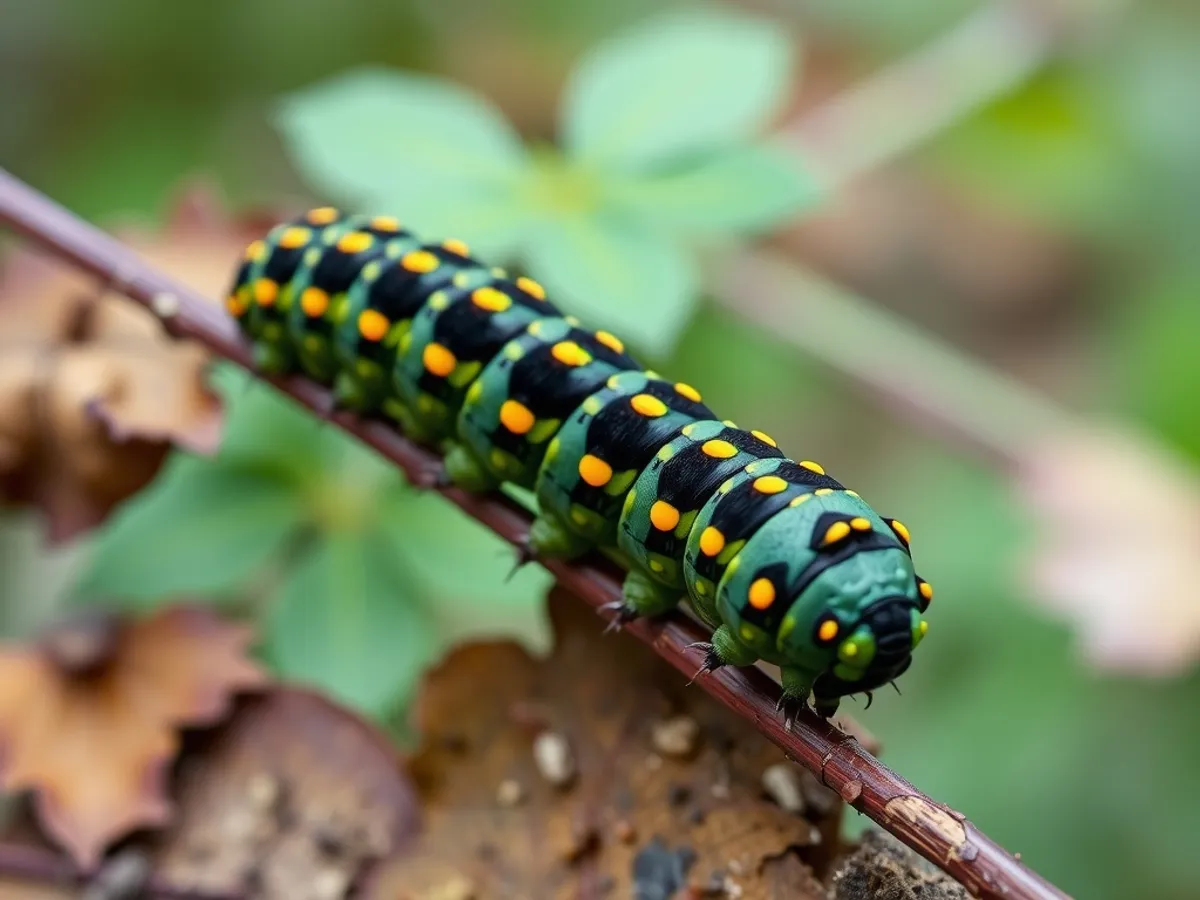
About the Saddleback Caterpillar
The Saddleback Caterpillar is a striking larval form of the moth Acharia stimulea, recognized for its bright green body adorned with a distinctive brown 'saddle' marking edged in white. This small, stout caterpillar is notorious for its venomous spines that can cause intense pain and skin irritation in humans upon contact. Found primarily in woodlands and gardens, it feeds on a wide variety of host plants, including ornamental shrubs and trees. Its vivid coloration serves as a warning to predators, showcasing its potent chemical defenses. As it matures, the caterpillar eventually pupates and transforms into a relatively inconspicuous brown adult moth.
Fascinating facts
Iconic Appearance
Its namesake 'saddle' marking is a bright green patch with a distinctive brown spot in the center, surrounded by white, making it easily recognizable.
Stinging Spines
The caterpillar is covered with urticating spines that deliver venom, causing pain, redness, and swelling if touched.
Wide Host Range
It feeds on leaves of many deciduous trees and shrubs, including oak, elm, maple, and ornamental plants.
Detailed description
The Saddleback Caterpillar (Acharia stimulea) is a distinctive larval stage of the Limacodidae family, measuring approximately 20–25 mm in length at maturity. Its most recognizable feature is the bright green, flattened body with a prominent, oval-shaped brown patch edged in white on its mid-dorsal region, resembling a saddle. The anterior and posterior ends are adorned with fleshy, horn-like protuberances covered in venomous urticating spines, which serve as a formidable defense mechanism against predators. The ventral surface is less conspicuous, aiding in camouflage when viewed from below. The caterpillar’s body is covered with shorter spines and setae that can also deliver toxins, causing localized pain, swelling, and sometimes systemic reactions in humans and other mammals. As a solitary feeder, it moves slowly and deliberately, relying on its aposematic coloration to warn potential threats. The larva undergoes several molts before spinning a tough, oval-shaped cocoon, often incorporating stinging spines into the silk for added protection. The adult moth, in contrast, is small and inconspicuous, with a wingspan of 25–40 mm, and exhibits muted brown and cream coloration, making it well-camouflaged among tree bark and leaf litter. The species is polyphagous, feeding on a wide range of host plants, including oaks, maples, elms, and various ornamental species, which contributes to its adaptability and widespread distribution in the eastern United States.
Did you know?
A single touch from the Saddleback Caterpillar’s spines can cause a burning, stinging sensation that may persist for hours in humans.
Research & sources
Behaviour & social structure
Saddleback Caterpillars are primarily solitary and do not exhibit social behaviors typical of some other Lepidoptera larvae. They are diurnal feeders, consuming host plant foliage during daylight hours, although feeding may continue into dusk. Their movement is slow and deliberate, and when threatened, they arch their bodies and display their spiny ends, maximizing the visual warning to predators. Feeding damage is typically characterized by irregular holes in leaves. The caterpillars do not actively hunt but rely on passive defense, with their venomous spines deterring birds, small mammals, and invertebrate predators. They do not construct communal nests or engage in cooperative behaviors. When ready to pupate, the caterpillar seeks a sheltered location on the underside of leaves or in leaf litter, where it constructs a silk cocoon for metamorphosis.
Reproduction & life cycle
Reproduction in Acharia stimulea follows the typical Lepidopteran pattern. Adults are nocturnal and are attracted to light sources, which facilitates mate location. Mating occurs shortly after adult emergence, usually in late spring to early summer, depending on regional climate. Females lay clusters of small, flattened, pale eggs on the undersides of host plant leaves. The incubation period for the eggs is approximately 7–10 days, after which the larvae emerge and begin feeding. There is typically one generation per year (univoltine) in northern parts of the range, but in southern regions, two generations (bivoltine) may occur. There is no parental care; after oviposition, the female does not tend to the eggs or larvae. Pupation occurs within a tough, silk cocoon, and the pupal stage can last from several weeks to overwintering, depending on environmental conditions.
Adaptations & survival
The Saddleback Caterpillar exhibits several notable adaptations. Its vivid aposematic coloration warns predators of its potent chemical defenses, a classic example of warning coloration in nature. The urticating spines contain hemolytic and vesicating toxins, including proteolytic enzymes and histamine-like compounds, which cause immediate pain and deter predation. The flattened body and cryptic ventral coloration provide camouflage from ground-based predators. The incorporation of spines into the cocoon adds a secondary layer of defense during the vulnerable pupal stage. Polyphagy, or the ability to feed on a wide variety of host plants, allows the species to exploit diverse habitats and reduces competition for resources. The adult moth’s cryptic coloration further aids in avoiding predation during its short, nocturnal life.
Cultural significance
The Saddleback Caterpillar is primarily known in human culture for its painful sting, which has led to its inclusion in public health advisories and educational materials about venomous insects in North America. It is sometimes featured in local folklore as a creature to be avoided, and its striking appearance makes it a subject of interest for naturalists and photographers. While it does not have deep mythological or symbolic significance, its presence in gardens and parks has made it a memorable species for those who encounter it. In some regions, it serves as a teaching tool for promoting awareness of native biodiversity and the importance of respecting wildlife.
Recent research
Recent research on Acharia stimulea has focused on the biochemical composition of its venom, revealing a complex mixture of proteins and peptides with cytolytic and neurotoxic properties. Studies have also examined the ecological interactions between the caterpillar and its parasitoids, highlighting the role of chemical defenses in shaping community dynamics. Genomic and transcriptomic analyses are underway to better understand the genetic basis of toxin production and resistance to plant secondary compounds. There is growing interest in the potential medical applications of caterpillar venoms, including their use as models for novel analgesics or anti-inflammatory agents. Ongoing citizen science initiatives, such as iNaturalist, have contributed valuable distributional data, aiding in the assessment of range shifts in response to climate change.
Sources
Life History and Defensive Behavior of the Saddleback Caterpillar, Acharia stimulea
Dyar, H.G. & Tuskes, P.M. (2018)
scientificAcharia stimulea (Clemens) (Lepidoptera: Limacodidae): Biology, Ecology, and Management
University of Florida, Entomology & Nematology Department (2017)
scientificAcharia stimulea (Clemens) (Lepidoptera: Limacodidae): Life History and Natural Enemies in Maryland
D. L. Wagner, J. L. Todd (1996)
scientificVideos
Habitat
Deciduous forests, gardens, and woodland edges


Conservation
The Saddleback Caterpillar is currently classified as Least Concern on the IUCN Red List.
Threats & challenges
Currently, Acharia stimulea faces few significant threats and is considered of Least Concern. Its broad host range and adaptability to disturbed habitats, such as gardens and suburban landscapes, contribute to stable populations. However, localized threats include habitat loss due to urbanization, pesticide use in ornamental plantings, and climate change, which may alter the distribution and phenology of both the caterpillar and its host plants. Natural enemies include parasitoid wasps (Braconidae, Ichneumonidae) and tachinid flies, which can significantly impact larval survival. There is no evidence of significant population declines, but ongoing monitoring is recommended, especially in areas of intensive land use change.
Taxonomy
Scientific name
Acharia stimulea
- Kingdom
- Animalia
- Phylum
- Arthropoda
- Class
- Insecta
- Order
- Lepidoptera
- Family
- Limacodidae
- Genus
- Acharia
- Species
- stimulea
Community notes
Share your observations about the Saddleback Caterpillar.
No community notes yet. Be the first!
Discover more wildlife
More fascinating animals from the encyclopedia.