
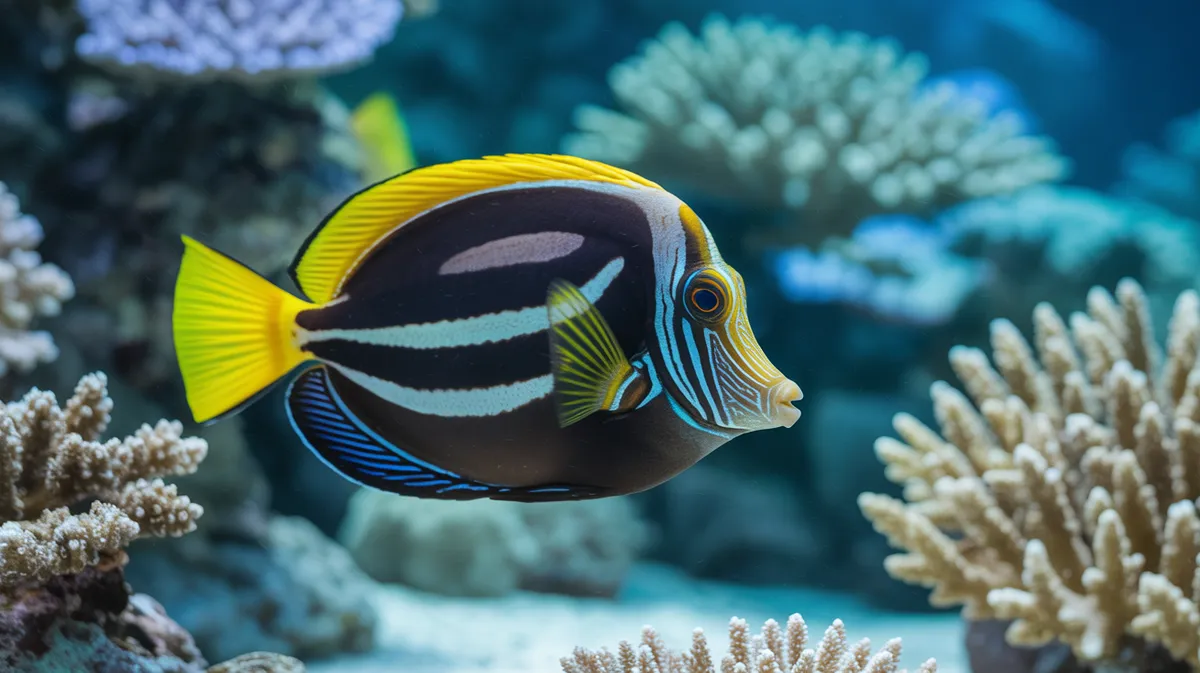
About the Sailfin Tang
The Sailfin Tang is a strikingly beautiful marine fish known for its large, sail-like dorsal and anal fins and its bold patterning of yellow and brown vertical stripes. Native to the Indo-Pacific region, this species thrives on coral reefs where it grazes on algae. Its laterally compressed body allows it to maneuver easily among coral branches, making it a popular choice for public and private aquariums. Sailfin Tangs are generally peaceful but may become territorial, especially in smaller tanks or when housed with other tangs.
Fascinating facts
Unique Fins
The Sailfin Tang's dorsal and anal fins are so elongated that when fully extended, they almost double the fish's body height.
Algae Eater
Sailfin Tangs are important reef cleaners, grazing constantly on algae and helping to maintain the health of coral ecosystems.
Hidden Weapon
This species has sharp, retractable spines near the base of its tail, which can inflict painful wounds on predators or rivals.
Detailed description
The Sailfin Tang (Zebrasoma veliferum) is a medium to large marine surgeonfish, reaching up to 40 cm (16 inches) in total length, though most individuals encountered are smaller. Its most distinctive features are the dramatically elongated dorsal and anal fins, which, when fully extended, give the fish a disk-like, sail-shaped profile. The body is laterally compressed, aiding in maneuverability among complex coral structures. The coloration consists of a pale to dark brown background with bold, vertical yellow bands and intricate blue or purple markings on the fins and face. Juveniles are generally darker and display less pronounced striping, gradually developing adult coloration as they mature. The mouth is small and terminal, equipped with specialized teeth adapted for grazing on filamentous algae. Like other surgeonfishes, it possesses a sharp, retractable spine or 'scalpel' on each side of the caudal peduncle, used for defense and territorial disputes. The eyes are positioned high on the head, providing a wide field of vision to detect predators and competitors. Sailfin Tangs are diurnal, spending daylight hours actively foraging and retreating to reef crevices at night for shelter. Their lifespan in the wild can exceed 15 years, though longevity in captivity is often shorter due to environmental stressors.
Did you know?
Despite their peaceful reputation, Sailfin Tangs have sharp, scalpel-like spines on their tails that they use for defense and to establish dominance.
Research & sources
Wikipedia summary
The sailfin tang, the Pacific sailfin tang, purple sailfinned tang or sailfin surgeonfish, is a marine ray-finned fish belonging to the family Acanthuridae which includes the surgeonfishes, unicornfishes and tangs. This fish is found in the Pacific Ocean and is popular in the aquarium hobby.
Behaviour & social structure
Sailfin Tangs are primarily herbivorous, feeding on a variety of benthic algae, including filamentous and macroalgae, which they crop from rocks and coral surfaces. This grazing behavior plays a crucial ecological role in controlling algal growth on reefs, thereby facilitating coral health. They are generally solitary or found in loose aggregations, especially when juveniles, but may form temporary feeding groups in areas of abundant food. Adults are territorial, particularly during the breeding season or in resource-limited environments, and will use their caudal spines to assert dominance or defend feeding territories. Social hierarchies are established through displays involving fin extension and lateral presentation. They exhibit site fidelity, often returning to the same sleeping crevice each night. In aquaria, they may become aggressive toward conspecifics or other tangs, especially in confined spaces.
Reproduction & life cycle
Reproduction in Zebrasoma veliferum is oviparous and involves external fertilization. Spawning typically occurs in pairs or small groups at dusk, coinciding with lunar cycles and warmer water temperatures, which may enhance larval survival. During courtship, males display intensified coloration and engage in circling and fin-flaring behaviors to attract females. Eggs are pelagic, buoyant, and hatch within 24–48 hours, depending on temperature. The larval stage, known as acronurus, is planktonic and can last several weeks, during which larvae disperse widely before settling onto suitable reef habitats. There is no parental care post-spawning; survival of offspring depends on dispersal and predation rates. Sexual maturity is generally reached at 2–3 years of age.
Adaptations & survival
The Sailfin Tang exhibits several notable adaptations. Its laterally compressed body and expanded fins allow for agile maneuvering through narrow reef crevices, aiding both in foraging and predator evasion. The sharp caudal peduncle spines serve as effective deterrents against predators and rivals. Specialized dentition and a long, coiled intestine enable efficient digestion of tough, fibrous algae. The ability to rapidly change coloration—darkening when threatened or during sleep—provides camouflage and reduces predation risk. Social and territorial behaviors are reinforced by visual displays, maximizing communication in the complex reef environment. Their pelagic larval stage promotes wide dispersal, enhancing genetic diversity and colonization potential.
Cultural significance
The Sailfin Tang is highly valued in the marine aquarium trade for its striking appearance and active behavior, often symbolizing the beauty and diversity of coral reef ecosystems. In some Pacific cultures, surgeonfishes are traditionally caught for food, though Zebrasoma veliferum is less commonly targeted due to its modest flesh yield and defensive spines. The species occasionally appears in popular media and educational materials as an ambassador for reef conservation. There are no significant mythological or ritual uses documented for this species.
Recent research
Recent research has focused on the ecological role of Zebrasoma veliferum in regulating reef algal communities and its resilience to environmental stressors. Studies have highlighted the importance of tangs in maintaining coral dominance by preventing algal overgrowth. Genetic analyses reveal substantial gene flow among populations across the Indo-Pacific, facilitated by the species' long pelagic larval duration. Ongoing research investigates the impacts of aquarium trade collection on wild populations and the potential for captive breeding to reduce wild harvest. Behavioral studies in both wild and captive settings continue to elucidate social dynamics, stress responses, and adaptation to environmental change.
Sources
Zebrasoma veliferum (Bloch, 1795): Species Summary
Froese, R. & Pauly, D. (eds.), FishBase (2023)
scientificVideos
Habitat
Coral reefs

Conservation
The Sailfin Tang is currently classified as Least Concern on the IUCN Red List.
Threats & challenges
Currently assessed as Least Concern by the IUCN, the Sailfin Tang faces localized threats from over-collection for the aquarium trade, habitat degradation due to coral reef loss, and climate change impacts such as ocean warming and acidification. While populations remain stable across much of their range, unsustainable harvesting in some regions can lead to local declines. Habitat fragmentation and declining coral cover may reduce available shelter and foraging grounds. Additionally, competition with invasive algae and changes in reef community structure pose indirect threats. Ongoing monitoring and sustainable collection practices are recommended to ensure long-term population health.
Taxonomy
Scientific name
Zebrasoma veliferum
- Kingdom
- Animalia
- Phylum
- Chordata
- Class
- Actinopterygii
- Order
- Acanthuriformes
- Family
- Acanthuridae
- Genus
- Zebrasoma
- Species
- veliferum
Community notes
Share your observations about the Sailfin Tang.
No community notes yet. Be the first!
Discover more wildlife
More fascinating animals from the encyclopedia.