
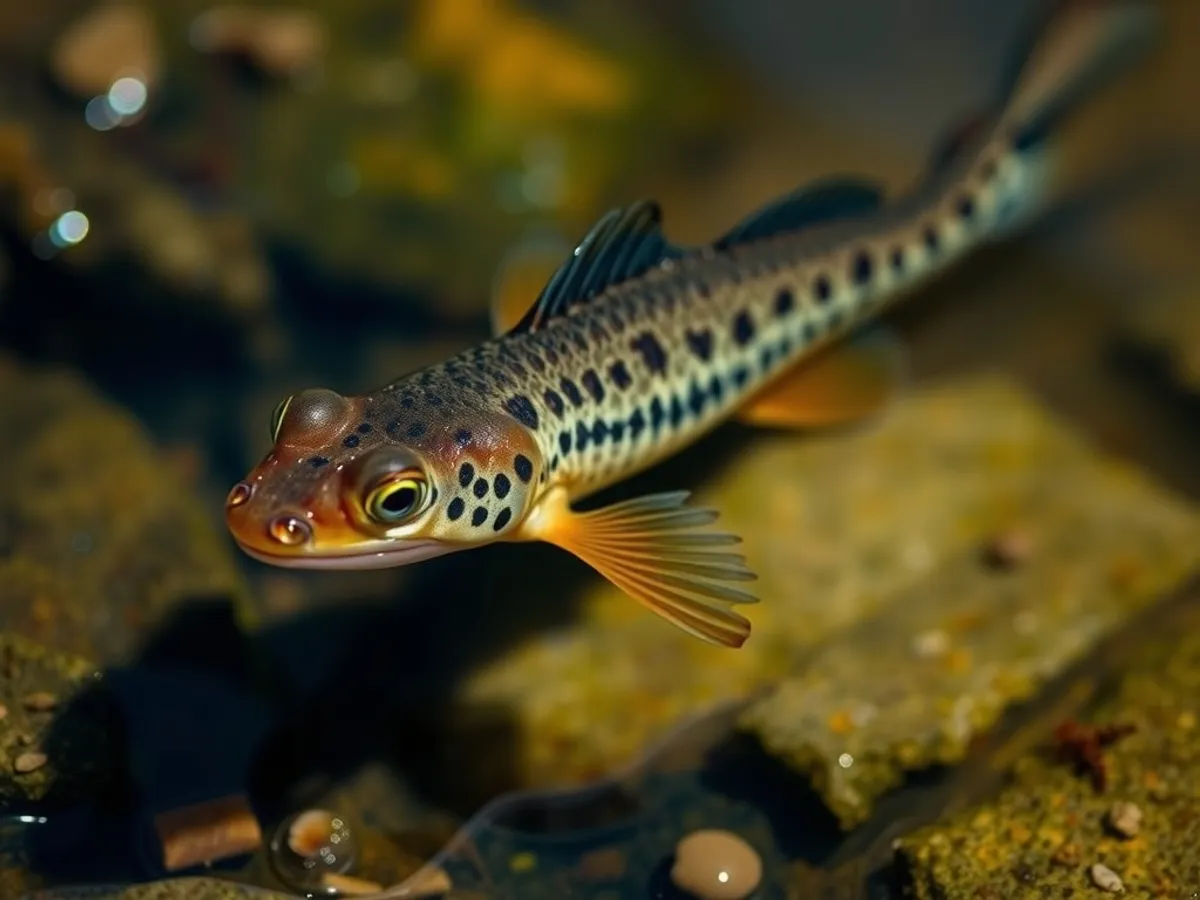
About the Salamanderfish
The Salamanderfish is a small, slender freshwater fish endemic to southwestern Australia. Noted for its unique ability to bend its body vertically and move its head independently like a salamander, it is one of the most unusual fish species in the world. It inhabits ephemeral, acidic pools and streams that often dry up in summer, surviving by burrowing into damp substrate. The Salamanderfish is the sole member of its family and genus, making it of significant evolutionary interest.
Fascinating facts
Salamander-like Movements
The Salamanderfish can rotate its head and flex its body vertically, a trait rare among fish and more akin to salamanders.
Survives Dry Seasons
During dry periods, it burrows into moist substrate to aestivate, slowing its metabolism until water returns.
Evolutionary Relic
It is the only species in its family, Lepidogalaxiidae, and represents a very ancient lineage of teleost fish.
Detailed description
The Salamanderfish (Lepidogalaxias salamandroides) is a diminutive, elongate freshwater fish, typically measuring 5–7 cm in length, with a maximum recorded size of about 7.5 cm. Its slender, cylindrical body is covered in small, cycloid scales and is usually olive-brown to dark brown, often with a mottled or speckled pattern that provides camouflage among leaf litter and sandy substrates. The head is broad and flattened, with large, upward-facing eyes adapted for spotting prey at the water’s surface. Uniquely among teleost fishes, the Salamanderfish can bend its neck and move its head independently of its body, a trait reminiscent of salamanders and rare among fishes. Fins are relatively small; the dorsal and anal fins are set far back on the body, aiding in rapid bursts of movement. The species is a facultative air-breather, able to survive in hypoxic conditions by gulping air at the surface. During the dry season, it burrows into moist sand or peat, entering a state of torpor (aestivation) until rains return. The Salamanderfish is solitary and cryptic, generally active during twilight hours (crepuscular), and is a specialized predator of aquatic invertebrates. Its unique evolutionary position as the sole member of its family and order makes it of great interest to evolutionary biologists.
Did you know?
Despite its name and salamander-like movements, the Salamanderfish is not related to amphibians but is a true fish with ancient evolutionary origins.
Research & sources
Wikipedia summary
Lepidogalaxias salamandroides is a species of small freshwater fish of Western Australia. It is the only member of the family Lepidogalaxiidae and genus Lepidogalaxias. Common names for this fish include salamanderfish and Shannon mudminnow. Although it is not a lungfish, it resembles lungfish in several respects, including its ability to survive dry seasons by burrowing into the sand. It is on the IUCN Red List as Endangered.
Behaviour & social structure
Salamanderfish are primarily ambush predators, lying motionless among leaf litter or submerged vegetation and darting out to capture small aquatic invertebrates such as insect larvae, microcrustaceans, and oligochaete worms. They exhibit a sit-and-wait hunting strategy, relying on their cryptic coloration and minimal movement to avoid detection by both prey and predators. Social interactions are minimal; individuals are typically solitary except during the breeding season. The species is known for its remarkable ability to flex its neck and lift its head, allowing it to scan for prey or predators above the substrate. Activity peaks during dawn and dusk, when the fish emerge from cover to feed. During the dry season, Salamanderfish burrow up to 30 cm deep into damp substrate, where they remain inactive, reducing metabolic rate to conserve energy and moisture.
Reproduction & life cycle
Breeding occurs during the austral winter and spring (June to October), coinciding with the filling of ephemeral pools. Males and females engage in simple courtship behaviors, with males following and nudging females. Fertilization is external; females lay small batches of adhesive eggs (50–150 per female) among submerged vegetation or detritus. There is no parental care; eggs are left to develop on their own. Embryonic development is rapid, with hatching occurring in about 7–10 days at typical water temperatures (12–18°C). Larvae are planktonic for a brief period before settling to the bottom and adopting benthic habits. Sexual maturity is reached within one year, and lifespan is estimated at 2–3 years in the wild.
Adaptations & survival
Key adaptations include the ability to aestivate for up to several months by burrowing into moist substrate, a trait that allows survival through the region’s harsh, dry summers. The flexible neck vertebrae, unique among teleosts, enable the fish to move its head independently, enhancing both prey detection and predator avoidance. Its tolerance for acidic, low-oxygen waters (pH as low as 3.0–4.5) is facilitated by efficient cutaneous and branchial respiration, and facultative air-breathing. The cryptic coloration and small size help avoid predation. Salamanderfish also exhibit rapid growth and early maturation, an adaptation to the unpredictable and ephemeral nature of their habitat.
Cultural significance
Due to its restricted range and cryptic lifestyle, the Salamanderfish has limited direct cultural significance. However, it is recognized as an important component of the region’s unique biodiversity and is of considerable scientific interest due to its evolutionary distinctiveness. The species is sometimes highlighted in conservation education and local biodiversity awareness campaigns in Western Australia. There are no known traditional uses or mythological associations.
Recent research
Recent molecular and morphological studies have confirmed the Salamanderfish’s status as a basal euteleost, representing an ancient lineage that diverged early from other modern teleosts. Its unique vertebral and cranial morphology has been the subject of anatomical and developmental research. Ongoing studies focus on its physiological adaptations to hypoxia and desiccation, as well as population genetics to inform conservation management. Habitat modeling and climate resilience research are underway to predict future distribution under changing environmental conditions. The species is also used as a model for studying vertebrate aestivation and the evolution of air-breathing in fishes.
Sources
The biology and ecology of the salamanderfish Lepidogalaxias salamandroides Mees (Pisces: Lepidogalaxiidae) in southwestern Australia
Morgan, D.L., Gill, H.S., Potter, I.C. (1995)
scientificVideos
Habitat
Ephemeral freshwater pools and streams

Conservation
The Salamanderfish is currently classified as Vulnerable on the IUCN Red List.
Threats & challenges
The primary threats to Salamanderfish are habitat loss and degradation, particularly due to land clearing for agriculture, urban development, and drainage of wetlands in southwestern Australia. Climate change poses a significant risk by altering rainfall patterns and increasing the frequency and duration of droughts, further reducing the availability of suitable ephemeral habitats. Invasive species, such as Gambusia holbrooki (mosquitofish), may compete for resources or prey on eggs and larvae. Pollution from agricultural runoff and altered fire regimes also threaten water quality and habitat structure. The species is listed as Endangered by the IUCN, with a declining and highly fragmented population restricted to a narrow range (<5,000 km²) in the south-western corner of Western Australia.
Taxonomy
Scientific name
Lepidogalaxias salamandroides
- Kingdom
- Animalia
- Phylum
- Chordata
- Class
- Actinopterygii
- Order
- Lepidogalaxiiformes
- Family
- Lepidogalaxiidae
- Genus
- Lepidogalaxias
- Species
- salamandroides
Community notes
Share your observations about the Salamanderfish.
No community notes yet. Be the first!
Discover more wildlife
More fascinating animals from the encyclopedia.