
About the Satanic Leaf-tailed Gecko
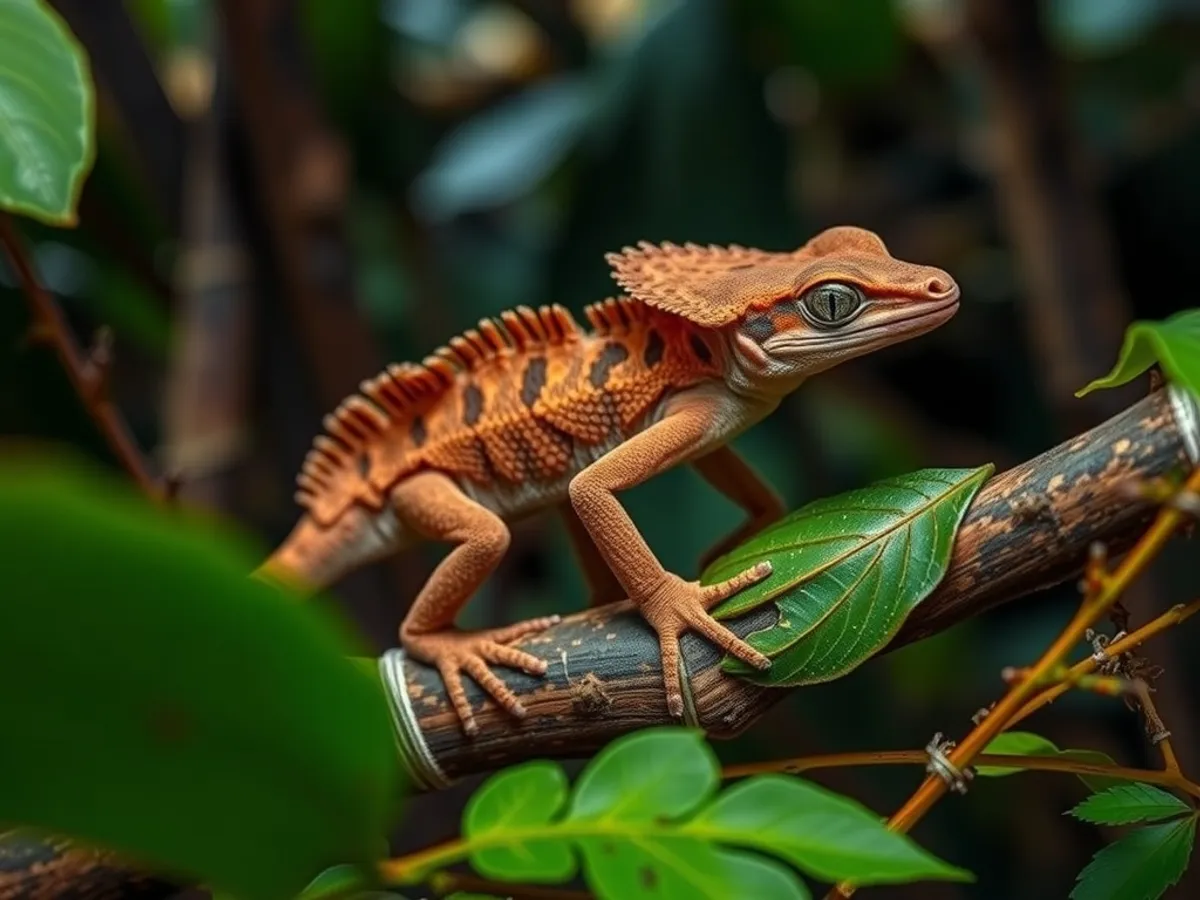
Uroplatus phantasticus, the satanic leaf-tailed gecko, is an eastern Madagascan rainforest lizard barely 7 to 9 centimetres long, and it is arguably the finest dead-leaf mimic among vertebrates. The mimicry is not merely leaf-shaped: the flattened tail carries irregular notches and asymmetric bite-outs that read as insect damage and rot, and the body bears raised veins and blotches of brown, russet and pale mould-like flecking. It is one of the smaller Uroplatus species, and the "horns" over the eyes are simply pointed supraocular scales. By day it hangs motionless below a branch, tail curled, and its outline is broken further by a fringe of skin along the jaw. It hunts insects at night; the vertical pupils open into enormous round apertures that gather what little light reaches the understorey. Despite the name, it has no venom, no relation to any devil, and no defence beyond stillness and a wide-mouthed bluff that flashes a bright red-orange lining. Its narrow range in humid montane forest, combined with heavy demand from the pet trade, has landed the whole genus under CITES protection.
Fascinating facts
Leaf Mimicry
This gecko's body and tail imitate dead leaves so well that it becomes nearly undetectable in its natural habitat.
Nocturnal Hunter
It is active at night, preying on insects and other small invertebrates in the dense rainforest understory.
Eye Cleaning
The gecko has no eyelids and regularly licks its eyes with its long tongue to keep them clean and moist.
Detailed description
The Satanic leaf-tailed gecko (Uroplatus phantasticus) is a small, arboreal lizard endemic to the humid rainforests of eastern Madagascar. Adults typically measure between 6.6 and 9.3 cm in total length, with the tail making up a significant portion of their body. Their most distinctive feature is the broad, flattened tail, which mimics a decaying leaf complete with notches, irregular edges, and intricate veining, enhancing their camouflage among forest detritus. The body is dorsoventrally compressed, aiding in concealment against tree bark and leaf litter. Their coloration varies from mottled brown to gray, often with subtle reddish or orange hues, allowing them to blend seamlessly with their surroundings. The gecko's large, lidless eyes are adapted for nocturnal vision, featuring vertical pupils that maximize light intake. Dermal flaps along the head, body, and limbs further break up their outline, making them nearly invisible to predators. Uroplatus phantasticus is primarily nocturnal, emerging at night to hunt and remaining motionless during the day. This species is solitary and highly territorial, relying on its cryptic appearance for both predation and predator avoidance. Its remarkable adaptations make it a subject of interest in studies of convergent evolution and cryptic morphology.
Did you know?
Despite its fearsome name, the Satanic leaf-tailed gecko is completely harmless and relies solely on camouflage for defense.
Research & sources
Behaviour & social structure
Satanic leaf-tailed geckos are strictly nocturnal, spending daylight hours pressed flat against tree trunks or among leaf litter to avoid detection. They exhibit sit-and-wait predatory behavior, remaining motionless until prey—primarily small insects such as crickets, moths, and beetles—comes within striking distance. Their hunting relies on stealth and rapid tongue projection. Social interactions are minimal outside of the breeding season, as individuals are territorial and may display threat postures or vocalizations if approached by conspecifics. They are known for their defensive behaviors, including tail autotomy (shedding the tail) and mouth-gaping displays to deter predators. During the night, they are more active, moving slowly and deliberately through the lower canopy and understory in search of food.
Reproduction & life cycle
Breeding in Uroplatus phantasticus generally coincides with the onset of the rainy season, typically from November to March. Males attract females through a combination of pheromonal cues and subtle behavioral displays. After mating, females lay clutches of 2 eggs, which are deposited in moist, concealed locations such as under leaf litter or in crevices. The eggs are oval and measure approximately 10–12 mm in length. Incubation lasts between 60 and 90 days, depending on ambient temperature and humidity. There is no parental care post-oviposition; hatchlings are fully independent and exhibit cryptic coloration from birth. Sexual maturity is reached at approximately 9–12 months of age.
Adaptations & survival
Uroplatus phantasticus displays a suite of morphological and behavioral adaptations for survival in Madagascar’s rainforest. Its leaf-like tail and body, complete with notches and veining, provide exceptional camouflage against predators such as birds and snakes. Dermal flaps along the body minimize shadow casting, enhancing their cryptic appearance. The gecko's skin is highly textured and can change slightly in hue to match its surroundings. Specialized toe pads with microscopic setae enable strong adhesion to smooth and rough surfaces, facilitating arboreal locomotion. The ability to shed the tail (autotomy) provides an escape mechanism from predators. Nocturnality reduces competition and predation risk, while large eyes with vertical pupils optimize night vision.
Cultural significance
The Satanic leaf-tailed gecko has gained international attention for its bizarre and striking appearance, often featured in ecotourism promotions and wildlife documentaries. Locally, it is not generally associated with specific myths or traditional uses, but its name and appearance have inspired fascination and superstition among some Malagasy communities. Globally, it serves as a flagship species for Madagascar’s unique biodiversity and is used in conservation campaigns to highlight the importance of rainforest preservation.
Recent research
Recent research has focused on the biomechanics of Uroplatus phantasticus's camouflage, including studies on dermal flap function and spectral reflectance matching with natural substrates. Genetic analyses are underway to clarify the phylogenetic relationships within the Uroplatus genus, which is known for high cryptic diversity. Conservation biologists are monitoring population trends using mark-recapture and habitat modeling to assess the impact of habitat fragmentation. Ongoing studies are also investigating the effects of the pet trade on wild populations and the efficacy of captive breeding programs as a conservation tool. Behavioral ecologists have documented unique anti-predator behaviors and are exploring the evolutionary drivers of extreme morphological adaptations in this species.
Sources
A revision of the genus Uroplatus (Squamata: Gekkonidae) in Madagascar
Glaw, F. & Vences, M. (2007)
scientificUroplatus phantasticus: The IUCN Red List of Threatened Species 2011
IUCN SSC Amphibian Specialist Group
conservationA revision of the genus Uroplatus (Squamata: Gekkonidae), with descriptions of eight new species
Frank Glaw, Miguel Vences (2007)
scientificUroplatus phantasticus: The IUCN Red List of Threatened Species 2020
IUCN SSC Amphibian Specialist Group
conservationVideos
Habitat
Tropical rainforests of Madagascar


Conservation
The Satanic Leaf-tailed Gecko is currently classified as Least Concern on the IUCN Red List.
Threats & challenges
While currently listed as Least Concern by the IUCN, the Satanic leaf-tailed gecko faces increasing threats from habitat destruction due to slash-and-burn agriculture, logging, and human settlement expansion in Madagascar. The illegal pet trade poses a significant risk, as their unique appearance makes them highly sought after by collectors, leading to unsustainable harvesting from the wild. Fragmentation of rainforest habitats restricts population connectivity and genetic diversity. Climate change may further exacerbate habitat loss and alter the microclimates essential for their survival. Although some populations persist in protected areas, ongoing deforestation and lack of effective enforcement of wildlife trade regulations remain major conservation challenges.
Taxonomy
Scientific name
Uroplatus phantasticus
- Kingdom
- Animalia
- Phylum
- Chordata
- Class
- Reptilia
- Order
- Squamata
- Family
- Gekkonidae
- Genus
- Uroplatus
- Species
- phantasticus
Community notes
Share your observations about the Satanic Leaf-tailed Gecko.
No community notes yet. Be the first!
Discover more wildlife
More fascinating animals from the encyclopedia.