
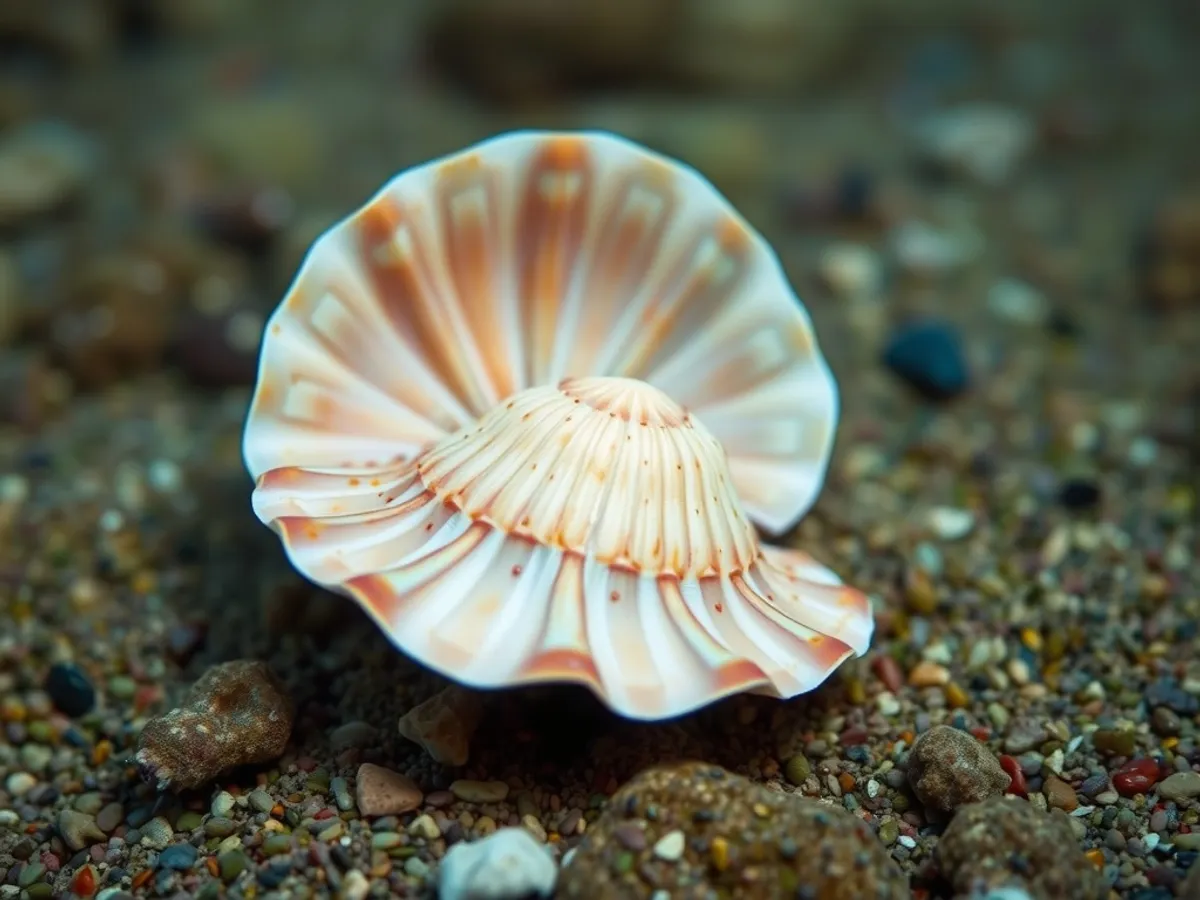
About the Scallop
Scallops are among the very few bivalves that swim, clapping their valves to jet water backwards out of the hinge corners and hopping erratically through the water column to escape sea stars. That escape burst is powered by a single oversized adductor muscle, and unlike most bivalve muscles it is largely fast-twitch striated fibre, which is exactly why the scallop is the one bivalve whose muscle is eaten as a steak. The more remarkable feature is the ring of up to 200 blue eyes fringing the mantle edge. These are mirror eyes rather than lens eyes: light passes through to a concave mirror built from stacked square guanine crystals at the back of the eye, which reflects and focuses an image onto two separate retinas. Research published in 2017 showed the crystals are tiled like a mosaic to minimise optical distortion, an arrangement engineers had assumed only telescopes used. The scallop's brain is a small ring of ganglia, so it cannot form a picture in any meaningful sense; the eyes appear to detect moving dark shapes and changes in particle drift, telling it when to snap shut or bolt. Many species, including the great scallop Pecten maximus, are hermaphrodites, with the orange roe and cream testis both visible in one animal.
Fascinating facts
Hundreds of Eyes
Scallops can have up to 200 tiny, vivid blue eyes along the edge of their mantle, which they use to detect light and movement, helping them evade predators.
Swimming Ability
Unlike many other bivalves, scallops can swim by forcefully clapping their shells together, allowing them to escape threats like starfish.
Culinary Delicacy
The scallop's adductor muscle is highly valued in global cuisine for its sweet, tender flavor and is a staple in many seafood dishes.
Detailed description
Pecten maximus, commonly known as the great scallop or king scallop, is a large marine bivalve mollusk distinguished by its robust, fan-shaped shell, which can reach up to 17 cm in diameter. The shell is composed of two convex valves, typically colored cream to reddish-brown, with distinctive radiating ribs and a wavy, fluted margin. Along the edge of its mantle, P. maximus possesses up to 200 tiny, vivid blue eyes containing mirror-like guanine crystals, which enable the detection of changes in light and movement, aiding in predator avoidance. The animal's muscular adductor muscle, responsible for closing the shell, is highly developed and allows for rapid shell clapping, propelling the scallop through the water in short bursts—a rare form of locomotion among bivalves. Internally, the scallop has well-developed gills for filter feeding, extracting phytoplankton and organic particles from the water column. P. maximus is primarily solitary, residing partially buried on sandy or gravelly substrates from the low tide mark to depths exceeding 100 meters, though it may aggregate in areas of high population density. Its life span can extend up to 20 years, with growth rates influenced by environmental conditions. The species exhibits a complex reproductive cycle, being a functional hermaphrodite with separate male and female gonads, and releases gametes into the water for external fertilization. Scallops play a significant ecological role as both prey and filter feeders, contributing to benthic-pelagic coupling in coastal ecosystems.
Did you know?
Unlike most bivalves, scallops are active swimmers, not just sedentary dwellers.
Research & sources
Wikipedia summary
Scallop is a common name that encompasses various species of marine bivalve molluscs in the taxonomic family Pectinidae, the scallops. However, the common name "scallop" is also sometimes applied to species in other closely related families within the superfamily Pectinoidea, which also includes the thorny oysters.
Behaviour & social structure
Pecten maximus is primarily sedentary but exhibits a unique escape response when threatened by predators such as starfish or crabs. Upon sensing danger, the scallop rapidly contracts its adductor muscle, clapping its valves together and expelling water through openings near the hinge, allowing it to swim in a series of jerky, backward leaps. This swimming behavior is energetically costly and used sparingly. Feeding occurs continuously; the scallop filters large volumes of water daily, using ciliated gills to trap plankton and organic detritus. Scallops are generally solitary but may form loose aggregations, especially in optimal habitats. They are most active during periods of increased plankton availability, often at night or during tidal flows. Sensory tentacles and eyes along the mantle edge provide environmental awareness, enabling rapid response to touch, shadows, or chemical cues.
Reproduction & life cycle
Pecten maximus is a protandric hermaphrodite, typically functioning first as a male and later as a female as it matures. Spawning occurs once or twice annually, usually in spring and late summer, triggered by rising water temperatures and increased food supply. During spawning, scallops release sperm and eggs into the water column, where external fertilization takes place. Each individual can produce millions of eggs per spawning event. The fertilized eggs develop into free-swimming planktonic larvae (veligers) within 24-48 hours. Larvae remain in the plankton for 3-4 weeks, undergoing several developmental stages before settling onto the substrate and metamorphosing into juvenile scallops. There is no parental care; survival rates are low due to predation and environmental factors.
Adaptations & survival
Pecten maximus possesses several notable adaptations, including its highly developed adductor muscle for rapid swimming, a rare trait among bivalves that enhances escape from benthic predators. The mantle's fringe of eyes and sensory tentacles provides advanced detection of light, movement, and chemical cues, increasing survival odds. The shell's ribbed structure offers mechanical strength and resistance to crushing. Filter-feeding adaptations include large, efficient gills and ciliated feeding grooves. The ability to alter shell coloration and patterning may provide camouflage against the substrate. Scallops also exhibit seasonal metabolic adjustments, reducing activity and growth during colder months to conserve energy.
Cultural significance
Scallops have held symbolic and economic importance for centuries. The shell of Pecten maximus is famously associated with the pilgrimage to Santiago de Compostela, serving as a badge for pilgrims and a symbol of spiritual journey in Christian iconography. In culinary traditions, the adductor muscle is a prized delicacy in European and global cuisines, featured in dishes such as Coquilles Saint-Jacques. Scallop shells have also been used historically as utensils, decorative items, and motifs in art and heraldry. The species supports significant fisheries, contributing to local economies and gastronomic heritage.
Recent research
Recent research on Pecten maximus has focused on its genome, which was sequenced in 2020, revealing insights into shell formation, sensory biology, and resistance to environmental stressors. Studies on larval dispersal and population genetics have improved understanding of connectivity among scallop beds, informing management. Investigations into the impact of microplastics and ocean acidification are ongoing, with early results indicating potential risks to larval development and adult health. Innovative aquaculture techniques, including hatchery-based stock enhancement and selective breeding for disease resistance, are being developed to support sustainable fisheries.
Videos
Habitat
Ocean

Conservation
The Scallop is currently classified as Least Concern on the IUCN Red List.
Threats & challenges
While Pecten maximus is currently listed as Least Concern, it faces several threats, primarily from intensive commercial harvesting, habitat degradation, and climate change. Overfishing can lead to local population declines, especially where dredging disturbs benthic habitats and removes juveniles. Ocean acidification and warming may impact larval development and shell formation. Bycatch and pollution, including microplastics, also pose risks. Management strategies, such as seasonal closures, size limits, and rotational harvesting, are implemented in many regions to promote sustainable populations. Ongoing monitoring is necessary to detect and mitigate emerging threats.
Taxonomy
Scientific name
Pecten maximus
- Kingdom
- Animalia
- Phylum
- Mollusca
- Class
- Bivalvia
- Order
- Pectinida
- Family
- Pectinidae
- Genus
- Pecten
- Species
- maximus
Community notes
Share your observations about the Scallop.
No community notes yet. Be the first!
Discover more wildlife
More fascinating animals from the encyclopedia.