
About the Scaly-foot gastropod
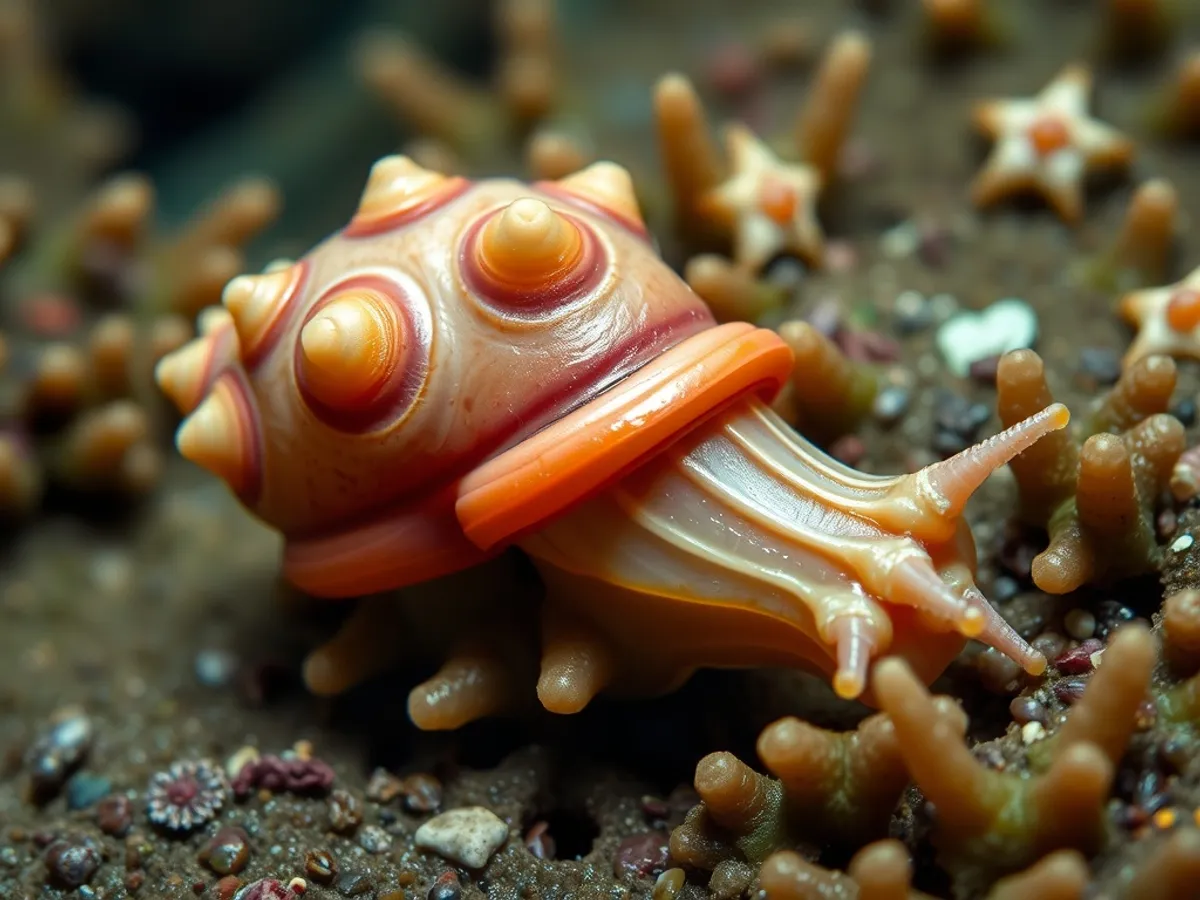
The scaly-foot gastropod (Chrysomallon squamiferum) lives only at a handful of deep hydrothermal vent fields in the Indian Ocean, at depths around 2,400 to 2,900 metres. It is the only animal known to build iron sulfide into its skeleton: the hundreds of overlapping scales armouring its foot, and the outer layer of its shell, are mineralised with greigite, giving it a black, metallic look. The armour is a three-layer sandwich, with a hard iron sulfide outer layer, a squashy organic middle layer that absorbs and dissipates the energy of a crab's crushing claw, and an aragonite inner layer, and materials scientists have studied the arrangement for body-armour design. Internally it is even stranger. Its heart is enormous, roughly four per cent of body volume, thought to be the largest heart relative to body size of any animal, because it must pump oxygen-rich blood to a hugely enlarged oesophageal gland packed with symbiotic sulfur-oxidising bacteria. Those bacteria feed the snail, whose gut and mouthparts are correspondingly reduced. It cannot move far from the vent chemistry it depends on, and in 2019 it became the first species listed as Endangered explicitly because of the threat of deep-sea mining.
Fascinating facts
Iron Armor
The Scaly-foot gastropod's shell and foot scales are uniquely reinforced with iron sulfide, offering robust protection against predators and harsh vent conditions.
Extreme Habitat
This species is found only at hydrothermal vent fields in the Indian Ocean, living at depths over 2,400 meters where temperatures and chemical concentrations are extreme.
Symbiotic Survival
It relies on symbiotic bacteria housed within its body to process hydrogen sulfide from vent fluids, converting it into energy.
Detailed description
The Scaly-foot gastropod (Chrysomallon squamiferum) is a deep-sea mollusk notable for its extraordinary anatomical adaptations to life at hydrothermal vents. Reaching up to 4.1 cm in shell length, its shell is uniquely composed of three layers: an outer layer of iron sulfide minerals (greigite and pyrite), a thick organic periostracum, and an inner aragonite layer. The foot is covered in overlapping sclerites—scale-like structures also mineralized with iron sulfides—providing robust protection against predators and the harsh vent environment. Internally, the snail possesses an enlarged esophageal gland that houses endosymbiotic gammaproteobacteria, which oxidize hydrogen sulfide from vent fluids to provide nutrition—a rare case of chemosymbiosis in gastropods. The circulatory system is highly developed, with a large heart (proportionally the largest among gastropods) and extensive blood sinuses, supporting oxygen transport in low-oxygen, high-sulfide conditions. The digestive tract is reduced, reflecting reliance on symbionts. The species is found exclusively at hydrothermal vent fields in the Indian Ocean, including the Kairei, Solitaire, and Longqi fields, at depths of 2,400–2,900 meters. The scaly-foot gastropod is slow-moving and adapted to a sedentary lifestyle, clustering around vent chimneys where chemical gradients are optimal. Its unique mineralized armor and symbiotic relationship with bacteria make it a subject of intense scientific interest, with no close analogs among other mollusks.
Did you know?
This species is so specialized to vent environments that it cannot survive outside of hydrothermal vent fields.
Research & sources
Wikipedia summary
Chrysomallon squamiferum, commonly known as the scaly-foot gastropod, scaly-foot snail, sea pangolin, or volcano snail, is a species of deep-sea hydrothermal-vent snail, a marine gastropod mollusc in the family Peltospiridae. This vent-endemic gastropod is known only from deep-sea hydrothermal vents in the Indian Ocean, where it has been found at depths of about 2,400–2,900 m (1.5–1.8 mi). C. squamiferum differs greatly from other deep-sea gastropods, even the closely related neomphalines. In 2019, it was declared endangered on the IUCN Red List, the first species to be listed as such due to risks from deep-sea mining of its vent habitat.
Behaviour & social structure
Chrysomallon squamiferum exhibits a largely sessile or slow-moving lifestyle, remaining close to active vent chimneys where hydrogen sulfide concentrations are high. It does not actively hunt; instead, it relies on its symbiotic bacteria for nutrition. Individuals are often found in dense aggregations, sometimes numbering hundreds per square meter, suggesting a tolerance for high population densities and possibly some degree of social facilitation or communal living. There is little evidence of aggressive interactions, and the species appears to coexist with other vent fauna, such as crabs and polychaete worms. The snail's behavior is closely tied to vent activity; it may relocate short distances if vent flow changes, but otherwise remains stationary. Daily routines are not well defined due to the constant darkness and stable conditions of the deep sea, but the snail's metabolic activity is thought to be regulated by the availability of vent chemicals.
Reproduction & life cycle
The reproductive biology of the scaly-foot gastropod is still being elucidated, but available evidence suggests it is a gonochoristic species (separate sexes). Females produce large, yolky eggs, indicative of lecithotrophic development—where larvae rely on yolk reserves rather than feeding in the plankton. Spawning likely occurs year-round, as is typical for many vent organisms, due to the stable environmental conditions. Fertilization is presumed to be external, with eggs released into the water column. There is no evidence of parental care post-spawning. The dispersal phase is thought to be brief, limiting the species' ability to colonize distant vent fields and contributing to its highly localized distribution.
Adaptations & survival
Chrysomallon squamiferum displays several remarkable adaptations: (1) Iron sulfide mineralization of the shell and foot scales, providing mechanical strength and resistance to predation (notably from vent crabs) and possibly protection from toxic vent fluids. (2) A hypertrophied esophageal gland housing chemosynthetic bacteria, allowing the snail to exploit chemical energy from vent emissions. (3) An enlarged heart and circulatory system to transport oxygen and sulfide efficiently in a low-oxygen environment. (4) Reduced digestive tract, reflecting reliance on endosymbionts. (5) Tolerance to high temperatures (up to 40°C) and extreme chemical gradients. (6) The ability to aggregate densely, possibly enhancing reproductive success and stability in a patchy habitat.
Cultural significance
While the scaly-foot gastropod is not part of traditional human culture or mythology due to its recent discovery (2001) and inaccessible habitat, it has become a symbol of deep-sea biodiversity and the need for conservation of hydrothermal vent ecosystems. Its unique iron-armored shell has inspired biomimetic research in materials science and engineering. The species is sometimes referred to as the 'sea pangolin' in popular media, drawing attention to its armored appearance and conservation plight.
Recent research
Recent research has focused on the biomineralization processes underlying the formation of iron sulfide scales and shell layers, with implications for materials science. Genomic studies have revealed genes associated with metal tolerance, chemosymbiosis, and shell formation. The species was the first animal to be listed as Endangered by the IUCN due to deep-sea mining threats, highlighting its role as a flagship species for vent conservation. Ongoing studies are investigating its population genetics, dispersal mechanisms, and the functional ecology of its symbiotic bacteria. The scaly-foot gastropod is also a model for studying adaptation to extreme environments and the evolution of symbiosis.
Sources
The iron-clad gastropod Chrysomallon squamiferum from hydrothermal vents (Gastropoda: Neomphalina: Peltospiridae): an ancient lineage with unique biomineralization
Chen, C., Linse, K., Copley, J.T., Rogers, A.D. (2015)
scientificVideos
Habitat
Deep-sea hydrothermal vents
Conservation
The Scaly-foot gastropod is currently classified as Endangered on the IUCN Red List.
Threats & challenges
The primary threat to the scaly-foot gastropod is deep-sea mining, particularly for polymetallic sulfides at hydrothermal vent fields. Mining activities can destroy vent habitats, disrupt chemical gradients, and cause population fragmentation or local extinction. The species' highly restricted range and low dispersal ability make it especially vulnerable to habitat loss. Additional threats include climate change impacts on ocean chemistry and potential pollution from mining operations. The IUCN Red List classifies C. squamiferum as Endangered, with populations declining due to imminent mining interests. Conservation challenges include the difficulty of monitoring deep-sea populations and the lack of legal protection for vent ecosystems in international waters.
Taxonomy
Scientific name
Chrysomallon squamiferum
- Kingdom
- Animalia
- Phylum
- Mollusca
- Class
- Gastropoda
- Order
- Neomphalida
- Family
- Peltospiridae
- Genus
- Chrysomallon
- Species
- squamiferum
Community notes
Share your observations about the Scaly-foot gastropod.
No community notes yet. Be the first!
Discover more wildlife
More fascinating animals from the encyclopedia.