
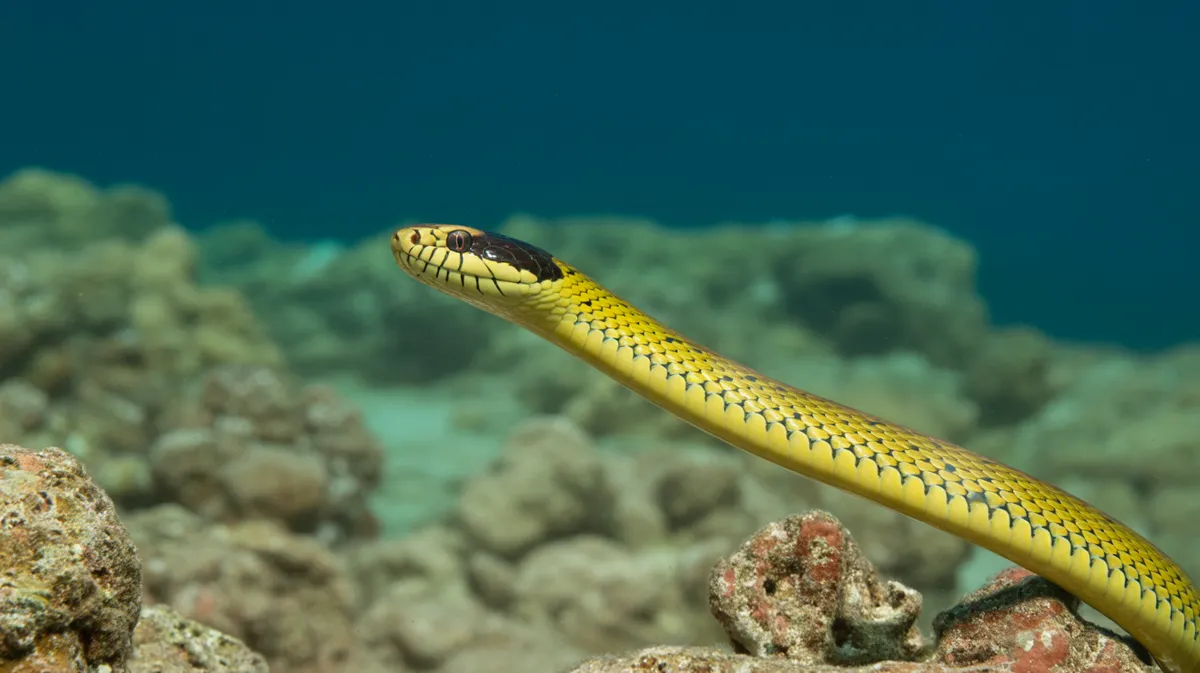
About the Short-nosed Sea Snake
The Short-nosed Sea Snake is a critically endangered marine reptile known for its distinctive short, rounded snout and robust body. This species is highly adapted to life in the ocean, with paddle-shaped tails and valved nostrils that allow it to swim efficiently and stay submerged for long periods. It is primarily found in the shallow reefs and coastal waters of northwestern Australia, particularly around Ashmore and Cartier Reefs. The Short-nosed Sea Snake feeds mainly on small fish and eels, using its potent venom to subdue prey. Due to its extremely restricted range and declining population, it is one of the rarest sea snakes in the world.
Fascinating facts
Unique Snout
The Short-nosed Sea Snake is easily recognized by its unusually short and rounded snout, which sets it apart from other sea snake species.
Marine Specialist
Unlike many snakes, this species spends its entire life in the ocean, rarely if ever coming ashore.
Venomous Hunter
It uses potent venom to immobilize its prey, mainly small fish and eels hiding in coral crevices.
Detailed description
The Short-nosed Sea Snake (Aipysurus apraefrontalis) is a medium-sized marine elapid, typically reaching total lengths of 60–80 cm, with females generally larger than males. It is distinguished by its notably short, blunt snout and a robust, cylindrical body that is laterally compressed towards the tail, enhancing its swimming efficiency. The dorsal coloration is usually a uniform dark brown to purplish hue, sometimes with faint lighter bands, while the ventral surface is paler. The species possesses large, paddle-shaped tails and reduced ventral scales, both adaptations for an aquatic lifestyle. Nostrils are positioned dorsally and equipped with valvular flaps to prevent water ingress during submersion. The eyes are relatively small, reflecting a reliance on chemoreception and mechanoreception over vision. The skin is covered in smooth scales, which reduce drag and may help resist fouling by marine organisms. Internally, the lungs are elongated, extending almost the entire length of the body, allowing for extended dives of up to two hours. This species is viviparous, giving birth to live young, and is highly specialized for life in shallow coral reef environments, where it occupies crevices and forages among complex substrates.
Did you know?
This species was once considered extinct until it was rediscovered in 2015 after not being seen for over 15 years.
Research & sources
Behaviour & social structure
Aipysurus apraefrontalis is primarily nocturnal, emerging from shelter in coral crevices at dusk to hunt. It exhibits solitary behavior, with individuals maintaining loosely defined home ranges and rarely interacting outside of the breeding season. The snake hunts by slowly patrolling the reef, using its forked tongue to detect chemical cues from prey. It preys mainly on small benthic fish and eels, ambushing them with a rapid strike and subduing them with potent neurotoxic venom. Feeding events are infrequent, with individuals sometimes fasting for extended periods. During daylight hours, the snake remains hidden to avoid predators and minimize energy expenditure. Social interactions are limited, though temporary aggregations may occur in areas of high prey density or during mating periods. The species is known to surface periodically to breathe, but can remain submerged for over an hour due to efficient oxygen storage and cutaneous respiration.
Reproduction & life cycle
The Short-nosed Sea Snake is viviparous, with internal fertilization and the development of embryos within the female. Mating is believed to occur during the austral winter (May–July), with males actively seeking out females using chemosensory cues. Courtship involves tactile stimulation and body alignment. Gestation lasts approximately 5–6 months, after which females give birth to 2–5 fully formed young, each measuring around 20–25 cm in length. Neonates are independent from birth and receive no parental care. Breeding frequency is thought to be annual, though reproductive output may be influenced by environmental conditions and prey availability. Little is known about juvenile survival rates, but recruitment is believed to be low, contributing to the species’ vulnerability.
Adaptations & survival
Aipysurus apraefrontalis exhibits a suite of adaptations for marine life. Its laterally compressed tail acts as a powerful paddle, enabling agile swimming and maneuverability in complex reef environments. The valved nostrils close tightly underwater, preventing water entry during dives. Reduced ventral scales minimize friction and facilitate smooth movement over coral and sand. The species’ potent venom is highly effective against fish, allowing rapid immobilization of prey in aquatic settings. Elongated lungs and the ability to absorb oxygen through the skin (cutaneous respiration) enable prolonged submersion. Salt glands located near the tongue excrete excess salt, maintaining osmotic balance. The snake’s cryptic coloration provides camouflage among coral and rocky substrates, reducing predation risk.
Cultural significance
Due to its remote distribution and rarity, the Short-nosed Sea Snake has little direct cultural significance to indigenous or local communities. It does not feature prominently in regional folklore or traditional medicine. However, as a component of coral reef biodiversity, it holds intrinsic ecological value and is of scientific interest as an indicator of reef health. Its precipitous decline has drawn attention from conservationists and marine biologists, symbolizing the vulnerability of specialized marine fauna to environmental change.
Recent research
Recent research has focused on population rediscovery and genetic analysis. A 2015 survey confirmed the continued existence of the species at Ashmore Reef, using underwater visual census and environmental DNA (eDNA) sampling. Genetic studies have revealed low genetic diversity, likely due to population bottlenecks and geographic isolation. Ongoing research aims to clarify its ecological requirements, reproductive biology, and responses to environmental stressors. Conservation efforts are being coordinated by Australian agencies, including habitat monitoring and the assessment of bycatch mitigation measures. The species is also being studied as a model for understanding the evolutionary adaptations of marine reptiles to extreme habitat specialization.
Sources
Aipysurus apraefrontalis (Short-nosed Sea Snake): Biology, Ecology, and Conservation Status
Lukoschek, V., Heatwole, H., & Guinea, M. (2013)
scientificAipysurus apraefrontalis: The IUCN Red List of Threatened Species 2010
IUCN SSC Marine Turtle Specialist Group
conservationThe taxonomy and biology of the Short-nosed Sea Snake (Aipysurus apraefrontalis)
Lukoschek, V., Guinea, M., & Fry, B.G. (2007)
scientificAipysurus apraefrontalis: The IUCN Red List of Threatened Species 2010
IUCN SSC Marine Turtle Specialist Group
conservationVideos
Habitat
Shallow coral reefs and coastal marine waters

Conservation
The Short-nosed Sea Snake is currently classified as Critically Endangered on the IUCN Red List.
Threats & challenges
The Short-nosed Sea Snake faces multiple severe threats. Its extremely limited range—historically restricted to Ashmore, Cartier, and Hibernia Reefs in the Timor Sea—makes it highly susceptible to localized disturbances. Major threats include habitat degradation from coral bleaching, cyclones, and oil spills, as well as bycatch in trawl fisheries. The introduction of invasive species and marine debris further degrade habitat quality. Population surveys indicate a dramatic decline since the late 1990s, with the species considered possibly extinct until a small population was rediscovered in 2015. Ongoing challenges include the lack of effective legal protection for its habitat and limited knowledge of its ecology, which hampers conservation planning. Climate change-driven shifts in sea temperature and coral health pose additional long-term risks.
Taxonomy
Scientific name
Aipysurus apraefrontalis
- Kingdom
- Animalia
- Phylum
- Chordata
- Class
- Reptilia
- Order
- Squamata
- Family
- Elapidae
- Genus
- Aipysurus
- Species
- apraefrontalis
Community notes
Share your observations about the Short-nosed Sea Snake.
No community notes yet. Be the first!
Discover more wildlife
More fascinating animals from the encyclopedia.