
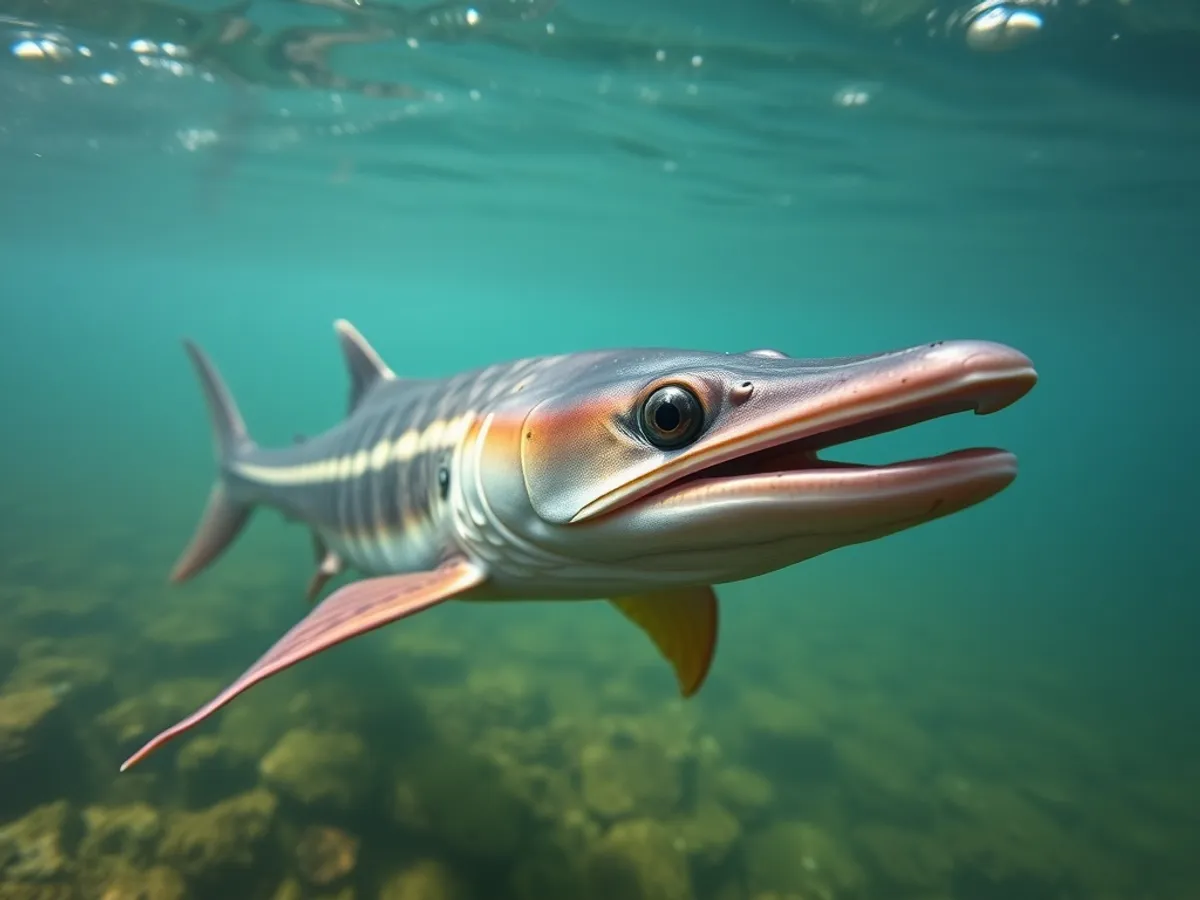
About the Shortnose sturgeon
The Shortnose sturgeon is a small, endangered species of sturgeon native to the eastern coast of North America. It is easily recognized by its short, broad snout and bony plates known as scutes that line its body. This bottom-dwelling fish inhabits large rivers and estuaries, spending most of its life in brackish or freshwater environments. Highly sensitive to habitat disturbance and pollution, the Shortnose sturgeon has suffered severe population declines due to overfishing, habitat fragmentation, and water pollution. Conservation efforts are ongoing to protect and restore its populations throughout its range.
Fascinating facts
Living Fossil
The Shortnose sturgeon has remained virtually unchanged for over 100 million years, making it a true living fossil.
Migratory Behavior
This species migrates upriver to spawn, often covering considerable distances between freshwater and brackish habitats.
Slow Growth
Shortnose sturgeon grow slowly and take up to 10 years to reach sexual maturity, contributing to their vulnerability.
Detailed description
The Shortnose sturgeon (Acipenser brevirostrum) is a primitive, cartilaginous fish distinguished by its short, rounded snout and five rows of bony scutes running along its body. Adults typically reach lengths of 60–110 cm (24–43 in) and can weigh up to 6.5 kg (14 lbs), though individuals over 120 cm have been recorded. Their coloration is generally olive-brown to gray dorsally, fading to a pale underside, which provides camouflage against riverbeds. The mouth is ventral and protrusible, lacking teeth, and is surrounded by four sensory barbels that help detect prey in murky substrates. Shortnose sturgeon are long-lived, with some individuals exceeding 60 years of age. They possess a heterocercal tail and a flattened head, adaptations for bottom-dwelling. The species is anadromous, migrating between freshwater and brackish habitats, but unlike other sturgeons, it rarely enters full marine environments. Their skeleton is largely cartilaginous, a trait retained from ancient ancestors, and they exhibit slow growth rates and late sexual maturity, with females maturing at 6–17 years and males at 2–12 years. This sturgeon is generally solitary but may aggregate during spawning migrations.
Did you know?
The Shortnose sturgeon can survive in both fresh and brackish water, and some individuals even migrate short distances into the sea.
Research & sources
Wikipedia summary
The shortnose sturgeon is a small and endangered species of North American sturgeon. As with most sturgeons, it is an anadromous bottom-feeder, which migrates upstream to spawn but spends most of its life feeding in rivers, deltas and estuaries.
Behaviour & social structure
Shortnose sturgeon are primarily nocturnal and crepuscular, spending daylight hours resting on the riverbed and becoming more active at dusk and night. They are benthic foragers, using their sensitive barbels to locate invertebrates, small mollusks, crustaceans, insect larvae, and detritus within soft substrates. Feeding involves a suction mechanism, where the fish extends its mouth downward to vacuum up prey. While generally solitary, they may form loose aggregations in areas of abundant food or during migration. Movement patterns are closely tied to water temperature and flow; individuals migrate upstream in spring for spawning and downstream in autumn to overwintering habitats. Shortnose sturgeon exhibit strong site fidelity, often returning to the same river stretches annually.
Reproduction & life cycle
Spawning occurs in freshwater, typically between March and May, when water temperatures reach 9–14°C (48–57°F). Males arrive at spawning sites before females and remain longer. Females release adhesive eggs over gravel or rocky substrates in fast-flowing river sections, where fertilization occurs externally. A single female can produce 40,000–200,000 eggs per spawning event. There is no parental care; eggs hatch in 8–13 days, depending on temperature. Larvae drift downstream to nursery habitats, where they remain until reaching juvenile stages. Females spawn every 3–5 years, while males may spawn more frequently. Sexual maturity is delayed, with females maturing at 6–17 years and males at 2–12 years, contributing to the species’ vulnerability.
Adaptations & survival
Shortnose sturgeon exhibit several adaptations for benthic and anadromous life. Their ventrally located, protrusible mouth and sensitive barbels enable effective foraging in turbid, sediment-rich environments. The bony scutes offer protection from predators and abrasive substrates. Their cartilaginous skeleton reduces body weight and increases flexibility, aiding in maneuverability along riverbeds. The ability to tolerate a wide range of salinities (euryhalinity) allows them to exploit both freshwater and brackish habitats. Slow metabolism and longevity are evolutionary strategies that buffer against environmental variability, though these traits also slow population recovery.
Cultural significance
Historically, shortnose sturgeon were harvested for their flesh and roe, though they never achieved the commercial prominence of larger sturgeon species. In some Indigenous cultures, sturgeon are regarded as symbols of longevity and resilience. Today, the species is primarily valued for its ecological role as an indicator of river health and as a focus for conservation initiatives. Its endangered status has made it a flagship species for riverine ecosystem restoration in eastern North America.
Recent research
Recent research has focused on genetic diversity and population structure, revealing significant differentiation among river systems, which has implications for management. Telemetry and tagging studies have improved understanding of migration routes, habitat use, and spawning behavior. Advances in captive breeding and larval rearing techniques have supported restoration efforts. Environmental DNA (eDNA) monitoring is increasingly used to detect presence in rivers where populations are low or elusive. Ongoing studies are assessing the impacts of climate change and contaminants on reproductive success and survival.
Videos
Habitat
Freshwater rivers and estuaries

Conservation
The Shortnose sturgeon is currently classified as Endangered on the IUCN Red List.
Threats & challenges
Major threats include habitat fragmentation from dams and river modifications, which block migration routes and alter spawning grounds. Water pollution from industrial, agricultural, and urban sources degrades habitat quality and can disrupt endocrine function. Bycatch in commercial fisheries, illegal harvest, and boat strikes further threaten populations. The species’ late maturity and infrequent spawning make it particularly susceptible to population declines. Climate change poses emerging risks by altering river flow regimes and water temperatures. Despite legal protections and ongoing restoration efforts, many populations remain small and isolated, with limited genetic diversity.
Taxonomy
Scientific name
Acipenser brevirostrum
- Kingdom
- Animalia
- Phylum
- Chordata
- Class
- Actinopterygii
- Order
- Acipenseriformes
- Family
- Acipenseridae
- Genus
- Acipenser
- Species
- brevirostrum
Community notes
Share your observations about the Shortnose sturgeon.
No community notes yet. Be the first!
Discover more wildlife
More fascinating animals from the encyclopedia.