
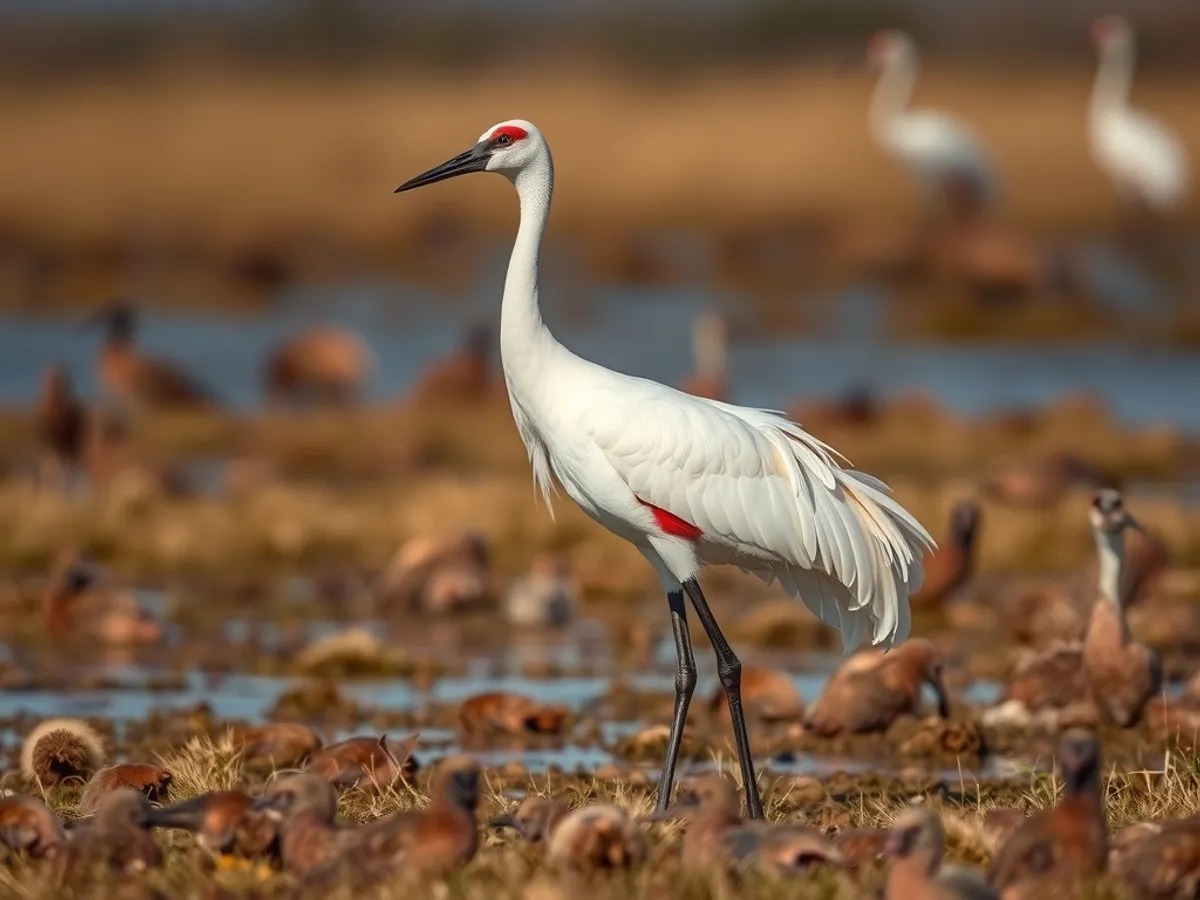
About the Siberian Crane
The Siberian crane (Leucogeranus leucogeranus) is the most aquatic of the cranes, wading belly-deep and rarely leaving wetlands for dry fields the way other cranes do. Its serrated bill, the most strongly toothed of any crane, is built for gripping and levering slippery underwater tubers and roots out of mud. That specialisation is precisely why the species is in such trouble: it cannot switch to farmland the way sandhill or common cranes have. Three populations once existed. The central population, wintering in India at Bharatpur, is gone. The western population, which wintered in Iran, has effectively collapsed, coming down to a single returning male known as Omid, whose annual arrival became a national event. Almost the entire species, some 4,000 birds, now belongs to the eastern population, which breeds in Arctic Yakutia and winters at Poyang Lake on China's Yangtze, so the fate of one lake decides the fate of the species; changes to Poyang's flood cycle driven by upstream dams are the central conservation fight. Adults are white with black primaries visible only in flight, and the face carries bare red skin. Chicks are cinnamon-brown and take several years to whiten fully.
Fascinating facts
Snow-white Plumage
Adult Siberian Cranes are easily recognized by their pure white feathers and contrasting black primary feathers seen only in flight.
Epic Migrants
Siberian Cranes undertake one of the longest migrations of any crane, traveling from Siberia to China and Iran, crossing multiple international borders.
Wetland Specialist
This crane species prefers shallow wetlands for both breeding and wintering, and its survival is closely tied to the health of these ecosystems.
Detailed description
The Siberian Crane (Leucogeranus leucogeranus) is a large, long-legged wading bird, standing 140–160 cm tall with a wingspan of 210–230 cm and weighing between 4.9 and 8.6 kg. Its plumage is almost entirely pure white, except for the black primaries and tertials visible in flight, and it has a distinctive bare red facial skin extending from the bill to behind the eyes. The bill is long, straight, and pinkish, adapted for probing soft substrates. Juveniles are buff-colored with brownish feathers and lack the red facial skin. Siberian Cranes are highly vocal, producing loud, far-carrying trumpeting calls, especially during migration and courtship. They are diurnal and spend much of their time foraging in shallow wetlands, where they exhibit a slow, deliberate gait. Socially, they are monogamous and form long-term pair bonds, often seen in small family groups or loose flocks during migration. Their elaborate courtship displays involve synchronized dancing, leaping, and vocalizations. Adapted to aquatic environments, they are excellent swimmers and prefer habitats with extensive shallow water and emergent vegetation, which provide both food and protection from predators.
Did you know?
There are fewer than 4,000 Siberian Cranes left in the wild, with the western population numbering less than 20 individuals.
Research & sources
Wikipedia summary
The Siberian crane, also known as the Siberian white crane or the snow crane, is a bird of the family Gruidae, the cranes. They are distinctive among the cranes: adults are nearly all snowy white, except for their black primary feathers that are visible in flight, and with two breeding populations in the Arctic tundra of western and eastern Russia. The eastern populations migrate during winter to China, while the western population winters in Iran and (formerly) in Bharatpur, India.
Behaviour & social structure
Siberian Cranes are primarily herbivorous, feeding on the roots, tubers, rhizomes, and stems of aquatic plants such as sedges (Carex spp.), bulrushes (Scirpus spp.), and wild rice (Zizania spp.), though they may also consume invertebrates, small vertebrates, and seeds opportunistically. Foraging typically occurs in shallow water, where they use their long bills to probe mud and soft substrates. They are highly territorial during the breeding season, with pairs defending nesting territories through vocalizations and aggressive displays. Outside the breeding season, they are more gregarious, forming flocks of up to several hundred individuals at key stopover and wintering sites. Daily routines include early morning and late afternoon foraging, midday resting, and preening. During migration, they travel in small groups, flying at high altitudes and covering up to 5,000 km between breeding and wintering grounds.
Reproduction & life cycle
Siberian Cranes are monogamous, typically forming lifelong pair bonds. Breeding occurs from late May to early August on the Arctic tundra, where pairs select nesting sites in remote wetlands. The nest is a shallow mound of vegetation, often surrounded by water for protection. Females lay 1–2 eggs, with both parents sharing incubation duties for 27–29 days. Chicks are precocial, leaving the nest within a day of hatching and following their parents to feeding areas. Both parents provide extensive care, feeding and protecting the chick(s) for up to 70–80 days until fledging. Juveniles remain with their parents during the southward migration and throughout the first winter, learning migratory routes and foraging skills.
Adaptations & survival
The Siberian Crane exhibits several adaptations for its specialized lifestyle. Its long legs and toes are well-suited for wading in deep, soft wetlands, while its long, straight bill enables efficient probing for submerged plant material. The white plumage provides camouflage against snowy and icy backgrounds during the breeding season, reducing predation risk. Their powerful flight muscles and high aspect-ratio wings enable sustained long-distance migration. Behavioral adaptations include synchronized group migration and the use of traditional stopover sites, which facilitate energy-efficient travel and predator avoidance. Their loud calls are adapted for communication over long distances in open landscapes.
Cultural significance
The Siberian Crane holds symbolic value in several cultures along its migratory route. In China, it is regarded as a symbol of longevity, purity, and fidelity, often appearing in art and folklore. In Russia and Central Asia, the crane is associated with wilderness and the health of wetlands. Conservation efforts for the species have fostered international cooperation, notably through the Memorandum of Understanding under the Convention on Migratory Species (CMS), and the species has become an emblem for wetland conservation in Eurasia.
Recent research
Recent research has focused on satellite telemetry to track migration routes and identify critical stopover sites, revealing the importance of specific wetlands in China, Kazakhstan, and Russia. Genetic studies have clarified the species’ evolutionary relationships, confirming its placement in the monotypic genus Leucogeranus. Conservation biology research has explored captive breeding and reintroduction, with mixed success. Studies on the effects of hydrological changes at Poyang Lake have highlighted the vulnerability of the eastern population to water management practices. Ongoing international collaborations aim to restore and protect migratory corridors and to engage local communities in conservation.
Videos
Habitat
Wetlands and shallow lakes in arctic tundra (breeding), freshwater marshes and floodplains (wintering)
 Polar and Subpolar Regions
Tundra
Cold, treeless regions with permafrost supporting specialized cold-adapted wildlife.
 Various Continental Regions
Grassland
Open areas dominated by grasses rather than trees, supporting numerous herbivores and their predators.
 Global
Freshwater
Lakes, rivers, and wetlands with diverse aquatic ecosystems.
Conservation
The Siberian Crane is currently classified as Critically Endangered on the IUCN Red List.
Threats & challenges
The primary threats to the Siberian Crane are habitat loss and degradation, particularly at key stopover and wintering sites due to wetland drainage, agricultural expansion, dam construction, and water pollution. Illegal hunting and disturbance during migration also pose significant risks. The western population, which once wintered in India, is now functionally extinct in the wild, with only a handful of individuals remaining in Iran. The eastern population, wintering in China’s Poyang Lake, faces threats from water management projects and reduced water levels. Climate change is altering wetland hydrology across their range, further exacerbating habitat loss. The global population is estimated at fewer than 4,000 individuals and is declining, leading to its Critically Endangered status.
Taxonomy
Scientific name
Leucogeranus leucogeranus
- Kingdom
- Animalia
- Phylum
- Chordata
- Class
- Aves
- Order
- Gruiformes
- Family
- Gruidae
- Genus
- Leucogeranus
- Species
- leucogeranus
Where to see a siberian crane
2 zoos and aquariums in 2 countries are recorded as keeping this species.

Community notes
Share your observations about the Siberian Crane.
No community notes yet. Be the first!
Discover more wildlife
More fascinating animals from the encyclopedia.