
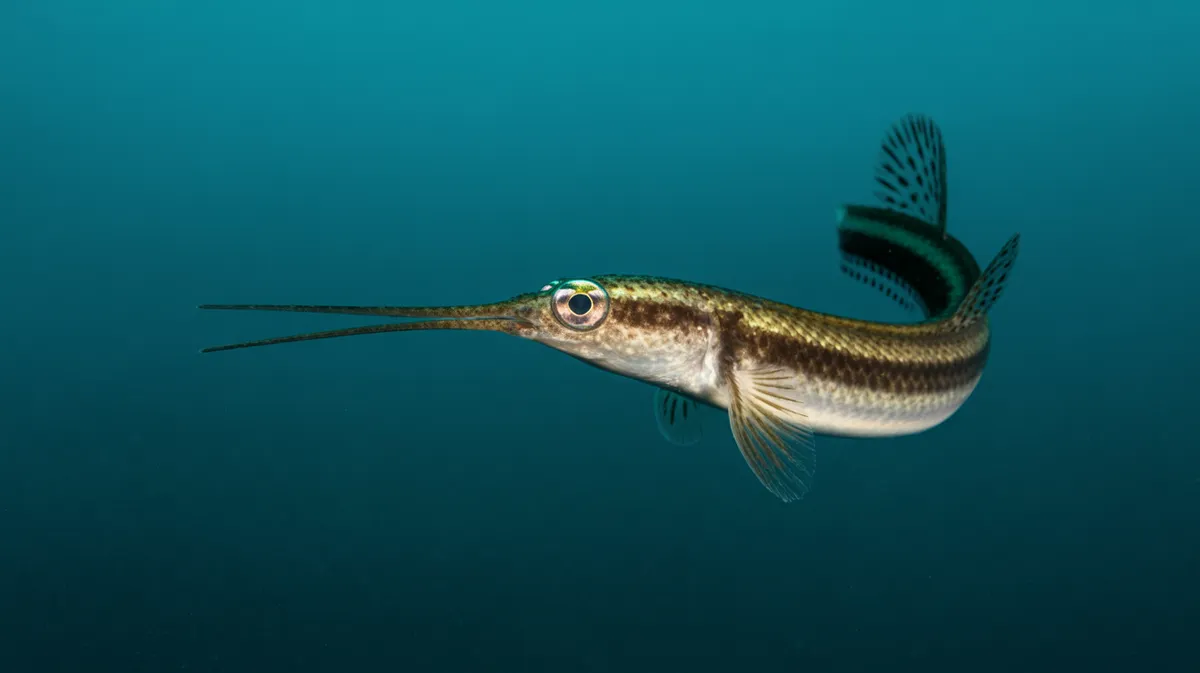
About the Slender snipe eel
The slender snipe eel is a deep-sea fish known for its extremely elongated, thread-like body and long, beak-like jaws filled with tiny hooked teeth. Reaching lengths of up to 1.5 meters, yet weighing only a few hundred grams, it is among the most bizarre and delicate-looking eels in the ocean. This eel inhabits mesopelagic to bathypelagic zones, often found at depths between 200 and 4,000 meters, where sunlight barely penetrates. Its unique jaw structure allows it to efficiently capture small crustaceans and plankton in the open water column.
Fascinating facts
Record-Breaking Spine
The slender snipe eel holds the record for the most vertebrae of any animal, with some individuals having over 750 vertebrae.
Deep-Sea Dweller
It inhabits depths from 200 to 4,000 meters, making it one of the ocean’s true deep-sea specialists.
Featherweight Giant
Despite reaching lengths of up to 1.5 meters, this eel can weigh less than 400 grams, giving it a remarkably light and fragile body.
Detailed description
The slender snipe eel (Nemichthys scolopaceus) is a remarkable deep-sea fish characterized by an extremely elongated, ribbon-like body that can reach up to 1.5 meters (about 5 feet) in length, while rarely exceeding 80 grams in mass. Its most distinctive feature is its long, bird-like jaws, which curve outward at the tips and are lined with numerous minute, recurved teeth ideal for ensnaring small, soft-bodied prey. The body is laterally compressed and covered in tiny, cycloid scales, giving it a delicate, almost translucent appearance. The dorsal and anal fins run nearly the entire length of the body, merging with the reduced caudal fin, while pectoral fins are small and set far forward. The slender snipe eel lacks pelvic fins, a trait common among true eels (order Anguilliformes). Its eyes are relatively large for a deep-sea species, aiding in the detection of faint bioluminescence from prey. The lateral line system is well-developed, allowing it to sense vibrations and movements in the dark oceanic environment. This species is typically found at depths ranging from 200 to 4,000 meters, inhabiting both the mesopelagic and bathypelagic zones of all major oceans, with a cosmopolitan distribution. Despite its fragile appearance, the slender snipe eel is an agile swimmer, capable of undulating its body to navigate the open water column. It is a solitary species, rarely observed in groups, and is thought to have a lifespan of up to 10 years. Its unique morphology and deep-sea lifestyle make it one of the most specialized and enigmatic members of the eel order.
Did you know?
A slender snipe eel's jaws are so long and curved that they cannot fully close, yet they are perfectly adapted for snagging tiny prey in the deep sea.
Research & sources
Wikipedia summary
The slender snipe eel, also known as the deep sea duck, is a fish that can weigh only a few ounces, yet reach 5 feet or 1.5 m in length. Features include a bird-like beak with curving tips, covered with tiny hooked teeth, which they use to sweep through the water to catch shrimp and other crustaceans. It has a lifespan of ten years.
Behaviour & social structure
Slender snipe eels exhibit primarily solitary behavior, spending most of their lives drifting or swimming slowly through the midwater column. They are nocturnal hunters, rising to shallower depths at night (vertical migration) to feed and descending during the day to avoid predators. Their feeding strategy involves sweeping their elongated jaws through the water in a scissor-like motion, capturing small crustaceans such as copepods, euphausiids (krill), and amphipods, as well as larval fish. The recurved teeth prevent prey from escaping once ensnared. They are not known to form schools or display complex social interactions, and encounters between individuals are likely rare outside of breeding periods. Slender snipe eels are believed to be opportunistic feeders, responding to the availability of prey in the water column. Their daily routine is largely dictated by the vertical migration of their prey and the need to avoid larger predators.
Reproduction & life cycle
Reproductive biology in Nemichthys scolopaceus is not fully understood due to the challenges of deep-sea research, but available evidence suggests that they are semelparous, spawning only once at the end of their lives. Spawning is believed to occur in the open ocean, possibly in deeper waters, with individuals undergoing significant physiological changes prior to reproduction—such as the atrophy of the digestive system and enlargement of the gonads. Females release large numbers of buoyant eggs, which rise to the upper layers of the ocean. The larvae, known as leptocephali, are transparent, leaf-shaped, and drift with ocean currents for several months, feeding on marine snow and microscopic plankton. There is no parental care; after spawning, adults die, and the larvae undergo a lengthy pelagic phase before metamorphosing into juvenile eels and descending to deeper waters. Breeding seasons are not well defined but may be influenced by oceanographic conditions and food availability.
Adaptations & survival
The slender snipe eel possesses numerous adaptations for deep-sea life. Its elongated, lightweight body minimizes energy expenditure during swimming and allows it to cover large vertical distances in search of food. The highly specialized jaws, with outward-curving tips and fine hooked teeth, are perfectly adapted for capturing small, elusive prey in the water column. Large, sensitive eyes enhance vision in low-light conditions, while an advanced lateral line system detects subtle water movements. The production of buoyant eggs enables wide dispersal of offspring. Physiological adaptations include a slow metabolism suited to the cold, low-oxygen environment of the deep sea, and the ability to withstand high hydrostatic pressures. The atrophy of the digestive system prior to spawning is a unique adaptation among eels, reallocating energy reserves to reproductive tissues.
Cultural significance
The slender snipe eel has limited direct significance in human culture due to its remote habitat and infrequent encounters with people. It occasionally appears in deep-sea documentaries and scientific literature as an example of extreme adaptation and morphological specialization. In some regions, its unusual appearance has inspired local nicknames such as 'deep sea duck.' There are no known traditional uses, myths, or symbolic associations involving this species.
Recent research
Recent research on Nemichthys scolopaceus has focused on its unique jaw mechanics, larval development, and ecological role in deep-sea food webs. Advances in deep-sea sampling and remotely operated vehicles (ROVs) have enabled more frequent observations and specimen collection, leading to improved understanding of its distribution and behavior. Studies using stable isotope analysis have helped clarify its trophic position and dietary preferences. Genetic analyses are ongoing to resolve relationships within the family Nemichthyidae and to investigate population structure across ocean basins. Despite these advances, many aspects of its life history, including precise spawning locations and larval dispersal patterns, remain poorly understood.
Sources
Nemichthys scolopaceus (Slender snipe eel): Taxonomy, morphology, and distribution
Karmovskaya, E., Papaconstantinou, C., de Morais, L., Smith-Vaniz, W.F., Carpenter, K.E. & de Bruyne, G. (2015)
scientificFunctional morphology of the jaws of the snipe eel Nemichthys scolopaceus
Mehta, R.S. & Wainwright, P.C. (2007)
scientificVideos
Habitat
Deep ocean (mesopelagic and bathypelagic zones)

Conservation
The Slender snipe eel is currently classified as Least Concern on the IUCN Red List.
Threats & challenges
Currently, the slender snipe eel faces few direct threats due to its deep-sea habitat, which is largely inaccessible to fisheries and human activities. It is not targeted by commercial fisheries and is rarely caught as bycatch. However, potential future threats include deep-sea mining, climate change (which may alter oceanic currents and prey availability), and pollution (such as microplastics and chemical contaminants that can accumulate in deep-sea food webs). Population trends are considered stable, and the species is listed as Least Concern by the IUCN. Ongoing monitoring is necessary to detect any emerging threats as human activities expand into deeper oceanic regions.
Taxonomy
Scientific name
Nemichthys scolopaceus
- Kingdom
- Animalia
- Phylum
- Chordata
- Class
- Actinopterygii
- Order
- Anguilliformes
- Family
- Nemichthyidae
- Genus
- Nemichthys
- Species
- scolopaceus
Community notes
Share your observations about the Slender snipe eel.
No community notes yet. Be the first!
Discover more wildlife
More fascinating animals from the encyclopedia.