
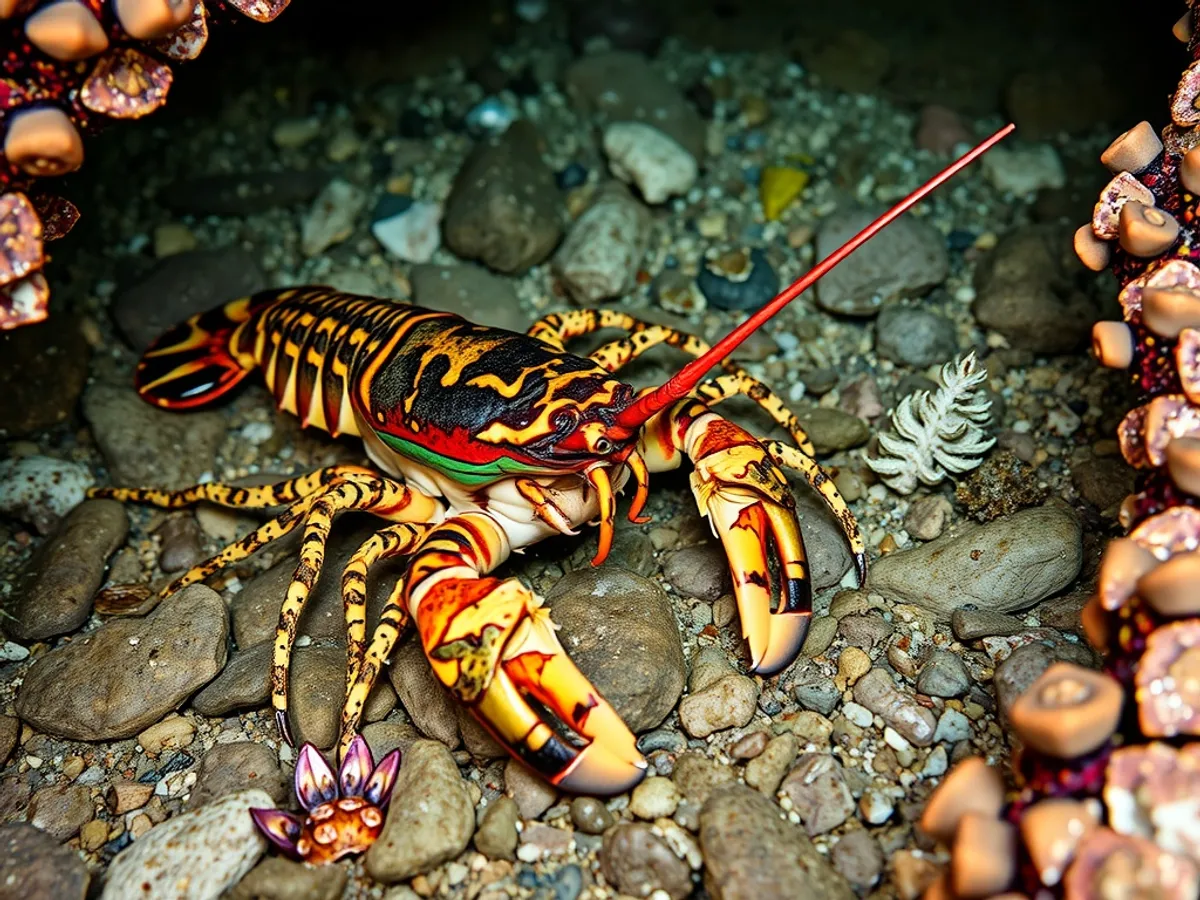
About the Slipper Lobster
Slipper lobsters are a group of marine crustaceans known for their distinctive flattened bodies and broad, shovel-like antennae. Unlike true lobsters, they lack prominent claws and instead have strong, armored shells that help protect them from predators. These nocturnal scavengers are found in warm, shallow waters worldwide, often hiding under rocks or buried in sandy or muddy substrates during the day. Slipper lobsters are important in some regional fisheries and are prized for their sweet, firm meat.
Fascinating facts
No Claws
Slipper lobsters lack the large, prominent pincers seen in true lobsters and instead rely on their tough exoskeleton for defense.
Nighttime Foragers
They are nocturnal and emerge at night to feed on mollusks, crustaceans, detritus, and occasionally algae.
Excellent Camouflage
Their mottled coloration and flattened bodies help them blend seamlessly into sandy or rocky seabeds, making them difficult for predators to spot.
Detailed description
Slipper lobsters (family Scyllaridae) are a diverse group of decapod crustaceans comprising over 90 recognized species, distributed primarily in tropical and subtropical marine environments. They are characterized by a dorsoventrally flattened body, which can range from 5 cm to over 50 cm in length depending on the species, and a robust, calcified exoskeleton that provides significant protection against predators. Their most distinctive feature is the pair of broad, plate-like antennae that extend forward and cover the head, functioning both as sensory organs and as a shield. Unlike true lobsters, slipper lobsters lack large chelae (claws) and instead possess strong, spiny walking legs and powerful mouthparts for manipulating food. Their coloration typically matches their substrate, ranging from sandy beige to mottled brown, aiding in camouflage. Slipper lobsters are primarily nocturnal, emerging at night to forage and retreating to crevices or burying themselves in sediment during the day. They are solitary animals, with minimal social interaction outside of the breeding season. Their diet is varied, consisting of mollusks, crustaceans, detritus, and plant material, which they crush with their heavily calcified mandibles. Slipper lobsters play an important ecological role as both prey and predator in benthic communities, and several species are targeted in commercial fisheries for their highly valued meat.
Did you know?
Despite their armored appearance, slipper lobsters are actually more closely related to spiny lobsters than to true lobsters.
Research & sources
Behaviour & social structure
Slipper lobsters are predominantly nocturnal, spending daylight hours concealed under rocks, within coral crevices, or buried in sand or mud to avoid predators. At night, they emerge to forage, using their sensitive antennae to detect food sources. Their feeding strategy is primarily that of a scavenger and opportunistic predator; they consume a wide range of benthic invertebrates such as bivalves, gastropods, polychaete worms, and occasionally small fish, as well as algae and detritus. They use their strong, molar-like mandibles to crush hard-shelled prey. Slipper lobsters are generally solitary, exhibiting little social behavior except during brief mating encounters. They communicate primarily through tactile and chemical cues, with little evidence of complex social hierarchies. Their movement is slow and deliberate, but they can perform rapid backward escapes by flexing their abdomens if threatened.
Reproduction & life cycle
Reproduction in slipper lobsters is seasonal in many species, often linked to water temperature and lunar cycles. Males transfer spermatophores to the female using specialized appendages during copulation. Females carry fertilized eggs attached to their pleopods (swimming legs) beneath the abdomen for several weeks, with incubation periods ranging from 3 to 8 weeks depending on species and environmental conditions. The number of eggs can vary widely, from a few thousand to over 100,000 in larger species. After hatching, larvae undergo a prolonged planktonic phase called the phyllosoma stage, which can last from several months up to a year. During this stage, larvae are highly transparent and morphologically distinct from adults, drifting with ocean currents before settling to the benthos and metamorphosing into juvenile lobsters. There is no parental care after hatching, and survival rates are low due to predation and environmental hazards.
Adaptations & survival
Slipper lobsters exhibit several key adaptations for benthic life. Their flattened bodies and broad antennae allow them to wedge tightly into crevices or bury themselves in substrate for protection and camouflage. The robust exoskeleton provides defense against predators, while cryptic coloration enhances concealment. Their reduced eyes are adapted for low-light environments, and their antennae are highly sensitive to tactile and chemical stimuli, compensating for limited vision. The powerful mandibles and molariform teeth are specialized for crushing hard-shelled prey. The phyllosoma larval stage is an evolutionary adaptation for wide dispersal, increasing the likelihood of colonizing new habitats. Rapid tail-flip escape responses provide a last-resort defense against predation.
Cultural significance
Slipper lobsters are considered a delicacy in many parts of the world, particularly in the Mediterranean, Southeast Asia, and Australia. Their meat is prized for its sweet, firm texture and is often used in high-end cuisine. In some cultures, slipper lobsters are featured in traditional dishes and are harvested both commercially and by artisanal fishers. While they do not hold significant roles in mythology or symbolism, their unique appearance has inspired local names and folklore in coastal communities. Sustainable management and aquaculture are increasingly important to meet demand and preserve wild populations.
Recent research
Recent research on slipper lobsters has focused on larval development, population genetics, and the impacts of fisheries on wild stocks. Advances in molecular phylogenetics have clarified relationships within the Scyllaridae family and revealed cryptic species diversity. Studies on larval dispersal patterns using genetic markers have provided insights into population connectivity and resilience. Ongoing research is investigating the feasibility of slipper lobster aquaculture, with some success in rearing larvae through the challenging phyllosoma stage. There is also growing interest in their role as bioindicators for monitoring reef and benthic ecosystem health.
Videos
Habitat
Coastal ocean floors, reefs, and rocky crevices

Conservation
The Slipper Lobster is currently classified as Least Concern on the IUCN Red List.
Threats & challenges
While most slipper lobster species are currently listed as Least Concern by the IUCN, localized populations face threats from overfishing, habitat degradation, and bycatch in trawl fisheries. Their slow growth rates and late sexual maturity make them vulnerable to overexploitation. Coastal development, pollution, and the destruction of coral reefs and seagrass beds further threaten their habitats. Climate change, particularly ocean warming and acidification, may impact larval development and adult survival in the future. Population trends are generally stable, but some species with restricted ranges or high commercial value are experiencing declines and may require targeted management.
Taxonomy
Scientific name
Scyllaridae spp.
- Kingdom
- Animalia
- Phylum
- Arthropoda
- Class
- Malacostraca
- Order
- Decapoda
- Family
- Scyllaridae
- Genus
- Scyllaridae (multiple genera, e.g. Scyllarus, Arctides)
- Species
- Various (e.g., Scyllarus arctus, Scyllarides latus)
Community notes
Share your observations about the Slipper Lobster.
No community notes yet. Be the first!
Discover more wildlife
More fascinating animals from the encyclopedia.