
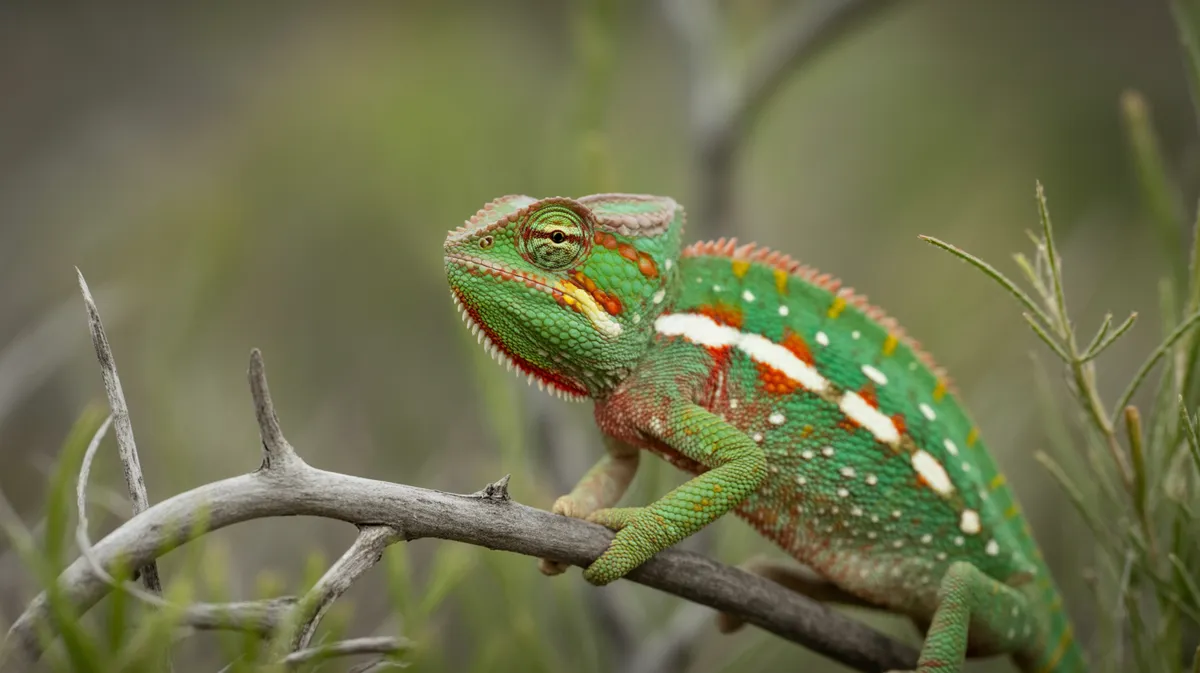
About the Smith's Dwarf Chameleon
Smith's Dwarf Chameleon is a small, cryptic reptile endemic to South Africa, known for its remarkable camouflage and diminutive size. Typically reaching just 7–10 cm in total length, it inhabits dense fynbos and coastal thicket vegetation, where its coloration and texture allow it to blend seamlessly with twigs and leaves. This species is primarily arboreal, moving slowly and methodically through shrubbery in search of small insects. Due to its restricted range, specific habitat requirements, and threats from habitat loss, it is considered to be at risk in the wild.
Fascinating facts
Endemic Habitat
Smith's Dwarf Chameleon is found only in the Eastern and Western Cape provinces of South Africa, specifically within the unique fynbos ecosystem.
Independent Eyes
Each eye can rotate and focus independently, giving the chameleon a 360-degree field of vision.
Live Birth
Unlike most reptiles, this species is viviparous, producing live young rather than eggs.
Detailed description
Smith's Dwarf Chameleon (Bradypodion taeniabronchum) is a diminutive, arboreal lizard endemic to the fynbos and coastal thicket regions of South Africa's Eastern Cape. Adults typically measure 7–10 cm in total length, with a prehensile tail comprising nearly half of this length, aiding in balance and grasping branches. The species exhibits a laterally compressed body, a casque (helmet-like structure) on the head, and independently mobile eyes that provide a panoramic field of vision. Its scalation is granular, with a series of small, pointed tubercles running along the dorsal crest. Coloration is highly variable, ranging from olive green and brown to muted grays, often with subtle striping or mottling that enhances camouflage. Unlike some larger chameleons, B. taeniabronchum lacks prominent head ornamentation, but males may display slightly more vivid coloration during social interactions. The tongue is highly specialized, capable of rapid ballistic projection to capture prey at distances up to twice the body length. This species is primarily active during the day (diurnal), moving with characteristic slow, swaying locomotion that mimics the movement of wind-blown vegetation. Its cryptic appearance and deliberate movements make it exceptionally difficult to detect in its natural habitat.
Did you know?
Smith's Dwarf Chameleon is one of the few chameleon species that are viviparous, meaning they give birth to live young rather than laying eggs.
Research & sources
Wikipedia summary
Smith's dwarf chameleon, also known as the Elandsberg dwarf chameleon, is a species of lizard in the family Chamaeleonidae endemic to Fynbos in South Africa's Eastern Cape. As in several species of chameleons in the genus Bradypodion, the Smith's dwarf chameleon can use its color-changing ability to actively camouflage itself depending on the vision of the specific predator species by which it is being threatened.
Behaviour & social structure
Smith's Dwarf Chameleon is solitary and territorial, with individuals maintaining small, overlapping home ranges within dense shrubbery. It is an ambush predator, relying on stealth and camouflage to approach insect prey such as flies, beetles, and caterpillars. Hunting involves slow, calculated movements, followed by rapid tongue projection to secure prey. The species exhibits a unique behavioral adaptation: it can modulate its skin coloration not only for background matching but also in response to the visual systems of different predators (e.g., birds vs. snakes), a phenomenon known as 'predator-specific camouflage.' Social interactions are generally limited to the breeding season, when males may engage in ritualized displays, including color changes, lateral body flattening, and head bobbing to deter rivals or attract females. At night, individuals roost on the tips of branches, where they are less accessible to ground-based predators.
Reproduction & life cycle
Bradypodion taeniabronchum is ovoviviparous, meaning females retain eggs internally and give birth to live young. Breeding typically occurs in the austral spring and early summer (September to January). After mating, females undergo a gestation period of approximately 4–6 months, depending on environmental conditions. Litter sizes range from 5 to 15 neonates, each measuring about 3 cm at birth. Neonates are fully independent at birth, dispersing into the surrounding vegetation. There is no parental care post-parturition. Sexual maturity is reached within 12–18 months. Courtship involves visual displays and gentle nudging by the male, with copulation lasting several minutes.
Adaptations & survival
Smith's Dwarf Chameleon possesses several key adaptations for survival in its specialized habitat. Its prehensile tail and zygodactylous feet (two toes forward, two backward) provide exceptional grip on thin branches and twigs. The independently mobile eyes allow for simultaneous scanning of different visual fields, enhancing predator detection and prey localization. The ballistic tongue is a hallmark of chameleon feeding, enabling rapid prey capture. Its ability to alter coloration is not only for camouflage but also for thermoregulation and social signaling. The species' slow, rocking gait mimics the movement of foliage, further reducing detection by predators. Additionally, its small size and cryptic behavior reduce energetic demands and predation risk in the dense, fire-prone fynbos ecosystem.
Cultural significance
Smith's Dwarf Chameleon has limited direct cultural significance but is occasionally featured in local folklore as a symbol of patience and adaptability due to its slow movements and color-changing abilities. In South African culture, chameleons are sometimes regarded with superstition or as omens, though B. taeniabronchum itself is not a major focus of traditional beliefs. Its charismatic appearance and ecological role have made it a flagship species for local conservation education initiatives.
Recent research
Recent research has focused on the species' remarkable predator-specific camouflage, demonstrating that individuals can adjust their coloration based on the visual capabilities of different predators—a rare example of dynamic, context-dependent camouflage in vertebrates. Studies on microhabitat use have highlighted the importance of native fynbos structure for maintaining viable populations. Genetic analyses have clarified the taxonomic relationships within the Bradypodion genus, supporting the distinctiveness of B. taeniabronchum. Ongoing research includes monitoring population genetics, assessing the impacts of habitat fragmentation, and evaluating the effectiveness of conservation interventions.
Videos
Habitat
Fynbos and coastal thicket


Conservation
The Smith's Dwarf Chameleon is currently classified as Endangered on the IUCN Red List.
Threats & challenges
Although currently listed as Least Concern by the IUCN, Smith's Dwarf Chameleon faces ongoing threats from habitat loss due to agricultural expansion, urban development, and invasive plant species that alter native vegetation structure. Fire management practices and climate change pose additional risks by modifying the fynbos ecosystem. The species is also vulnerable to illegal collection for the pet trade, though it is protected under CITES Appendix II. Population trends are believed to be stable in protected areas, but local declines have been documented in fragmented habitats. Conservation challenges include maintaining habitat connectivity and controlling invasive species.
Taxonomy
Scientific name
Bradypodion taeniabronchum
- Kingdom
- Animalia
- Phylum
- Chordata
- Class
- Reptilia
- Order
- Squamata
- Family
- Chamaeleonidae
- Genus
- Bradypodion
- Species
- taeniabronchum
Where to see a smith's dwarf chameleon
1 zoo and aquarium in 1 country are recorded as keeping this species.

Community notes
Share your observations about the Smith's Dwarf Chameleon.
No community notes yet. Be the first!
Discover more wildlife
More fascinating animals from the encyclopedia.