
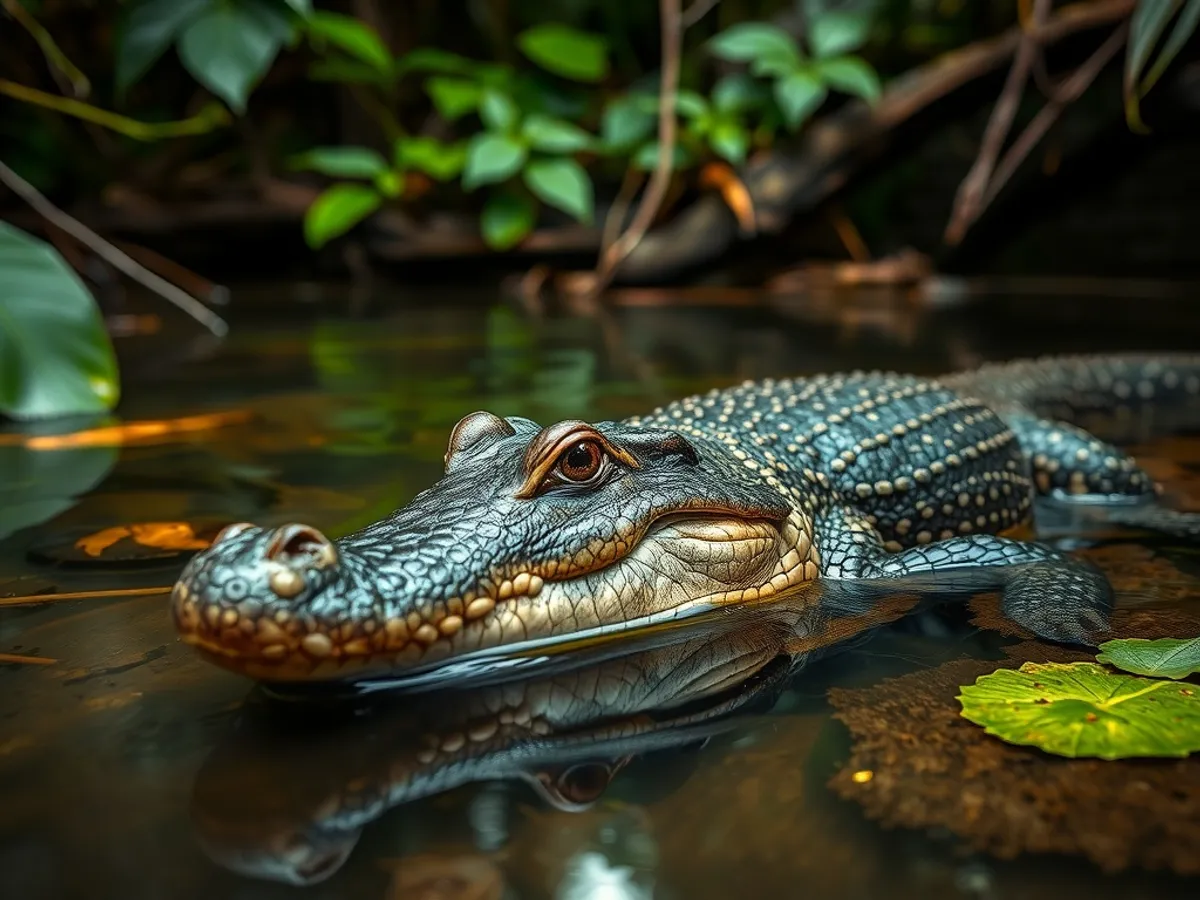
About the Smooth-fronted Caiman
The Smooth-fronted Caiman, also known as Schneider’s Dwarf Caiman, is a relatively small crocodilian native to northern and central South America. Distinguished by its smooth, sloping forehead and heavily armored body, this species is adept at blending into its forested, freshwater habitats. It is primarily nocturnal and elusive, spending much of its time hidden among dense vegetation or in burrows near streams. Despite its small size compared to other caimans, it is a formidable predator, feeding on a variety of prey including fish, amphibians, and small mammals.
Fascinating facts
Forest Dweller
The smooth-fronted caiman is found deep within tropical rainforests, often far from large rivers, favoring small streams and creeks.
Heavy Armor
Its body is covered with extremely tough, bony plates (osteoderms), making it one of the most heavily armored crocodilians.
Nocturnal Hunter
This species is primarily active at night, hunting for prey under the cover of darkness to avoid larger predators.
Detailed description
The smooth-fronted caiman (Paleosuchus trigonatus) is a small, robust crocodilian distinguished by its wedge-shaped, smooth forehead and heavily ossified, armor-like dorsal and lateral scales, which provide significant protection against predators and conspecific aggression. Adults typically measure 1.2 to 1.6 meters in length, with males occasionally reaching up to 2.3 meters, and weigh between 9 and 20 kg, though exceptional individuals may weigh up to 36 kg. The species exhibits a relatively short, broad snout and prominent bony ridges above the eyes, which aid in camouflage among leaf litter and submerged roots. Its coloration ranges from dark brown to blackish, with lighter underparts and occasional pale banding in juveniles. The tail is laterally compressed, aiding in swimming, while the limbs are sturdy and adapted for terrestrial locomotion. Adapted to life in forested freshwater habitats, the smooth-fronted caiman is primarily nocturnal and highly secretive, often sheltering in burrows or dense vegetation during the day. Unlike many other crocodilians, it spends considerable time on land, especially during the wet season when it may travel between water bodies. Its sensory organs—eyes, ears, and nostrils—are positioned dorsally, allowing it to remain mostly submerged while monitoring its surroundings. The species is solitary outside of the breeding season, exhibiting territoriality and a preference for secluded, slow-moving streams and flooded forest floors.
Did you know?
The smooth-fronted caiman is one of the smallest living crocodilian species, with adults rarely exceeding 1.5 meters in length.
Research & sources
Wikipedia summary
The smooth-fronted caiman, also known as Schneider's dwarf caiman or Schneider's smooth-fronted caiman, is a crocodilian from South America, where it is native to the Amazon and Orinoco Basins. It is the second-smallest species of the family Alligatoridae, the smallest being Cuvier's dwarf caiman, also from tropical South America and in the same genus. An adult typically grows to around 1.2 to 1.6 m in length and weighs between 9 and 20 kg. Exceptionally large males can reach as much as 2.3 m (7.5 ft) in length and 36 kg (79 lb) in weight.
Behaviour & social structure
Smooth-fronted caimans are predominantly nocturnal, emerging at dusk to hunt and patrol their territories. They are ambush predators, relying on stealth and patience to capture prey, which includes fish, crustaceans, amphibians, small mammals, birds, and occasionally invertebrates. Juveniles feed primarily on aquatic insects and small vertebrates, while adults expand their diet to larger prey. Hunting is typically conducted from the water's edge or shallow pools, with rapid lunges to seize unsuspecting animals. The species is largely solitary, with individuals maintaining defined home ranges and exhibiting aggressive behaviors toward intruders, especially during the breeding season. Vocalizations are rare but may include grunts or hisses during territorial disputes. During the day, smooth-fronted caimans retreat to burrows—often excavated into stream banks—or dense vegetation, which provide thermal regulation and protection from predators. Basking is infrequent compared to other caimans, likely due to their preference for shaded, forested environments.
Reproduction & life cycle
Breeding occurs during the rainy season, typically from December to April, depending on local climate patterns. Males establish and defend territories, attracting females through vocalizations and physical displays. After mating, females construct mound nests from leaf litter and soil, usually close to water but well concealed. Clutch size ranges from 10 to 25 eggs, with incubation lasting approximately 90 to 105 days, depending on ambient temperature and humidity. Females exhibit strong nest-guarding behavior, remaining nearby to deter predators such as large mammals, snakes, and egg-eating birds. Upon hatching, the female assists the young in emerging from the nest and may transport them to water in her mouth. Parental care continues for several weeks, with the female remaining vigilant against predators. Juvenile mortality is high, with predation and environmental factors contributing to significant losses.
Adaptations & survival
The smooth-fronted caiman possesses several adaptations for survival in dense, forested aquatic environments. Its heavily ossified, keeled scales provide exceptional defense against predators and conspecific attacks. The smooth, sloping forehead and short snout facilitate movement through tangled roots and submerged debris. Dorsally positioned sensory organs allow for effective ambush hunting while remaining concealed. The species' cryptic coloration enhances camouflage among leaf litter and shadowed water. Behavioral adaptations include burrow excavation for shelter and thermoregulation, as well as terrestrial mobility, allowing individuals to traverse between isolated water bodies during seasonal changes. Its relatively small size and secretive habits reduce competition with larger crocodilians and minimize detection by humans and predators.
Cultural significance
The smooth-fronted caiman holds limited direct significance in indigenous folklore compared to larger crocodilian species, but it is sometimes featured in local myths as a guardian of forest streams or as a symbol of stealth and resilience. In some Amazonian communities, caiman teeth or bones are used as talismans or in traditional medicine, though this is less common than with other crocodilians. The species is occasionally displayed in zoos and wildlife parks, contributing to public education about Amazonian biodiversity and conservation.
Recent research
Recent phylogenetic studies, such as those by Rio & Mannion (2021), have clarified the evolutionary relationships of Paleosuchus trigonatus within Crocodylia, highlighting its divergence from other caimans and unique morphological traits. Ongoing research focuses on its ecological role in forest stream ecosystems, reproductive biology, and responses to environmental disturbances. Studies using radio telemetry have revealed previously unknown aspects of its terrestrial movements and habitat use. Conservation genetics research is underway to assess population structure and connectivity across its range, which is critical for long-term management. Additionally, investigations into the impact of mercury contamination from gold mining on caiman health are of growing concern.
Sources
Phylogenetic analysis of a new morphological dataset elucidates the evolutionary history of Crocodylia and resolves the long-standing gharial problem
Jonathan P. Rio & Philip D. Mannion (2021)
scientificVideos
Habitat
Tropical rainforest streams and rivers
 Tropical Regions
Rainforest
Dense, wet forests with the highest biodiversity on Earth, containing more than half of the world's plant and animal species.
 Global
Forest
Wooded areas with significant tree cover and diverse plant and animal communities.
 Global
Freshwater
Lakes, rivers, and wetlands with diverse aquatic ecosystems.
Conservation
The Smooth-fronted Caiman is currently classified as Least Concern on the IUCN Red List.
Threats & challenges
Despite being classified as Least Concern by the IUCN, the smooth-fronted caiman faces several localized threats. Habitat loss due to deforestation, gold mining, and agricultural expansion poses significant risks, particularly in the Amazon and Orinoco basins. Pollution of waterways from mining and agricultural runoff can degrade habitat quality and affect prey availability. The species is occasionally targeted for the illegal pet trade, though its secretive nature and aggressive temperament limit widespread exploitation. Human-wildlife conflict is rare but may occur where caimans are perceived as threats to livestock or fish stocks. Population trends are generally stable, but ongoing habitat fragmentation and environmental degradation could impact long-term viability in some regions.
Taxonomy
Scientific name
Paleosuchus trigonatus
- Kingdom
- Animalia
- Phylum
- Chordata
- Class
- Reptilia
- Order
- Crocodylia
- Family
- Alligatoridae
- Genus
- Paleosuchus
- Species
- trigonatus
Community notes
Share your observations about the Smooth-fronted Caiman.
No community notes yet. Be the first!
Discover more wildlife
More fascinating animals from the encyclopedia.