
About the Southern Ground Hornbill
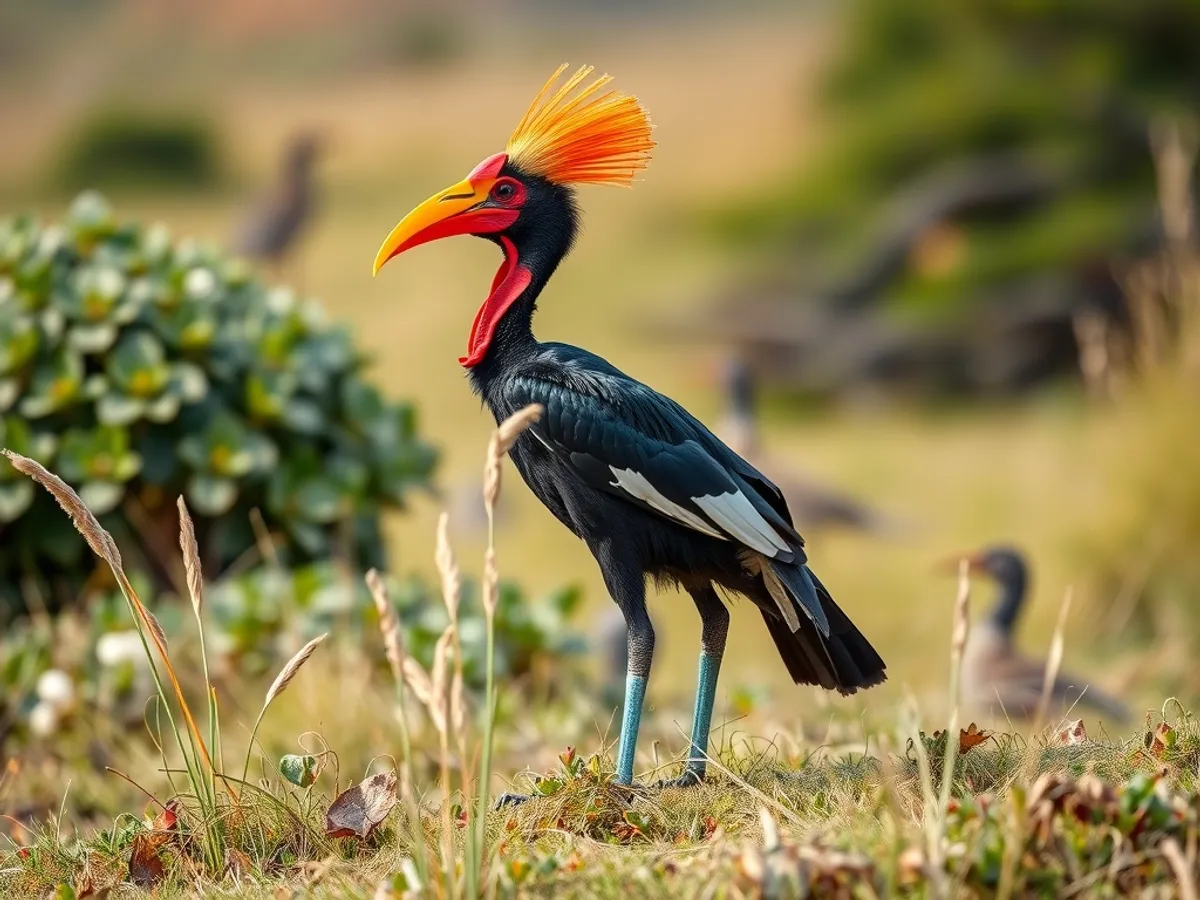
The southern ground hornbill (Bucorvus leadbeateri) is a black, turkey-sized hornbill that has given up flight for most purposes and walks the African savanna hunting on foot, killing snakes, tortoises, frogs, hares and even small mongooses with a heavy bill. It is one of the slowest-breeding birds in the world. Groups are cooperative, consisting of a breeding pair and several helpers, and a young bird cannot breed until it is six to ten years old; individuals may live 50 to 60 years. Two eggs are laid but the second chick is never raised: it hatches days behind its sibling, cannot compete, and always starves, so a group fledges roughly one chick every three years. This means a population cannot recover quickly from any loss of adults. The famous booming call, delivered at dawn with the head lowered and the red throat wattle inflated, carries several kilometres and is often mistaken for a distant lion. The bare red facial and throat skin is a signal; females carry a violet-blue patch on the throat. Long eyelashes that shade the eyes are modified feathers. The bird is culturally protected in parts of southern Africa as a rainmaker or a bringer of ill omen, but it is declining fast through habitat loss, secondary poisoning and the loss of the huge old trees whose cavities it needs to nest.
Fascinating facts
Booming Voices
Their deep, resonant calls are among the loudest of any bird and are used to communicate over long distances.
Family Teams
Southern Ground Hornbills live in cooperative groups where only the dominant pair breeds, while others help raise the young.
Slow Breeders
They typically lay only one or two eggs every few years, and raising a chick to independence can take several years.
Detailed description
The Southern Ground Hornbill (Bucorvus leadbeateri) is a large, terrestrial hornbill, measuring 90–129 cm (35–51 in) in length and weighing between 2.2–6.2 kg (4.9–13.7 lbs), with males typically larger than females. It is distinguished by its predominantly black plumage, white primary feathers visible in flight, and vivid red bare skin on the face and throat, which is blue in females. The bill is long, decurved, and robust, equipped with a casque at the base. Adapted for terrestrial life, its long legs and broad feet allow efficient walking over vast distances, covering up to 11 km per day. The species is highly social, living in stable, cooperative groups of 2–12 individuals, usually consisting of a dominant breeding pair and several helpers. Southern Ground Hornbills are diurnal, spending most daylight hours foraging on the ground for a diverse diet of insects, amphibians, reptiles, small mammals, and even other birds. Their deep, resonant booming calls serve for territory advertisement and group cohesion, audible up to 3 km away. The species is long-lived, with lifespans exceeding 40 years in the wild and up to 50 years in captivity. Breeding is slow, with pairs producing a single chick every 3–9 years, contributing to their vulnerability. Their ecological role as apex avian predators and scavengers is crucial in regulating prey populations and nutrient cycling in savanna ecosystems.
Did you know?
Southern Ground Hornbills are considered a symbol of rain and fertility in many African cultures, but are also sometimes persecuted due to superstitions.
Research & sources
Wikipedia summary
The southern ground hornbill is one of two species of ground hornbill, both of which are found solely within Africa, and is the largest species in the hornbill order worldwide. It can be found in the southern regions of Africa, ranging from Kenya to South Africa. Within these regions, they inhabit both woodlands and savannas. The other species of the genus Bucorvus is the Abyssinian ground hornbill, B. abyssinicus.
Behaviour & social structure
Southern Ground Hornbills are primarily ground-dwelling and spend most of their day walking in search of food, using their powerful bills to probe soil, overturn debris, and dig for prey. They hunt cooperatively, with group members working together to flush out or corner prey, and often forage in a loose line formation. Social interactions are complex, involving allopreening, vocal duets, and ritualized displays such as bill clattering and wing spreading. The group is structured around a dominant breeding pair, with non-breeding helpers (often offspring from previous years) assisting in territory defense, chick rearing, and food provision. Territorial boundaries are maintained through loud, synchronized booming calls performed at dawn. Roosting occurs communally in large trees, and the group maintains a well-defined home range of 50–100 km². Aggressive encounters with neighboring groups can occur at territory boundaries.
Reproduction & life cycle
Southern Ground Hornbills are obligate cooperative breeders, with only the dominant pair in a group reproducing while subordinates assist. Breeding season varies with rainfall but typically occurs from September to December. Nests are placed in large tree cavities, cliff faces, or occasionally on the ground. The female lays 1–3 eggs, but siblicide is common and usually only one chick survives. Incubation lasts 37–43 days, performed solely by the female, while the male and helpers provide food. The chick is altricial, hatching naked and blind, and remains in the nest for 85–90 days. Fledglings are dependent on the group for up to two years, an unusually prolonged period among birds. Sexual maturity is reached at 6–7 years, and the interval between successful breeding attempts is often several years, reflecting their slow reproductive rate.
Adaptations & survival
Southern Ground Hornbills exhibit several adaptations for terrestrial predation and savanna life. Their strong, decurved bills are specialized for digging, prying, and dispatching a wide variety of prey, including venomous snakes. The bare facial and throat skin is thought to aid in thermoregulation and may play a role in social signaling. Their long legs and robust feet facilitate efficient ground locomotion and enable them to cover large territories. Cooperative breeding and extended parental care increase offspring survival in unpredictable environments. Their deep, low-frequency calls are adapted for long-distance communication across open landscapes. The species' longevity and delayed maturity are evolutionary responses to the variable and resource-scarce habitats they occupy.
Cultural significance
Southern Ground Hornbills hold significant cultural value in many African societies. In some traditions, they are regarded as harbingers of rain or omens of drought, and their booming calls are associated with ancestral spirits. Feathers, body parts, and eggs are sometimes used in traditional medicine and rituals, believed to confer protection or healing. Conversely, in agricultural areas, they are occasionally persecuted due to the mistaken belief that they damage crops or prey on poultry. Conservation programs increasingly incorporate local cultural beliefs to foster coexistence and protection of the species.
Recent research
Recent research has focused on the species' cooperative breeding system, revealing the importance of helper individuals in chick survival and group stability. Studies using GPS telemetry have mapped extensive home ranges and highlighted the need for large, contiguous habitats. Vocalization research has elucidated the function of duets and group choruses in territory defense and mate bonding. Conservation efforts include artificial nest provision, reintroduction programs, and community-based education initiatives. Genetic studies are underway to assess population structure and inform management strategies. Ongoing research also examines the impact of climate change on breeding success and prey availability.
Sources
Videos
Habitat
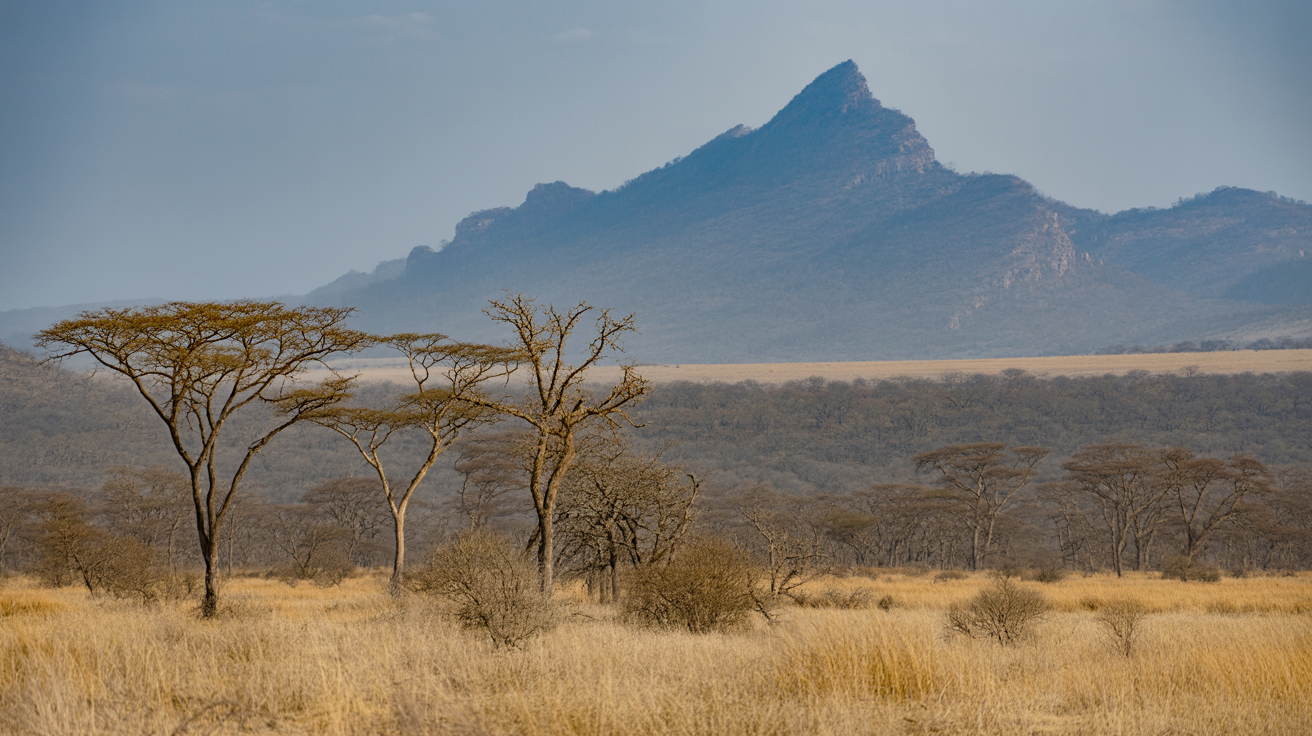
Savanna and open grassland

Conservation
The Southern Ground Hornbill is currently classified as Vulnerable on the IUCN Red List.
Threats & challenges
The Southern Ground Hornbill faces multiple threats, primarily habitat loss due to agricultural expansion, logging, and urbanization, which reduce suitable nesting sites and foraging grounds. Persecution and accidental poisoning (from pesticides or poisoned baits targeting other species) are significant mortality factors. The species is also affected by illegal capture for the traditional medicine trade in some regions. Low reproductive rates, high nestling mortality, and dependence on large, old trees for nesting exacerbate population declines. Fragmentation of populations and reduced genetic diversity are emerging concerns. The IUCN estimates the global population at fewer than 8,000 mature individuals, with a continuing downward trend, classifying the species as Vulnerable.
Taxonomy
Scientific name
Bucorvus leadbeateri
- Kingdom
- Animalia
- Phylum
- Chordata
- Class
- Aves
- Order
- Bucerotiformes
- Family
- Bucorvidae
- Genus
- Bucorvus
- Species
- leadbeateri
Where to see a southern ground hornbill
10 zoos and aquariums in 1 country are recorded as keeping this species.
 San Diego Zoo🇺🇸 San Diego, United States
 Santa Barbara Zoological Gardens🇺🇸 Santa Barbara, United States
 Honolulu Zoo🇺🇸 Honolulu, United States
 Brevard Zoo🇺🇸 Melbourne, United States
 Barrett Park Staten Island Zoo🇺🇸 United States
Community notes
Share your observations about the Southern Ground Hornbill.
No community notes yet. Be the first!
Discover more wildlife
More fascinating animals from the encyclopedia.