
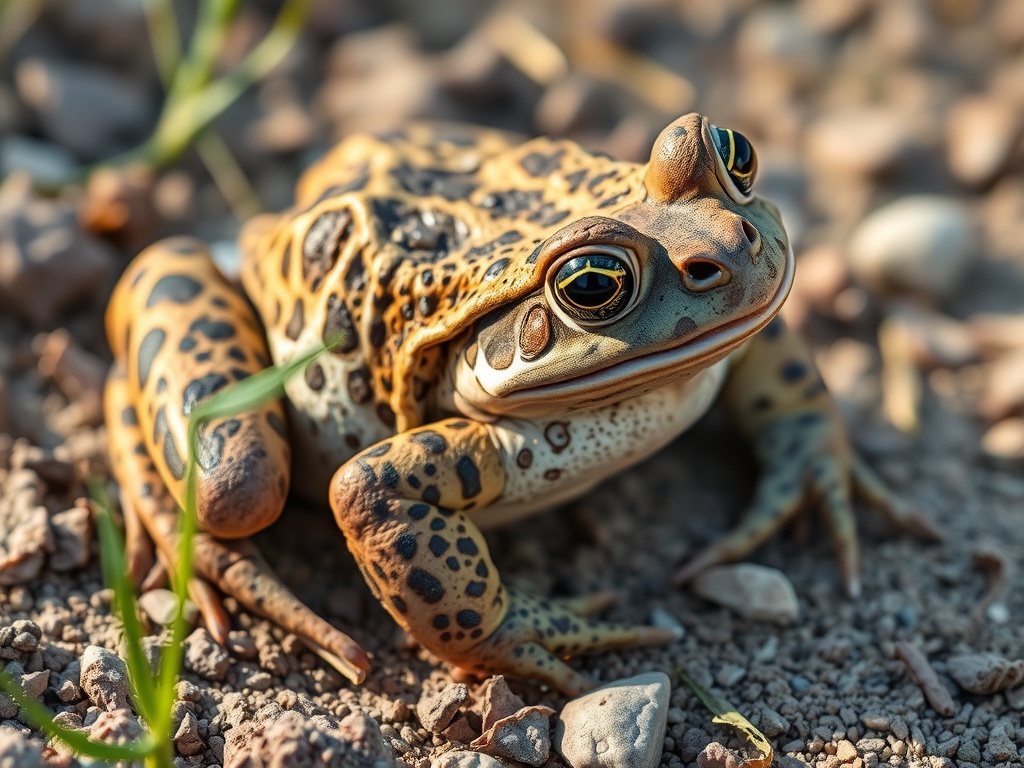
About the Spadefoot Toad
Spadefoot toads (families Scaphiopodidae and Pelobatidae) are burrowers built around one tool: a hard, keratinised, sharp-edged tubercle on each hind foot, the "spade", with which the animal digs backwards, sinking into the soil with an alternating shuffle. In arid country a spadefoot may spend ten or eleven months of the year a metre down, sealed in a cocoon of shed skin that reduces water loss, and it emerges only when heavy rain both softens the ground and generates the low-frequency vibration that appears to trigger emergence. What follows is explosive: hundreds of animals converge on a temporary pool, males call, spawning happens within a night or two, and the eggs must beat evaporation. Spadefoot tadpoles are among the fastest-developing amphibians known, and some Spea species can go from egg to metamorph in as little as eight days. North American Spea also display one of the textbook cases of developmental plasticity: if the tadpoles eat fairy shrimp, some switch into a carnivorous morph with a broad head, huge jaw muscles and a serrated beak, which grows faster and can cannibalise its own smaller, omnivorous siblings, and the switch is triggered by the diet itself rather than by genes.
Fascinating facts
Spade-shaped Feet
Spadefoot Toads have a hard, black, wedge-shaped 'spade' on each hind foot that aids in rapid burrowing.
Rapid Development
Spadefoot tadpoles can metamorphose in as little as 14 days to avoid drying temporary pools.
Rain Triggers Breeding
These toads emerge en masse to breed only after heavy rains, taking advantage of ephemeral water sources.
Detailed description
The Plains Spadefoot Toad (Spea bombifrons) is a small, robust amphibian typically measuring 40–65 mm in length, with females generally larger than males. Its most distinctive anatomical feature is the keratinized, black, wedge-shaped 'spade' on each hind foot, which facilitates rapid burrowing into sandy or loose soils. The dorsum is olive to brownish-gray, often mottled with darker spots, and the skin is relatively smooth compared to true toads, with only scattered small tubercles. The eyes are large and set high on the head, with vertical, cat-like pupils adapted for nocturnal activity. The species is primarily fossorial, spending much of the year underground in self-excavated burrows at depths of up to 1 meter to avoid desiccation and temperature extremes. When conditions are favorable, especially after heavy rains, Spea bombifrons emerges en masse to breed in ephemeral pools. Its call is a distinctive, low-pitched snore, and males congregate in choruses to attract females. The toad’s rapid larval development—sometimes as little as 8–16 days from hatching to metamorphosis—is among the fastest of North American amphibians, an adaptation to the transient nature of its breeding sites. Adults are opportunistic carnivores, feeding on a wide range of invertebrates, while larvae display remarkable phenotypic plasticity, with some developing into cannibalistic morphs under crowded or resource-poor conditions.
Did you know?
Unlike most toads, Spadefoot Toads have smooth, moist skin and vertical pupils, traits more commonly associated with frogs.
Research & sources
Wikipedia summary
Spadefoot may refer to the following toads:Scaphiopodidae, a family, the American spadefoot toads Megophrys edwardinae, Edwardina's spadefoot toad, a species of southeast Asia Notaden, a genus, the Australian spadefoot toads Pelobatidae, a family with one extant genus, Pelobates, the European spadefoot toads
Behaviour & social structure
Spea bombifrons is primarily nocturnal, emerging from burrows at dusk to forage and breed. Its activity is strongly correlated with rainfall and humidity, and during dry periods, it remains underground in a state of torpor. Foraging behavior is opportunistic; adults consume insects such as beetles, ants, termites, and spiders, using a sit-and-wait strategy near burrow entrances or at the water’s edge. Social interactions are most pronounced during the breeding season, when males form loose aggregations and engage in vocal competition. Outside of breeding, the species is largely solitary. Daily routines are dictated by environmental conditions, with surface activity limited to warm, moist nights. Tadpoles exhibit complex social dynamics, including kin recognition and cannibalism, which can accelerate growth rates and increase survival in rapidly drying pools.
Reproduction & life cycle
Breeding occurs explosively following heavy rainfall, typically from late spring to midsummer. Males arrive first at temporary pools and begin calling to attract females. Amplexus is axillary, and females lay up to 2,000 eggs in gelatinous strings attached to submerged vegetation or debris. Eggs hatch within 24–48 hours, and larval development is highly plastic, with metamorphosis occurring in as little as 8 days under optimal conditions. There is no parental care post-oviposition. Tadpoles may develop into two morphs: omnivorous or carnivorous (including cannibalistic), depending on environmental cues such as density and food availability. This phenotypic flexibility is rare among amphibians and enhances survival in unpredictable habitats.
Adaptations & survival
Key adaptations include the keratinized spade for efficient burrowing, allowing the toad to escape surface extremes and predators. The species exhibits remarkable desiccation tolerance, reducing metabolic rates and water loss while underground. Rapid, plastic larval development enables exploitation of ephemeral pools. Tadpoles can switch to a carnivorous, cannibalistic morph, characterized by enlarged jaw muscles and mouthparts, when in crowded or nutrient-poor conditions—an evolutionary response to intense competition and drying pools. Adults have highly absorbent skin for water uptake and can rehydrate rapidly after emerging. Vertical pupils enhance night vision, supporting nocturnal activity.
Cultural significance
Spadefoot toads have limited direct cultural significance but are sometimes featured in indigenous folklore as symbols of rain or fertility due to their sudden appearance after storms. Their unique life cycle and rapid emergence have made them subjects of local curiosity and educational programs about amphibian adaptations. In some regions, they are considered indicators of healthy prairie and grassland ecosystems.
Recent research
Recent research has focused on the genetic and hormonal mechanisms underlying the remarkable phenotypic plasticity of Spea bombifrons tadpoles, including the environmental triggers for cannibal morph development. Studies have also examined the species’ physiological adaptations to arid environments, such as water conservation strategies and metabolic suppression during estivation. Ongoing research addresses the impacts of climate change on breeding phenology and population connectivity, as well as the effects of agricultural chemicals on larval development and survival.
Sources
Phenotypic Plasticity in Spadefoot Toad Tadpoles: Environmental Cues and Evolutionary Implications
David W. Pfennig, Karin S. Pfennig (2010)
scientificNatural History and Ecology of the Plains Spadefoot Toad (Spea bombifrons)
Stebbins, R.C. & Cohen, N.W. (1995)
scientificVideos
Habitat
Arid and semi-arid grasslands, prairies, and deserts
 Arid Regions
Desert
Arid lands with minimal rainfall, extreme temperatures, and specialized wildlife adapted to harsh conditions.
 Various Continental Regions
Grassland
Open areas dominated by grasses rather than trees, supporting numerous herbivores and their predators.
 Global
Freshwater
Lakes, rivers, and wetlands with diverse aquatic ecosystems.
Conservation
The Spadefoot Toad is currently classified as Least Concern on the IUCN Red List.
Threats & challenges
Although currently listed as Least Concern by the IUCN, Spea bombifrons faces localized threats from habitat loss due to agriculture, urbanization, and road construction, which can destroy breeding sites and disrupt migration. Pesticide runoff and water pollution pose additional risks, particularly to larvae. Climate change may alter precipitation patterns, affecting the availability and duration of breeding pools. Road mortality during mass breeding migrations is a significant threat in some regions. Despite these challenges, the species’ broad range, adaptability, and rapid development confer resilience, though local populations may be vulnerable to cumulative impacts.
Taxonomy
Scientific name
Spea bombifrons
- Kingdom
- Animalia
- Phylum
- Chordata
- Class
- Amphibia
- Order
- Anura
- Family
- Scaphiopodidae
- Genus
- Spea
- Species
- bombifrons
Community notes
Share your observations about the Spadefoot Toad.
No community notes yet. Be the first!
Discover more wildlife
More fascinating animals from the encyclopedia.