
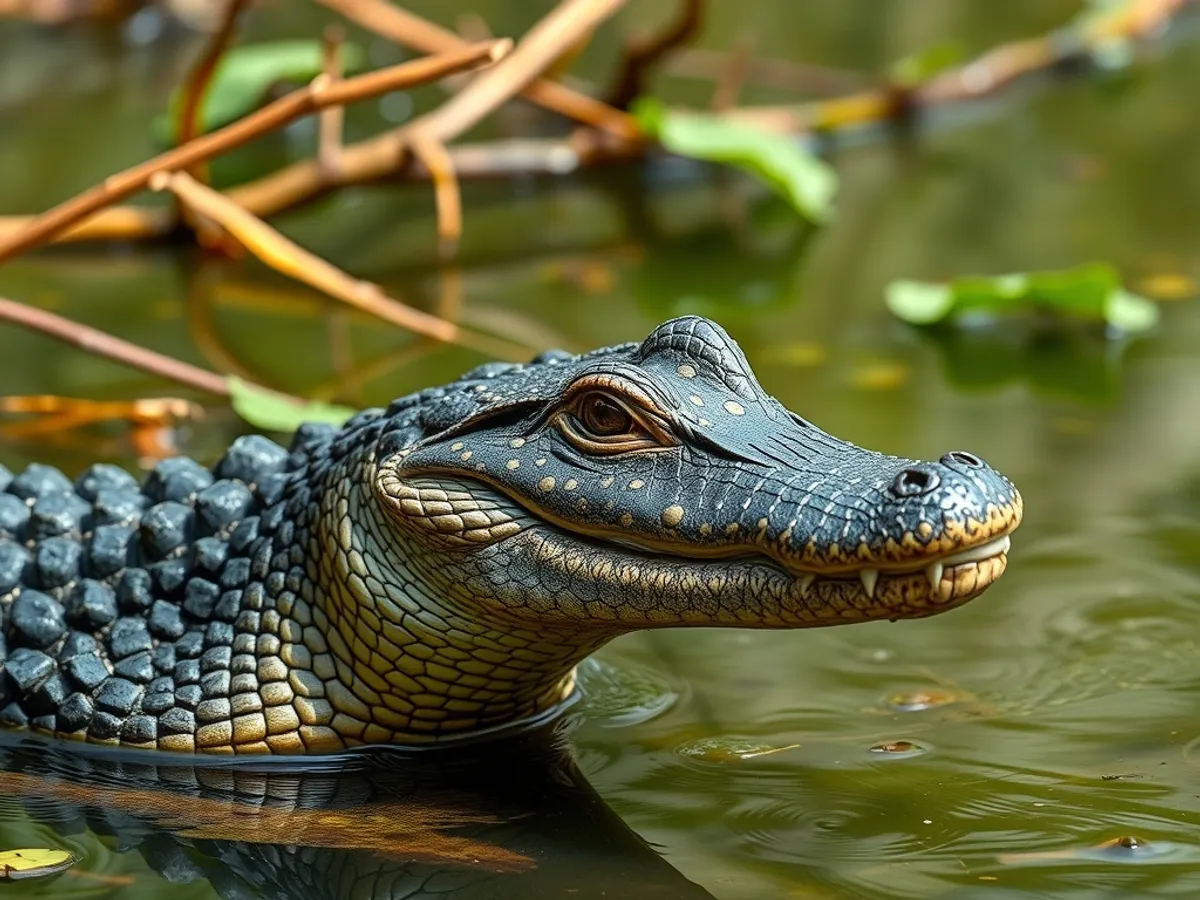
About the Spectacled Caiman
The Spectacled Caiman is a medium-sized crocodilian native to Central and South America, easily recognized by the bony ridge between its eyes that resembles a pair of spectacles. This adaptable reptile inhabits a variety of freshwater environments, including rivers, lakes, and wetlands. It has a broad snout and can vary in color from olive green to brown, often with dark banding on the body and tail. The Spectacled Caiman is both a skilled hunter and a scavenger, feeding on a wide range of prey from insects to fish and small mammals.
Fascinating facts
Distinctive Eyewear
The Spectacled Caiman gets its name from a bony ridge between its eyes that looks like a pair of spectacles.
Wide Distribution
It is the most widespread species of caiman, found throughout much of Central and South America.
Parental Care
Females guard their nests and may help hatchlings reach the water, displaying rare parental care among reptiles.
Detailed description
The spectacled caiman (Caiman crocodilus) is a medium-sized crocodilian distinguished by a prominent bony ridge between its eyes, giving the appearance of 'spectacles.' Adults typically measure 1.4–2.5 meters in length, with males growing larger than females, and weigh between 7 and 40 kilograms. Their coloration varies from olive-green to brownish or yellowish-gray, often with dark bands across the body and tail, aiding in camouflage among aquatic vegetation. The snout is broad and slightly upturned, adapted for capturing a variety of prey. The skin is covered in tough, osteoderm-reinforced scales that provide protection from predators and environmental hazards. Spectacled caimans possess a nictitating membrane over the eyes for underwater vision and nostrils positioned atop the snout, allowing them to breathe while mostly submerged. They are highly adaptable, occupying a range of freshwater habitats from slow-moving rivers and lakes to flooded savannas and man-made canals. Their vocalizations include grunts, bellows, and distress calls, which play roles in communication, especially during the breeding season. Juveniles are banded and more brightly colored, providing camouflage among reeds and grasses. Lifespan in the wild is estimated at 30–40 years, with some individuals in captivity living longer.
Did you know?
The 'spectacles' that give the Spectacled Caiman its name are not actual glasses but a bony ridge between its eyes.
Research & sources
Wikipedia summary
The spectacled caiman, also known as the white caiman, common caiman, and speckled caiman, is a crocodilian in the family Alligatoridae. It is brownish-, greenish-, or yellowish-gray colored and has a spectacle-like ridge between its eyes, which is where its common name come from. It grows to a length of 1.4–2.5 m and a weight of 7–40 kg (15–88 lb), with males being both longer and heavier than females. Its diet varies seasonally, commonly consisting of crabs, fish, small mammals, amphibians and snails. Breeding occurs from May to August and 14–40 eggs are laid in July and August. This crocodilian has a large range and population; it is native to much of Latin America, and has been introduced to the United States, Cuba, and Puerto Rico.
Behaviour & social structure
Spectacled caimans are primarily nocturnal, spending daylight hours basking on riverbanks or concealed in vegetation. They are opportunistic feeders, employing both ambush and active hunting strategies. Juveniles feed mainly on insects, crustaceans, and small fish, while adults consume a broader range of prey including fish, amphibians, reptiles, birds, and small mammals. During the dry season, when aquatic prey is scarce, they may scavenge or prey on terrestrial animals. Caimans exhibit territoriality, particularly during the breeding season, with dominant males defending prime nesting and basking sites. Social structure is loosely organized; individuals may aggregate in favorable habitats but are generally solitary outside of breeding or basking. Communication is achieved through vocalizations, body postures, and water slapping. Hatchlings form crèches—groups of young from multiple females—often guarded by one or more adults, enhancing survival rates.
Reproduction & life cycle
Breeding in spectacled caimans is closely tied to seasonal rainfall, typically occurring from May to August. Courtship involves vocalizations and physical displays, with males competing for access to females. Females construct mound nests from vegetation and mud, usually laying 14–40 eggs per clutch in July or August. Incubation lasts approximately 70–90 days, with temperature influencing the sex of hatchlings (temperature-dependent sex determination). Females guard the nest aggressively against predators such as raccoons, tegu lizards, and humans. Upon hatching, the mother assists the young in emerging from the nest and may transport them to water in her jaws. Parental care continues for several weeks, with females remaining nearby to protect the vulnerable hatchlings. Sexual maturity is reached at 4–7 years, depending on environmental conditions and food availability.
Adaptations & survival
The spectacled caiman exhibits several key adaptations for survival in variable aquatic environments. Its broad, robust snout is effective for capturing diverse prey, while conical teeth are suited for gripping slippery fish and crushing hard-shelled invertebrates. The bony 'spectacle' ridge may offer protection to the eyes and serve as a visual signal. The nictitating membrane allows for clear vision underwater, and dorsally placed eyes and nostrils facilitate stealthy breathing and observation while submerged. The caiman's skin is armored with osteoderms, providing defense against predators and injury. Behavioral adaptations include the ability to estivate (enter a state of dormancy) during extreme droughts, burrowing into mud to retain moisture. Their tolerance for a wide range of water conditions, including brackish and polluted waters, contributes to their ecological success.
Cultural significance
Spectacled caimans hold varied significance in local cultures across their range. In some indigenous traditions, caimans are revered as symbols of strength and guardianship, featuring in folklore and mythology. Historically, their skins were highly valued in the leather trade, leading to extensive hunting in the 20th century. Today, they are sometimes kept in managed ranching systems for sustainable harvest. Ecotourism centered on caiman watching contributes to local economies and conservation awareness. In some regions, caimans are viewed with apprehension due to perceived threats to humans or livestock, influencing attitudes toward their protection.
Recent research
Recent genetic studies have clarified the taxonomy of Caiman crocodilus, revealing several subspecies and highlighting the complexity of hybridization with related species. Ongoing research focuses on their ecological role as apex and mesopredators, influencing fish and invertebrate populations and contributing to wetland ecosystem health. Studies on temperature-dependent sex determination in eggs provide insights into potential impacts of climate change on population dynamics. Conservation research includes population monitoring using drone and satellite technology, and the effectiveness of community-based management programs. Notably, the spectacled caiman's ability to thrive in disturbed and urbanized habitats makes it a model species for studying reptilian resilience to environmental change.
Sources
Phylogenetic analysis of a new morphological dataset elucidates the evolutionary history of Crocodylia and resolves the long-standing gharial problem
Jonathan P. Rio & Philip D. Mannion (2021)
scientificVideos
Habitat
Freshwater wetlands, rivers, and lakes


Conservation
The Spectacled Caiman is currently classified as Least Concern on the IUCN Red List.
Threats & challenges
While currently listed as Least Concern by the IUCN, spectacled caimans face localized threats from habitat loss, pollution, and illegal hunting for their skin and meat. In some regions, overharvesting in the past led to population declines, but their adaptability and high reproductive rates have allowed for recovery. Hybridization with other caiman species, such as Caiman yacare, poses genetic challenges in overlapping ranges. Human-caiman conflict arises where caimans prey on livestock or compete with fisheries. Climate change and altered hydrological cycles may impact nesting success and juvenile survival. Ongoing habitat fragmentation and water contamination remain significant concerns, particularly in rapidly developing areas.
Taxonomy
Scientific name
Caiman crocodilus
- Kingdom
- Animalia
- Phylum
- Chordata
- Class
- Reptilia
- Order
- Crocodylia
- Family
- Alligatoridae
- Genus
- Caiman
- Species
- crocodilus
Where to see a spectacled caiman
4 zoos and aquariums in 4 countries are recorded as keeping this species.
 Śląski Ogród Zoologiczny🇵🇱 Chorzów, Poland
- 🦁Greater Vancouver Zoo🇨🇦 Canada
 Пермский зоопарк🇷🇺 Пермь, Russia
- 🦁Palm Beach Zoo & Conservation Society🇺🇸 West Palm Beach, United States
Community notes
Share your observations about the Spectacled Caiman.
No community notes yet. Be the first!
Discover more wildlife
More fascinating animals from the encyclopedia.