
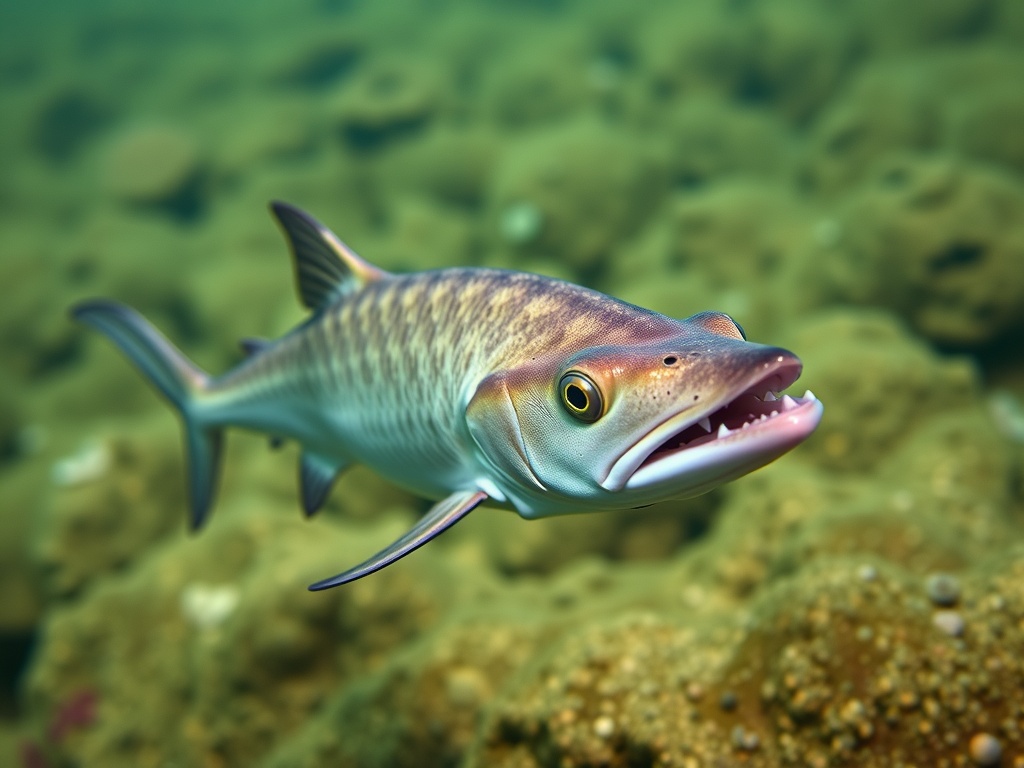
About the Spiny dogfish
The spiny dogfish (Squalus acanthias) is a small, slate-grey shark of cold shelf waters, rarely over 1.2 metres, and it holds one of the longest gestations of any vertebrate: 18 to 24 months, longer than an elephant's. In front of each dorsal fin is a stout, mildly venomous spine, and a captured dogfish will arch its back to drive one into a hand. Its life history is the whole reason it matters. It grows extremely slowly, and in the northeast Pacific females may not mature until their thirties and can live 70 to 100 years, making it one of the longest-lived sharks. Combine a century-long life, a two-year pregnancy and a litter of perhaps two to fifteen pups, and the species can sustain almost no fishing pressure. It was for decades one of the most abundant sharks in the world, and it is the standard "dogfish" of school biology dissections and, in Britain, the classic fish-and-chip fish sold as rock salmon. Heavy targeted fishing from the 1980s, largely to supply European markets, collapsed the northeast Atlantic stock, which is now assessed as Endangered. Dogfish form vast schools segregated by size and sex, and their aggregations can strip an area of herring, which is why fishermen have long regarded them as vermin.
Fascinating facts
Venomous Spines
The spiny dogfish gets its name from the sharp spines in front of each dorsal fin, which secrete a mild venom to deter predators.
Long Gestation
Females can be pregnant for up to 24 months, making their gestation period one of the longest among vertebrates.
Massive Schools
Spiny dogfish are known to form massive schools, sometimes numbering in the thousands, often segregated by age and sex.
Detailed description
The spiny dogfish (Squalus acanthias) is a small, slender shark typically measuring 60–130 cm in length, with females generally larger than males. Its body is streamlined and covered in rough dermal denticles, aiding in hydrodynamics and protection. The species is easily identified by two prominent, mildly venomous dorsal spines—one preceding each dorsal fin—which serve as a defense mechanism against predators. The coloration is a muted gray or brownish-gray dorsally with a pale white ventral surface and distinctive irregular white spots along the flanks, especially prominent in juveniles. The snout is pointed, and the eyes are large, adapted for low-light environments. Spiny dogfish lack an anal fin, a trait characteristic of the Squalidae family. Their teeth are small, flat, and arranged in interlocking rows, ideal for grasping and slicing soft-bodied prey. Internally, they possess a spiral valve intestine, maximizing nutrient absorption. This species is highly migratory, forming vast schools segregated by size and sex, and is known for its remarkable longevity, with lifespans exceeding 35–70 years. Spiny dogfish are considered one of the most abundant and widely distributed shark species in temperate and subarctic waters worldwide.
Did you know?
Despite their small size, spiny dogfish have been reported to travel thousands of kilometers during seasonal migrations.
Research & sources
Wikipedia summary
The spiny dogfish, spurdog, mud shark, or piked dogfish is one of the best known species of the Squalidae (dogfish) family of sharks, which is part of the Squaliformes order.
Behaviour & social structure
Spiny dogfish exhibit complex social behaviors, often traveling in large, dense schools that can number in the thousands. These aggregations are typically composed of individuals of similar size and sex, possibly reducing intraspecific competition and predation risk. They are primarily diurnal, with peak activity during dawn and dusk (crepuscular), when they hunt for prey. Their diet is diverse, including bony fishes (such as herring, cod, and mackerel), cephalopods, crustaceans, and occasionally jellyfish. Spiny dogfish are opportunistic feeders, employing a combination of stealth and sudden lunges to capture prey. They use electroreception and acute olfactory senses to locate food, often hunting in coordinated groups. When threatened, they arch their bodies to present the dorsal spines, which can inflict painful wounds. Seasonal migrations are common, with individuals moving to deeper or more southerly waters during colder months.
Reproduction & life cycle
Spiny dogfish are ovoviviparous, meaning embryos develop inside eggs that remain within the mother's body until hatching. Mating typically occurs in late winter to early spring, with males using specialized claspers to transfer sperm. The gestation period is exceptionally long for a shark—ranging from 18 to 24 months, and in some populations, up to 2 years—making it one of the longest among vertebrates. Females give birth to small litters of 2–20 pups, each measuring 20–33 cm at birth. There is no parental care post-birth; pups are fully independent. Sexual maturity is reached at 10–12 years for males (60–80 cm) and 12–20 years for females (80–100 cm), contributing to the species' vulnerability to overfishing due to slow population recovery rates.
Adaptations & survival
Key adaptations include the presence of mildly venomous dorsal spines for defense, a highly efficient spiral valve intestine for nutrient absorption, and a cartilaginous skeleton that reduces body weight and increases flexibility. Their dermal denticles provide hydrodynamic advantages and protection from parasites. Spiny dogfish have a well-developed lateral line system and ampullae of Lorenzini, enabling them to detect minute vibrations and electrical fields produced by prey. Their ability to tolerate a wide range of temperatures and salinities allows them to inhabit diverse marine environments, from shallow coastal zones to depths exceeding 900 meters.
Cultural significance
Spiny dogfish have played a notable role in European and North American fisheries, particularly in the 20th century, where their meat was a staple in fish and chips in the UK. They have also been used in traditional medicines and as a source of squalene oil. In scientific research, spiny dogfish have served as model organisms for studies in vertebrate physiology, neurobiology, and embryology due to their abundance and manageable size. Despite their economic importance, they are often viewed negatively by commercial fishers due to their predation on valuable fish stocks.
Recent research
Recent research has focused on population genetics, revealing significant genetic structuring between Atlantic and Pacific populations, suggesting limited gene flow and the need for region-specific management. Studies on their reproductive physiology have provided insights into the mechanisms of long gestation and embryonic diapause. Conservation research is ongoing, with satellite tagging projects tracking migration routes and habitat use. There is also growing interest in the ecological role of spiny dogfish as mid-level predators and their influence on marine food webs. Notably, their resilience to environmental changes and pollutants is being investigated, given their widespread distribution.
Videos
Habitat
Coastal and continental shelf waters, often in temperate oceans

Conservation
The Spiny dogfish is currently classified as Vulnerable on the IUCN Red List.
Threats & challenges
The primary threats to spiny dogfish are overfishing and bycatch, particularly due to their slow growth, late maturity, and low reproductive rates. Historically targeted for their meat (often sold as 'rock salmon' or 'huss'), fins, and liver oil, populations in the North Atlantic and other regions have experienced significant declines. Habitat degradation and pollution further exacerbate their vulnerability. Although some populations show signs of recovery due to management measures, the species remains classified as 'Vulnerable' by the IUCN and 'Imperiled' by NatureServe. Regional population trends vary, with some stocks still heavily depleted.
Taxonomy
Scientific name
Squalus acanthias
- Kingdom
- Animalia
- Phylum
- Chordata
- Class
- Chondrichthyes
- Order
- Squaliformes
- Family
- Squalidae
- Genus
- Squalus
- Species
- acanthias
Community notes
Share your observations about the Spiny dogfish.
No community notes yet. Be the first!
Discover more wildlife
More fascinating animals from the encyclopedia.