
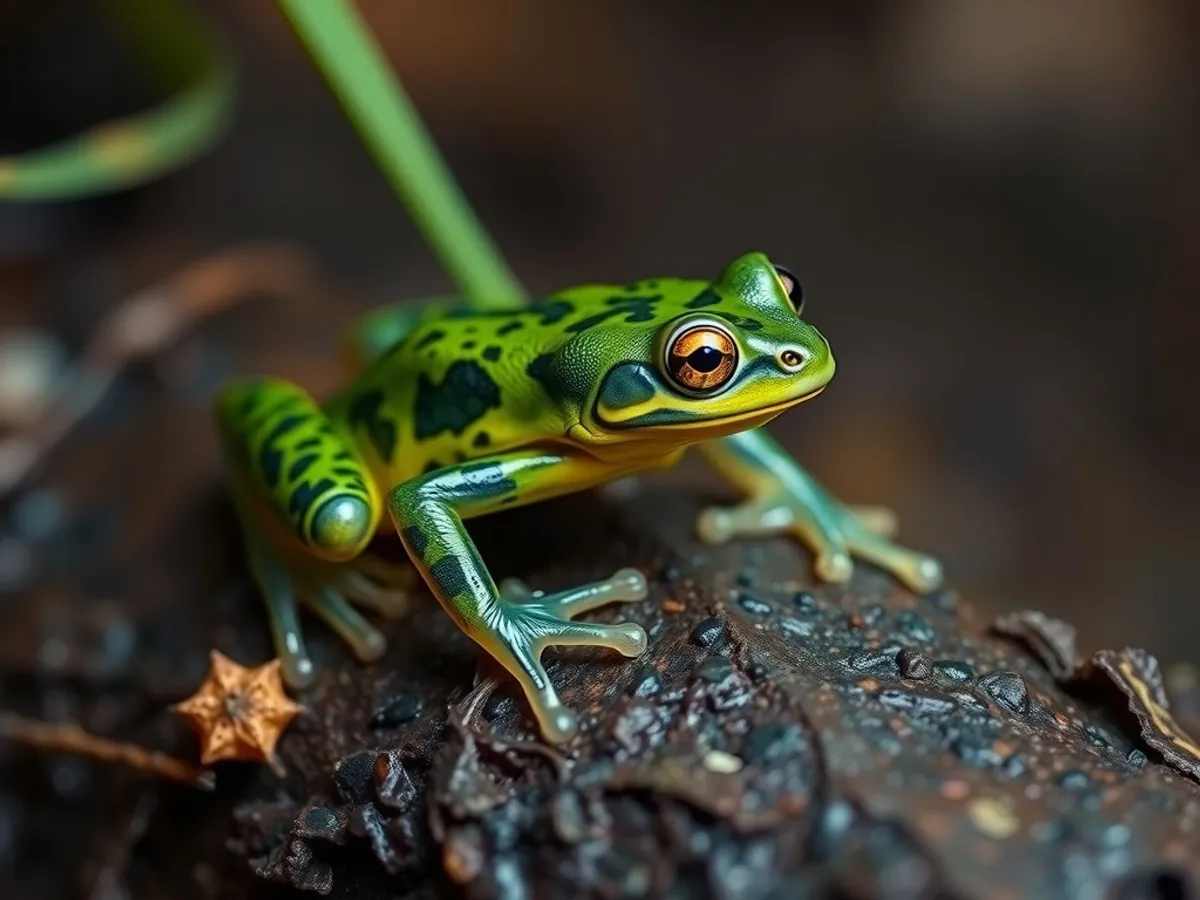
About the Spiny Glass Frog
The Spiny Glass Frog is a small, nocturnal amphibian known for its translucent skin, which allows the internal organs to be visible from below. Males are uniquely characterized by tiny spines on their upper arms, which become more pronounced during breeding season and are used in male-to-male combat. This frog inhabits humid lowland and montane forests, usually near clear, fast-flowing streams where it breeds. Its cryptic coloration and transparent underside provide excellent camouflage against predators.
Fascinating facts
Transparent Skin
The Spiny Glass Frog's belly is so transparent that its heart, liver, and digestive tract are visible from below.
Egg Guardians
Males guard the eggs, which are laid on leaves above streams, to protect them from predators and keep them moist.
Spiny Combat
Males grow tiny spines on their arms and use them in territorial battles against rival males during breeding season.
Detailed description
The Spiny Glass Frog (Espadarana prosoblepon) is a small, delicate amphibian, typically measuring 22–27 mm in snout–vent length, with males slightly smaller than females. Its most striking feature is its ventral skin, which is highly translucent, allowing clear visibility of the heart, liver, and gastrointestinal tract—a trait common among glass frogs but especially pronounced in this species. The dorsal surface is a vibrant green, often speckled with tiny yellow or white spots, providing camouflage among moss and leaves. Males possess distinctive humeral spines—keratinized projections on their upper arms—that become more prominent during the breeding season and are used in ritualized combat with rival males. The species is primarily nocturnal, emerging at dusk to forage and engage in reproductive activities. Its large, forward-facing eyes with horizontal pupils grant excellent night vision. Espadarana prosoblepon is arboreal, spending most of its life in the vegetation overhanging fast-flowing streams, rarely descending to the ground. Its limbs are long and slender, with extensive webbing between the toes, facilitating both climbing and occasional gliding leaps. The species exhibits a high degree of site fidelity, with individuals returning to the same breeding sites year after year.
Did you know?
Despite their fragile appearance, male Spiny Glass Frogs fiercely defend their territories and can engage in intense wrestling matches.
Research & sources
Behaviour & social structure
Spiny Glass Frogs are nocturnal and highly secretive, spending daylight hours motionless on the undersides of leaves above streams, where their coloration and transparency render them nearly invisible to predators. At night, they become active, hunting for small arthropods such as ants, spiders, and flies, using a sit-and-wait strategy or slow, deliberate stalking. Males are territorial during the breeding season, calling from the undersides of leaves to attract females and warn off rivals. Their calls are soft, high-pitched whistles, often repeated in rapid succession. Aggressive encounters between males involve wrestling and the use of their humeral spines to inflict minor wounds. Outside of breeding, individuals are generally solitary, though multiple frogs may occupy the same area if resources are abundant. They exhibit a strong homing instinct, often returning to the same leaf night after night.
Reproduction & life cycle
Breeding occurs during the rainy season, typically from May to October, when increased humidity and water levels provide optimal conditions for egg and tadpole development. Males call to attract females, who select mates based on call quality and territory. After amplexus (the mating embrace), females deposit clutches of 20–40 eggs on the undersides of leaves overhanging streams. Males often guard the eggs, protecting them from predators and desiccation by moistening them with their bodies. Embryonic development lasts 10–14 days, after which the tadpoles hatch and drop into the stream below, where they continue development for 2–3 months before metamorphosing into juvenile frogs. Parental care is primarily paternal, with males remaining near the clutch to deter egg predators such as ants and wasps.
Adaptations & survival
Espadarana prosoblepon exhibits several remarkable adaptations. Its translucent ventral skin provides camouflage from aquatic predators below, while the green dorsal coloration blends with foliage above. The humeral spines in males are an evolutionary specialization for intraspecific combat, enhancing reproductive success. Enlarged toe pads and extensive webbing facilitate arboreal locomotion and adherence to wet, slippery leaves. The species' nocturnal activity reduces predation risk and competition for food. Additionally, their eggs possess a gelatinous coating that resists desiccation and microbial infection, crucial for survival in exposed leaf environments.
Cultural significance
Glass frogs, including Espadarana prosoblepon, are often featured in local folklore and are admired for their unusual appearance. In some Central and South American cultures, their transparency is associated with themes of invisibility or spiritual purity. They are occasionally used in environmental education to highlight the importance of amphibian conservation and the unique biodiversity of tropical forests. However, there are no known traditional medicinal or utilitarian uses for this species.
Recent research
Recent research on Espadarana prosoblepon has focused on its reproductive behavior, particularly the role of paternal care and the function of humeral spines in male competition. Studies using genetic markers have revealed high site fidelity and limited dispersal among populations. Ongoing research is investigating the species' sensitivity to environmental contaminants and its potential as a bioindicator. Advances in imaging technology have allowed detailed study of the frog's transparent anatomy, providing insights into amphibian physiology and evolutionary adaptation. Conservation biologists are also monitoring population trends in response to habitat alteration and climate change.
Sources
Systematics of the glassfrog genus Espadarana (Anura: Centrolenidae)
Guayasamin, J.M., Castroviejo-Fisher, S., Trueb, L., Ayarzagüena, J., Rada, M., & Vilà, C. (2009)
scientificEspadarana prosoblepon: The IUCN Red List of Threatened Species 2020
IUCN SSC Amphibian Specialist Group (2020)
conservationSystematics and Natural History of Glass Frogs (Centrolenidae): A Review
Guayasamin, J.M., Castroviejo-Fisher, S., et al. (2020)
scientificEspadarana prosoblepon: The IUCN Red List of Threatened Species 2020
IUCN SSC Amphibian Specialist Group (2020)
conservationVideos
Habitat
Humid lowland and montane forests near streams
 Elevated Terrain
Mountain
High-altitude environments with varying climates and specialized wildlife adapted to rugged terrain and thin air.
 Tropical Regions
Rainforest
Dense, wet forests with the highest biodiversity on Earth, containing more than half of the world's plant and animal species.
 Global
Forest
Wooded areas with significant tree cover and diverse plant and animal communities.
 Global
Freshwater
Lakes, rivers, and wetlands with diverse aquatic ecosystems.
Conservation
The Spiny Glass Frog is currently classified as Least Concern on the IUCN Red List.
Threats & challenges
While currently listed as Least Concern by the IUCN, Espadarana prosoblepon faces localized threats from habitat loss due to deforestation, agricultural expansion, and pollution of freshwater streams. Pesticide runoff and increased sedimentation can negatively impact egg and tadpole survival. Climate change poses a long-term threat by altering precipitation patterns and stream flow, potentially disrupting breeding cycles. The species is sensitive to environmental changes, making it a useful bioindicator for ecosystem health. Despite these challenges, its wide distribution and adaptability to secondary forests have helped maintain stable populations in many areas.
Taxonomy
Scientific name
Espadarana prosoblepon
- Kingdom
- Animalia
- Phylum
- Chordata
- Class
- Amphibia
- Order
- Anura
- Family
- Centrolenidae
- Genus
- Espadarana
- Species
- prosoblepon
Community notes
Share your observations about the Spiny Glass Frog.
No community notes yet. Be the first!
Discover more wildlife
More fascinating animals from the encyclopedia.