
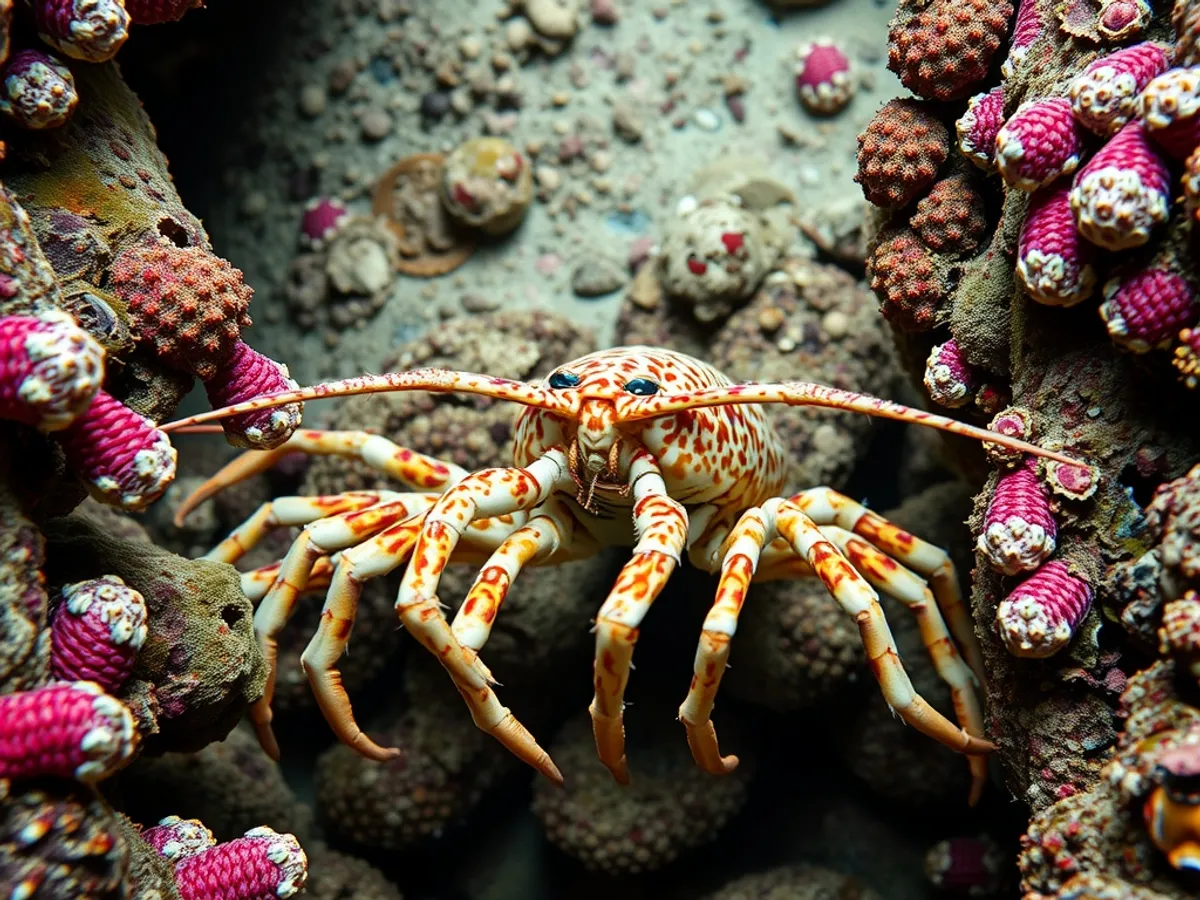
About the Spiny Lobster
The spiny lobster is a large marine crustacean recognized for its long, spiny antennae and lack of large front claws, distinguishing it from true lobsters. It inhabits warm waters, often found hiding in crevices and reefs across the western Atlantic Ocean, Caribbean Sea, and the Gulf of Mexico. Spiny lobsters are nocturnal and migrate in groups, sometimes forming long lines as they travel across the seafloor. Their robust exoskeleton provides protection from predators, and they play a crucial role in their ecosystem as both prey and predator.
Fascinating facts
No Claws
Unlike true lobsters, spiny lobsters do not have large front claws and instead use their powerful, spiny antennae for defense.
Mass Migrations
Spiny lobsters are known for their mass migrations, traveling in single-file lines across the seafloor to find new habitats or escape predators.
Stridulation
When threatened, spiny lobsters create a screeching noise by rubbing their antennae against a rough part of their shell, deterring predators.
Detailed description
The Caribbean spiny lobster (Panulirus argus) is a robust marine crustacean characterized by a cylindrical, segmented body that can reach lengths of up to 60 cm, though most adults average 20–40 cm. Its exoskeleton is covered in sharp spines for defense, and its coloration ranges from reddish-brown to olive, often with pale spots and bands. Unlike true lobsters, P. argus lacks large chelae (claws); instead, it possesses extremely long, thick, spiny antennae used for defense and sensory perception. The carapace is smooth except for the spines, and the tail is muscular, aiding in rapid backward escapes. The species is nocturnal, sheltering in crevices or under ledges during the day and emerging at night to forage. Socially, spiny lobsters often aggregate in groups, particularly during migrations, forming single-file lines known as 'lobster trains.' Their diet is omnivorous, including mollusks, crustaceans, detritus, and plant matter. Reproduction involves complex courtship and external fertilization, with females carrying fertilized eggs under their abdomen. Spiny lobsters are ecologically significant as both predators and prey, influencing reef community dynamics and serving as a key species in benthic food webs.
Did you know?
Spiny lobsters are capable of regenerating lost limbs, including their legs and antennae, over successive molts.
Research & sources
Wikipedia summary
Spiny lobsters, also known as langustas, langouste, or rock lobsters are marine decapod crustaceans belonging to the family Palinuridae. Spiny lobsters are also, especially in Australia, New Zealand, Ireland, South Africa, and the Bahamas, called crayfish, sea crayfish, or crawfish, terms which elsewhere are reserved for freshwater crayfish.
Behaviour & social structure
Panulirus argus exhibits pronounced nocturnal activity, leaving daytime shelters at dusk to forage across diverse substrates. They use their sensitive antennae and chemoreceptors to detect prey and avoid predators. Feeding behavior is opportunistic; they prey on gastropods, bivalves, small crustaceans, and carrion, using their mandibles to crush shells. Socially, they display gregariousness, especially during the annual autumnal migrations triggered by environmental cues such as temperature drops and storms. During these migrations, hundreds of individuals may form linear processions, likely as a predator avoidance strategy. Communication is achieved through tactile and chemical signals, and they can produce a rasping sound (stridulation) by rubbing their antennae against a specialized file on their carapace to deter predators. Territorial disputes are rare, but when threatened, individuals will raise and wave their antennae defensively.
Reproduction & life cycle
Spiny lobsters reach sexual maturity at approximately 2–3 years of age. Mating typically occurs from March to June in the Caribbean, though timing can vary regionally. Males deposit spermatophores (tar spots) onto the ventral surface of the female's carapace using specialized appendages. Females then extrude eggs, fertilizing them externally and attaching them to their pleopods (swimmerets) under the tail. A single female can carry between 230,000 and 2 million eggs, depending on her size. The incubation period lasts about 3–4 weeks, after which planktonic phyllosoma larvae hatch and drift in ocean currents for 6–12 months, undergoing multiple molts before settling as juveniles in shallow seagrass or algal beds. There is no parental care beyond egg brooding; after hatching, larvae are entirely independent.
Adaptations & survival
Panulirus argus possesses several notable adaptations: its spiny exoskeleton and long, armored antennae provide effective defense against predators such as groupers, snappers, and octopuses. The powerful, muscular tail enables rapid backward escape movements ('tail-flipping') when threatened. Chemoreceptors on the antennae and mouthparts allow detection of food and pheromones, crucial for foraging and social interactions. The species' nocturnality reduces predation risk and competition. The extended planktonic larval phase facilitates wide dispersal, enhancing genetic exchange between populations. Aggregation and migratory behaviors may reduce individual predation risk and increase reproductive success. The ability to regenerate lost limbs is another important survival trait.
Cultural significance
Spiny lobsters are of considerable economic and cultural importance throughout the Caribbean and western Atlantic. They are a major seafood delicacy and a cornerstone of local fisheries, supporting livelihoods and export economies. In some Caribbean cultures, the spiny lobster features in folklore and traditional cuisine, often served grilled or in stews. The annual lobster season is celebrated in places like the Bahamas and Florida Keys, drawing tourists and recreational fishers. The species also appears in art and local symbolism, representing marine abundance and resilience.
Recent research
Recent research has focused on the genetic connectivity of Panulirus argus populations, revealing high gene flow across the Caribbean due to the extended larval phase. Studies on the PaV1 virus have advanced understanding of disease dynamics in wild crustacean populations. Ecological research has highlighted the lobster's role in structuring benthic communities, particularly through predation on mollusks and competition with other crustaceans. Ongoing work is investigating the impacts of climate change on larval dispersal and settlement, as well as the effectiveness of marine protected areas (MPAs) in sustaining lobster stocks. Tagging and telemetry studies have provided new insights into migration patterns and habitat use.
Videos
Habitat
Coral reefs, rocky crevices, and seagrass beds in warm, shallow ocean waters

Conservation
The Spiny Lobster is currently classified as Least Concern on the IUCN Red List.
Threats & challenges
Major threats to Panulirus argus include overfishing, habitat degradation (especially of coral reefs and seagrass beds), and disease. The species is heavily targeted by commercial and artisanal fisheries throughout its range, leading to localized population declines and concerns about recruitment overfishing. The spread of the lethal Panulirus argus Virus 1 (PaV1) has also impacted juvenile populations in some areas. Climate change poses additional risks by altering larval dispersal patterns and degrading critical habitats. Despite these pressures, the species is currently listed as Least Concern by the IUCN, though ongoing monitoring and management are essential to ensure long-term sustainability.
Taxonomy
Scientific name
Panulirus argus
- Kingdom
- Animalia
- Phylum
- Arthropoda
- Class
- Malacostraca
- Order
- Decapoda
- Family
- Palinuridae
- Genus
- Panulirus
- Species
- argus
Community notes
Share your observations about the Spiny Lobster.
No community notes yet. Be the first!
Discover more wildlife
More fascinating animals from the encyclopedia.