
About the Spotfin Lionfish
The lionfish is a superb predator and, in the Atlantic, an ecological catastrophe. Native to the Indo-Pacific, it was introduced to the western Atlantic and Caribbean, where nothing recognises it as dangerous and nothing has learned to eat it, and it has spread explosively. It hunts by spreading its enormous fan-like pectoral fins to herd and corner small fish against the reef, then strikes so fast that the prey frequently never reacts at all, and it will swallow nearly anything that fits — including the juveniles of commercially important fish and the algae-grazers that keep a reef from being smothered. A single lionfish on a patch of reef can measurably suppress the recruitment of young fish. Its spines are venomous, delivering a protein toxin that causes intense pain, but they are purely defensive and play no role in hunting whatsoever. It breeds year-round and can release tens of thousands of eggs at a time. The most effective control so far is human appetite: spearfishing derbies, and a campaign to get people eating it, since the flesh is excellent and entirely safe once the spines are removed.
Fascinating facts
Venomous Spines
The long, elegant spines of the Spotfin Lionfish contain venom that can deter most potential predators, but the venom is rarely fatal to humans.
Nocturnal Hunter
Spotfin Lionfish are primarily active at night, using ambush tactics to capture small fish and crustaceans that venture too close.
Reef Dweller
This species prefers shallow coral and rocky reefs, often hiding in crevices or beneath ledges during daylight hours.
Detailed description
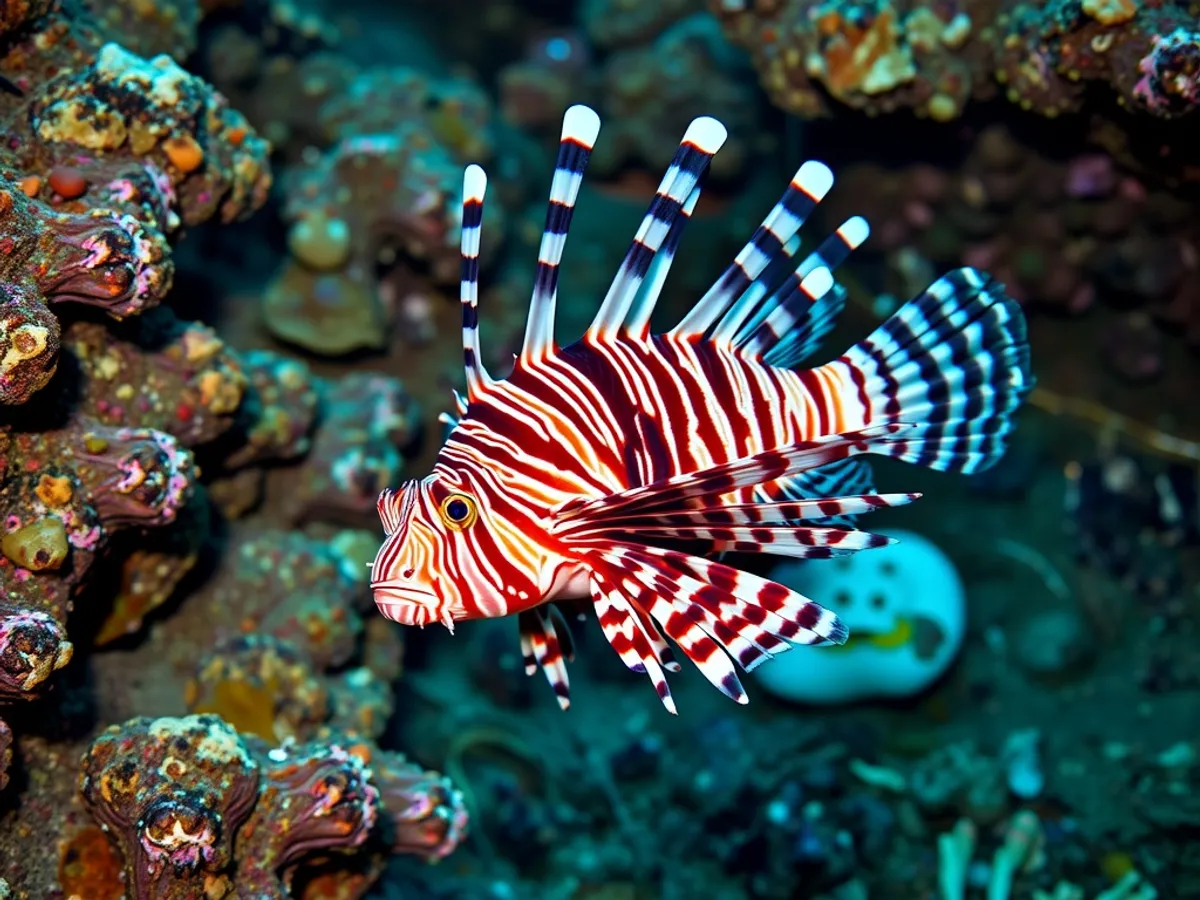
The Spotfin Lionfish (Pterois antennata) is a medium-sized marine fish, typically reaching lengths of 20–22 cm, with some individuals growing up to 24 cm. Its body is laterally compressed and adorned with alternating vertical bands of reddish-brown, white, and dark brown, providing effective camouflage among coral and rocky substrates. The most distinctive anatomical features are its elongated, fan-like pectoral fins, which are marked with prominent black spots—hence the common name 'spotfin.' These fins, along with the long, separated dorsal spines, are equipped with venomous glands capable of delivering a painful sting to potential predators or unwary humans. The head is large with a protruding mouth and fleshy tentacles above the eyes and below the jaw, which may serve as lures or aid in sensory perception. Pterois antennata is primarily nocturnal, hiding in reef crevices during daylight hours and emerging at dusk to hunt. Its diet consists mainly of small teleost fishes, crustaceans, and occasionally mollusks, which it corners using its outstretched pectoral fins before striking with rapid suction feeding. The species is generally solitary outside of breeding periods and exhibits territorial behavior, especially among mature males. Reproduction involves elaborate courtship displays, with external fertilization and the release of buoyant, gelatinous egg masses into the water column. The Spotfin Lionfish is well-adapted to complex reef environments, relying on both cryptic coloration and venomous defenses. Although currently listed as Least Concern, it is susceptible to habitat loss, particularly from coral reef degradation and destructive fishing practices.
Did you know?
Despite their threatening appearance, Spotfin Lionfish are sometimes preyed upon by large groupers and eels that are immune to their venom.
Research & sources
Behaviour & social structure
Spotfin Lionfish are solitary and highly territorial, with individuals maintaining and defending small home ranges within the reef. During the day, they remain motionless, wedged into crevices or beneath ledges, relying on their cryptic coloration for concealment. At night, they become active hunters, using their expansive pectoral fins to herd and corner prey against the substrate. Their hunting technique involves slow, deliberate movements followed by a rapid strike, utilizing a powerful suction mechanism to ingest prey whole. Spotfin Lionfish are opportunistic feeders, preying on small reef fishes, shrimp, and crabs. Social interactions are limited, with the exception of brief courtship encounters during the breeding season, when multiple individuals may aggregate. Aggressive displays, such as flaring fins and head shaking, are used to deter intruders or competitors. They are generally non-migratory and exhibit strong site fidelity.
Reproduction & life cycle
Reproduction in Pterois antennata is oviparous, with external fertilization. Spawning typically occurs during warmer months and is often synchronized with lunar cycles, particularly around the new or full moon. Courtship involves males displaying their fins and circling females, sometimes engaging in gentle nudging or parallel swimming. Females release two buoyant, gelatinous egg masses, each containing up to 15,000 eggs, which are then fertilized by the male. The eggs float near the surface and hatch within 36–48 hours, depending on water temperature. Larvae are planktonic for several weeks, feeding on zooplankton before settling onto the reef as juveniles. There is no parental care; both adults depart immediately after spawning. Sexual maturity is typically reached at 1–2 years of age.
Adaptations & survival
The Spotfin Lionfish possesses several key adaptations for survival in coral reef environments. Its venomous dorsal, anal, and pelvic spines provide effective defense against predators, deterring attacks from larger fish and marine mammals. The elaborate pectoral fins not only aid in prey capture but also serve as a visual warning to potential threats. Cryptic coloration and banding patterns help the fish blend seamlessly into the reef, reducing predation risk. Nocturnal activity reduces competition with diurnal predators and prey, while specialized sensory tentacles enhance environmental awareness in low-light conditions. The species' suction feeding mechanism allows rapid and efficient capture of elusive prey. Evolutionarily, these adaptations have enabled Pterois antennata to occupy a specialized niche within the reef ecosystem.
Cultural significance
The Spotfin Lionfish, like other lionfish species, is admired for its striking appearance and is a popular exhibit in public aquariums worldwide. In some Indo-Pacific cultures, lionfish are featured in folklore as symbols of danger and beauty, though Pterois antennata specifically is less prominent in traditional narratives compared to other species. The venomous spines are sometimes used as cautionary examples in marine education. There are no significant traditional uses for this species, and it is not commonly consumed due to the risk of envenomation.
Recent research
Recent research on Pterois antennata has focused on its ecological role within reef communities, particularly its impact on prey populations and interactions with other predatory fish. Studies have examined the composition and potency of its venom, revealing complex mixtures of proteins and peptides with potential biomedical applications. Genetic analyses have clarified its phylogenetic relationships within the Scorpaenidae family, distinguishing it from closely related lionfish species. Ongoing research is investigating the effects of habitat loss and climate change on its distribution and reproductive success. Unlike the invasive Pterois volitans in the Atlantic, P. antennata has not established populations outside its native range, but its ecological plasticity is a subject of interest for invasion biology.
Sources
Pterois antennata (Spotfin Lionfish): Species Profile
Froese, R. & Pauly, D. (Eds.) - FishBase (2024)
scientificPterois antennata: The IUCN Red List of Threatened Species 2016
Motomura, H. & Fricke, R.
conservationVideos
Habitat
Coral reefs and rocky reef environments

Conservation
The Spotfin Lionfish is currently classified as Least Concern on the IUCN Red List.
Threats & challenges
While currently assessed as Least Concern by the IUCN, the Spotfin Lionfish faces several threats, primarily related to habitat degradation. Coral reef destruction from climate change, ocean acidification, destructive fishing practices (such as blast fishing), and coastal development reduces available shelter and breeding sites. Overfishing of reef species may indirectly affect their food supply. Although not targeted by fisheries due to their venomous spines, they are sometimes collected for the aquarium trade, which can impact local populations. Pollution and sedimentation further degrade reef health. Population trends are generally stable, but localized declines have been reported in areas with severe reef damage.
Taxonomy
Scientific name
Pterois antennata
- Kingdom
- Animalia
- Phylum
- Chordata
- Class
- Actinopterygii
- Order
- Scorpaeniformes
- Family
- Scorpaenidae
- Genus
- Pterois
- Species
- antennata
Where to see a spotfin lionfish
1 zoo and aquarium in 1 country are recorded as keeping this species.

Community notes
Share your observations about the Spotfin Lionfish.
No community notes yet. Be the first!
Discover more wildlife
More fascinating animals from the encyclopedia.