
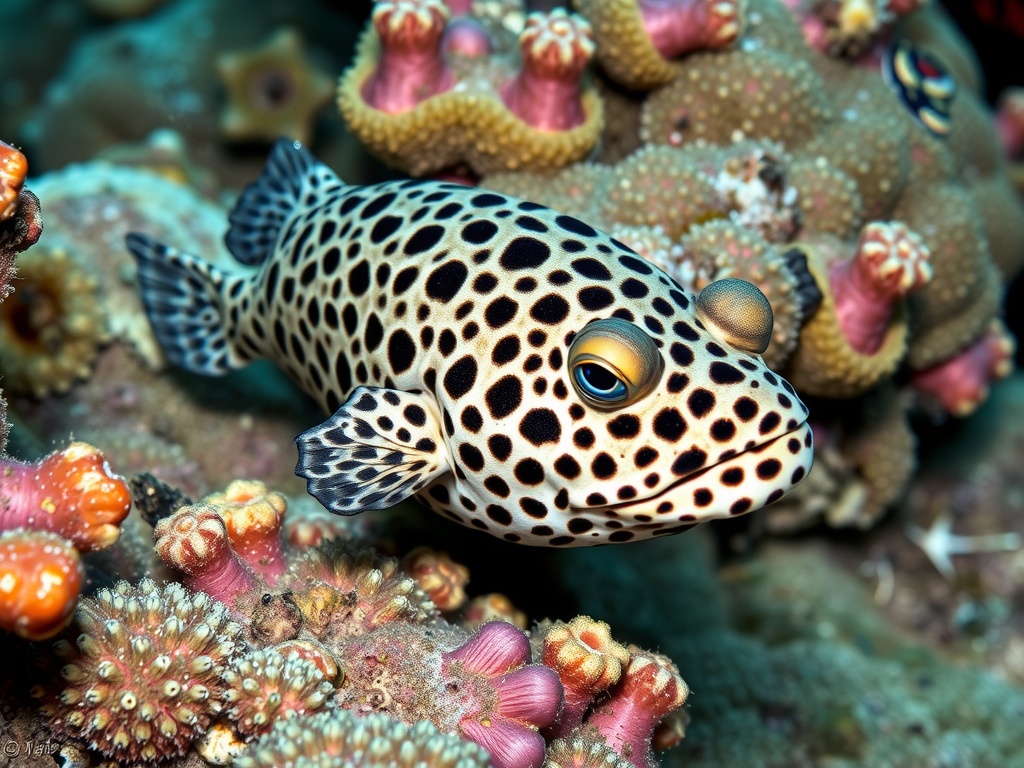
About the Spotted Pufferfish
The Spotted Pufferfish, also known as the Blackspotted Puffer or Dog-faced Puffer, is a medium-sized marine fish recognized for its round body and prominent black spots scattered over a pale or yellowish background. This species is notable for its ability to inflate its body as a defense mechanism against predators. It is commonly found in shallow coral reefs and lagoons throughout the Indo-Pacific region. The Spotted Pufferfish is both admired for its unique appearance and handled with caution due to its highly toxic internal organs.
Fascinating facts
Inflation Defense
When threatened, the Spotted Pufferfish rapidly ingests water (or air if out of water), expanding its body to deter predators.
Toxic to Eat
Its internal organs contain tetrodotoxin, a potent toxin that is deadly to humans and many predators.
Expressive Faces
Spotted pufferfish are known for their dog-like facial expressions, which make them popular among aquarists.
Detailed description
The Spotted Pufferfish (Arothron nigropunctatus) is a robust, medium-sized marine fish typically reaching 20–33 cm in length, with a maximum recorded size of about 33 cm. Its body is oval, lacking scales, and covered in small, prickly dermal spines that become more pronounced when the fish inflates. The coloration varies from pale grey to yellowish or even bluish hues, adorned with numerous distinct black spots of varying size, and a characteristic 'dog-like' face with large, expressive eyes and a short, broad snout. The mouth is terminal and beak-like, formed by fused teeth adapted for crushing hard-shelled prey. Unlike many fish, it lacks a pelvic fin and has a single dorsal fin set far back on the body. The skin and internal organs, especially the liver and gonads, contain potent tetrodotoxin, making the species highly toxic if ingested. Spotted Pufferfish are generally solitary, spending much of their time slowly swimming close to the substrate, investigating crevices and coral heads. When threatened, they can rapidly ingest water (or air if out of water), inflating their bodies to deter predators. Their unique combination of aposematic coloration, toxicity, and inflation ability makes them well-adapted to the complex coral reef environment. They play a role in controlling populations of invertebrates and algae, contributing to reef health.
Did you know?
Unlike most fish, spotted pufferfish do not have scales but a tough, leathery skin for added protection.
Research & sources
Behaviour & social structure
Arothron nigropunctatus is primarily diurnal, being most active during daylight hours. It exhibits a slow, deliberate swimming style, using its pectoral, dorsal, and anal fins for precise maneuvering among coral branches. The species is generally solitary and territorial, with individuals maintaining and patrolling small home ranges. Feeding involves foraging along the reef, using their strong beak to break open hard-shelled prey such as mollusks, crustaceans, echinoderms, and occasionally grazing on algae and sponges. They are opportunistic omnivores, and their diet can shift based on local prey availability. When approached by divers or potential predators, they may display warning postures or retreat into crevices. Social interactions are limited outside of breeding, but individuals may occasionally tolerate conspecifics in overlapping territories, especially in areas of abundant food.
Reproduction & life cycle
Spotted Pufferfish are oviparous, with external fertilization. Courtship and spawning typically occur during warmer months, often synchronized with lunar cycles, though exact timing varies regionally. Males may display to females by circling and exhibiting brighter coloration. Females lay adhesive demersal eggs on sandy or rubble substrates, sometimes in shallow depressions. There is no parental care after spawning; eggs are left to develop and hatch independently. The pelagic larvae drift with plankton for several weeks before settling onto the reef as juveniles. Sexual maturity is usually reached at 1–2 years, depending on environmental conditions.
Adaptations & survival
Arothron nigropunctatus possesses several notable adaptations for survival. Its ability to inflate by rapidly ingesting water or air increases its apparent size and makes it difficult for predators to swallow. The skin and organs contain tetrodotoxin, a neurotoxin that deters most predators; this toxin is acquired through diet, likely from symbiotic bacteria or consumption of toxic prey. The beak-like dental plates allow it to feed on hard-shelled invertebrates, giving access to a wide range of food sources. Its cryptic yet warning coloration serves as aposematic signaling. The lack of pelvic fins and the use of pectoral, dorsal, and anal fins for locomotion provide exceptional maneuverability in complex reef environments.
Cultural significance
The Spotted Pufferfish is admired in the aquarium trade for its unique appearance and engaging behavior, though its toxicity requires careful handling. In some Indo-Pacific cultures, pufferfish are featured in folklore as symbols of transformation or danger. Unlike the Japanese fugu (Takifugu spp.), Arothron nigropunctatus is not traditionally consumed due to its high toxicity, but it is sometimes used in traditional medicine or as a curiosity. Its striking looks make it a popular subject in underwater photography and marine education.
Recent research
Recent studies have focused on the ecological role of Arothron nigropunctatus in coral reef systems, particularly its influence on invertebrate populations and potential to control algal overgrowth. Research into the origin and biosynthesis of tetrodotoxin in pufferfish has suggested a symbiotic relationship with toxin-producing bacteria, with ongoing studies examining the microbiome of the skin and gut. Genetic analyses have clarified its phylogenetic relationships within the Tetraodontidae family. There is also interest in the species' resilience to environmental stressors such as ocean acidification and warming, with some evidence suggesting moderate adaptability.
Videos
Habitat
Coral reefs and lagoons

Conservation
The Spotted Pufferfish is currently classified as Least Concern on the IUCN Red List.
Threats & challenges
While currently listed as Least Concern, the Spotted Pufferfish faces several localized threats. Habitat degradation from coral reef destruction, pollution, and climate change-induced bleaching can reduce available shelter and food. Collection for the aquarium trade, although regulated, can impact local populations. Overfishing of reef species may indirectly affect their food resources. Despite their toxicity, they are sometimes caught as bycatch or targeted for traditional uses in some regions, posing potential risks to humans. Population trends are stable globally, but ongoing habitat loss could pose future challenges.
Taxonomy
Scientific name
Arothron nigropunctatus
- Kingdom
- Animalia
- Phylum
- Chordata
- Class
- Actinopterygii
- Order
- Tetraodontiformes
- Family
- Tetraodontidae
- Genus
- Arothron
- Species
- nigropunctatus
Community notes
Share your observations about the Spotted Pufferfish.
No community notes yet. Be the first!
Discover more wildlife
More fascinating animals from the encyclopedia.